The First Atmosphere Found on a Planet Transiting a Dead Star

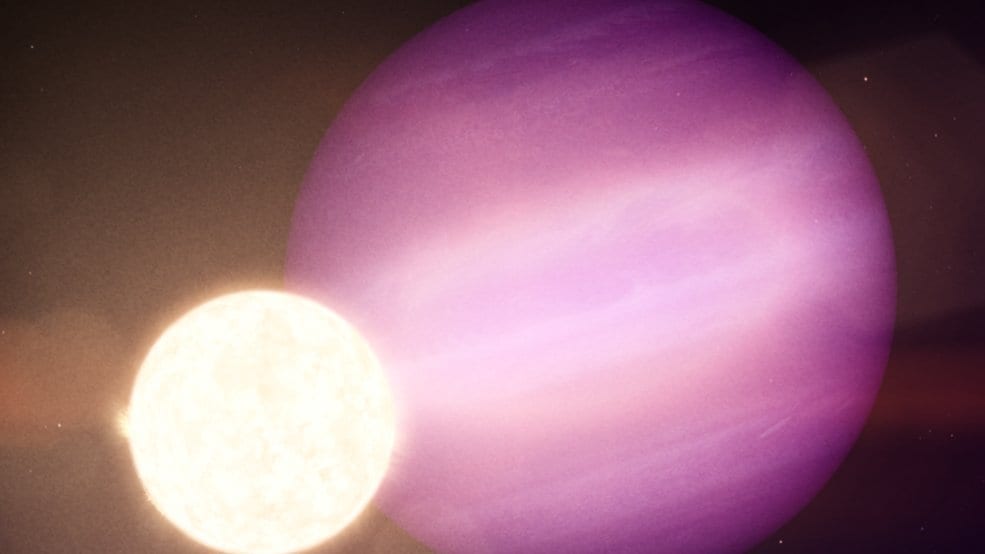
Every 34 hours, a giant planet slips across the face of a dead star. The star is WD 1856+534, a white dwarf no bigger than Earth. It is the smoldering core left behind after a Sun-like star exhausted its fuel, ballooned into a red giant, and shrugged off its outer layers. The planet, WD 1856 b, is seven times wider than the star it circles, and it should not be there at all. During the red-giant phase, the swelling star would have reached out and swallowed anything orbiting as close as this planet now sits, barely two million miles out.
Yet there it is. And for the first time, astronomers have read what its air is made of.
An international team led by Ryan MacDonald of the University of St Andrews pointed the James Webb Space Telescope at the system and caught the planet as it transited, passing in front of the white dwarf so that starlight filtered through the thin shell of its atmosphere on the way to Webb's detectors. That technique, transmission spectroscopy, is the workhorse of atmosphere-hunting around ordinary stars. Turning it on a planet crossing a stellar corpse is new. In the Nature paper published July 1, the team reports the telltale fingerprints of hydrocarbons, most likely methane, along with small cloud particles and aerosols suspended in a haze.
"We saw the telltale signatures of small cloud particles and hydrocarbons, most likely methane, which is the first time we have seen an atmosphere on a planet transiting a dead star," said Victoria Boehm of Cornell University, a co-author on the study.
The distinction matters. Webb has looked at a white-dwarf world before: in 2025 it teased apart the atmosphere of WD 0806-661 b, a distant companion caught by direct imaging. What sets WD 1856 b apart is the method and the geometry: it is the first white-dwarf planet studied as it transits, its atmosphere read in silhouette rather than in a portrait. The NASA release accompanying the paper frames it the same way.
A world warmer than it has any right to be
Webb's spectrum did more than sniff out chemistry. It let the team pin down the planet's basics. WD 1856 b weighs somewhere between 4 and 11 times as much as Jupiter, firmly in giant-planet territory, and its temperature sits around 260 degrees Fahrenheit (126 degrees Celsius). That last number is a small surprise. A white dwarf is a dim ember, and the feeble light it throws should leave a planet colder than this. Something else is keeping WD 1856 b warm.
The team's reading is that the heat is a leftover from the planet's violent arrival. "As the planet moved inward, its interactions with the strong gravity of the white dwarf will have caused it to warm up considerably, and it has been cooling ever since," said co-author Christopher O'Connor of Northwestern University.
The methane and haze, meanwhile, would tint the planet. If you could stand off and watch it, the chemistry points toward the muddy, sunset colors of Saturn's moon Titan rather than the blue-white glare of a hot Jupiter.
How do you survive your star's death?
That is the puzzle the paper circles, and it is worth being precise about what the data can and cannot say. The atmosphere, the mass and the temperature are measurements. The survival story is an inference.
The problem is one of timing and distance. When the host star swelled into a red giant, its outer envelope would have swept past the planet's current orbit and destroyed anything sitting there. So WD 1856 b almost certainly was not sitting there at the time. The team's favored explanation is that the planet rode out the red-giant phase far away, at a safe remove, and only migrated inward much later, 3 to 5.5 billion years after the star had already collapsed into a white dwarf. WD 1856+534 belongs to a triple star system, and gravitational tugs from its stellar companions could have nudged the planet down onto the tight, 34-hour orbit it holds today.
That is the likely path, not a proven one. The migration timing and the companion-star mechanism are the team's best reconstruction of a history no one witnessed, consistent with what Webb measured but not directly seen. It is the kind of explanation that a longer look, or a second white-dwarf world with an atmosphere, could sharpen or overturn.
A postcard from the Sun's future
What gives WD 1856 b its pull is that it is, in a loose sense, a message from our own far future. Billions of years from now, the Sun will run through the same arc: red giant, shed layers, white-dwarf ember. Whatever planets remain will have to reckon with that ending. A giant world that not only endured but held onto an atmosphere is the closest thing astronomers have to a photograph of that fate.
The results are peer-reviewed, published in Nature on July 1, 2026. WD 1856 b was first spotted back in 2020 with NASA's TESS satellite and the retired Spitzer Space Telescope; only now, with Webb, has anyone managed to read the air of a planet that outlived its star.