A Full Exoplanet Chemistry Report From a Single JWST Setting

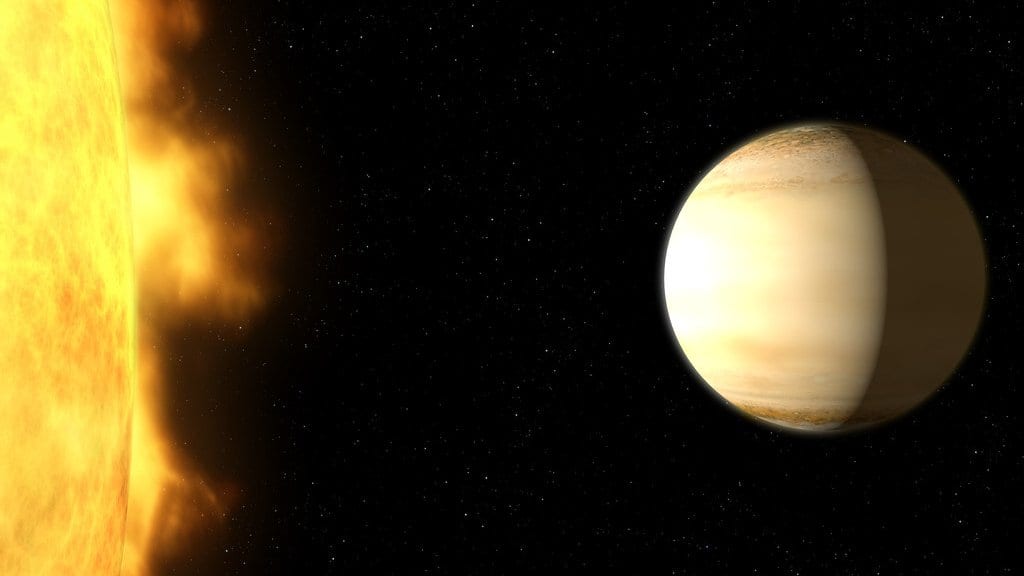
WASP-39 b is one of the most-studied planets outside our solar system, a puffy hot Jupiter roughly 700 light-years away that became a showcase target for JWST early in the telescope's life. So it makes a fitting test case for a new preprint from Arjun Savel and colleagues, which is less about the planet than about a smarter way to read it.
The usual problem in this field is greedy. To measure an exoplanet's atmospheric chemistry with confidence, astronomers typically combine spectra from several JWST instrument modes, each covering a different band of wavelengths. That takes multiple observing programs and a lot of scarce telescope time. Savel's team wanted to know how much they could wring from a single mode, NIRSpec's G395H, on its own.
Their approach is a technique called phase-resolved cross-correlation retrieval, run at the detector's native pixel resolution. Rather than averaging a planet's light into one smeared spectrum, it tracks how the signal shifts as the planet moves along its orbit, using that motion to pull faint molecular fingerprints out of the noise. The payoff is a full accounting of the atmosphere's carbon and oxygen carriers: water, carbon dioxide, sulfur dioxide, and, tellingly, carbon monoxide.
That last molecule is the headline of the method. When the team ran a conventional retrieval on the same G395H data, carbon monoxide essentially vanished into the noise, and the derived chemistry came out biased. The new technique found it decisively and pinned it as the atmosphere's dominant carbon carrier. From the completed inventory, the authors report a metallicity of [(C+O)/H] = 1.2 ± 0.2 and a carbon-to-oxygen ratio of 0.68, a measurement precise enough to be scientifically useful from a single instrument mode.
Why does a ratio of two elements deserve the attention? Because a planet's carbon-to-oxygen ratio is a chemical birth certificate. Where a giant planet forms in its natal disk, and how much icy or rocky material it swept up on the way, leaves a lasting mark on the balance of carbon to oxygen in its air. Measure that ratio well and you gain a handle on a planet's origin story that its size and orbit alone cannot give you.
The new methodology does not overturn existing knowledge about WASP-39 b, but rather demonstrates that a fuller planetary portrait can be extracted from thinner data than the field previously assumed.
JWST time is among the most contested resources in astronomy, and every target characterized from a single instrument mode instead of several costs less to understand. This technique stretches the telescope's observational capacity across more worlds, an efficiency that often matters more than any single planet's chemistry.
Sources
- arXivPreprint