The Rogue Black Hole That Gave Itself Away by Eating a Star

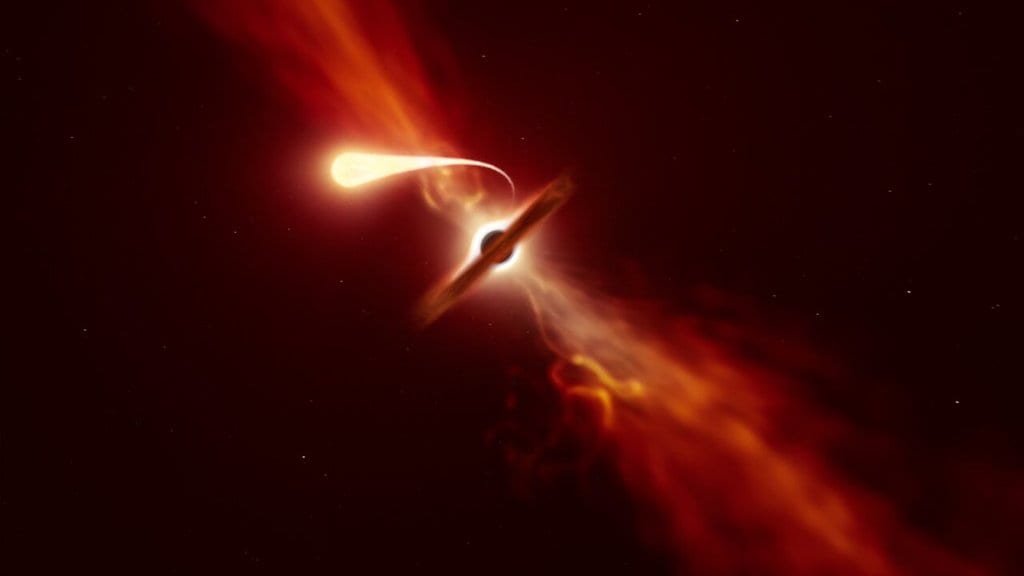
A black hole with nothing to eat is, for observational purposes, absent. No disk of hot gas, no X-rays, no jet. Theory says big galaxies should be littered with them: black holes knocked loose from a nucleus, or ferried in by a smaller galaxy and left stranded partway through the merger. Nobody has a good way to count something that emits nothing. The only reliable trick is to wait for one of them to catch a star.
That is what happened in a galaxy cataloged as WISEA J014656.04-152214.7, about 750 million light-years away in the constellation Cetus, according to NASA. In November 2025 the Zwicky Transient Facility recorded a source there brightening fast, and the flare briefly outshone the entire galaxy around it. What made it strange was not the brightness but the address: 9.5 arcseconds from the nucleus, a projected distance of 9.3 kiloparsecs, or roughly 30,000 light-years. On the sky, that is about as far as the Sun sits from the center of the Milky Way.
Robert Stein, an astronomer at the University of Maryland, College Park and NASA's Goddard Space Flight Center, led the team that made the case for what happened there. Their analysis appeared in The Astrophysical Journal Letters on July 27. "We were looking for these star-shredding events as a way to find otherwise invisible supermassive black holes wandering away from the galactic cores where they usually reside," Stein said in a NASA statement. The looking was the hard part.
Tidal disruption events are rare, and their light curves resemble several commoner things: supernovae, flaring active galactic nuclei, ordinary variable stars. Surveys cope by filtering hard, and one of the standard filters is position. A transient sitting on a galaxy's nucleus is a candidate; a transient out in the disk is almost certainly something else, and gets discarded. So the team rebuilt the filter. They ran a custom off-nuclear implementation of TDEScore, a machine-learning classifier that sorts fresh ZTF transients by the shape of their light curves, and pointed it at exactly the events the usual pipeline throws away.
Confirmation came from a stack of other instruments. Jonathan Carney of the University of North Carolina at Chapel Hill obtained spectra with the Southern Astrophysical Research telescope in Chile, which showed the broad hydrogen and helium emission that marks out a tidal disruption of the H+He class. Swift's Ultraviolet/Optical Telescope tracked the flare and measured a temperature near 30,000 degrees Celsius, while its X-Ray Telescope watched the high-energy end. Deep images from the DESI Legacy Survey and the Lowell Discovery Telescope established what was, and was not, sitting at the flare's position. NASA puts the peak output at roughly ten billion times the Sun's, most of it in the ultraviolet.
The mass of the black hole that did the shredding is where care is needed, because it was estimated rather than weighed. The team infers it from a scaling relation between a flare's peak luminosity and the mass behind it, which puts the figure at about 1.2 million solar masses with an uncertainty of 0.53 dex. That is astronomers' shorthand for a factor of roughly 3.4 in either direction, so the honest range runs from around 360,000 to around 4 million. What survives the uncertainty is the comparison. The nucleus of the same galaxy holds a black hole of about 660 million solar masses, several hundred times heavier. Whatever ate this star, it was not the galaxy's central engine seen slightly off-center.
Two caveats travel with the geometry. Those 9.3 kiloparsecs are a projected separation, the gap between two points as they happen to fall on the sky, so the true three-dimensional distance can only be larger. And the reason the black hole is out there at all remains unsettled. The paper offers two possibilities and declines to choose between them: either the object was dynamically ejected from the nucleus, or it sits at the center of a very faint dwarf galaxy that has been tidally stripped and is now falling in as a minor merger. Late-time observations, the authors write, could tell them apart.
A separate team has already looked. Kishore Patra and colleagues observed the same object with JWST and the Keck telescopes and posted their analysis to arXiv in April, ahead of peer review. Their independently measured offset, 9.08 kiloparsecs, agrees with Stein's; their black hole mass, somewhere between one million and ten million solar masses, is consistent; and they too find the galaxy's nuclear black hole hundreds of times heavier. They lean toward the minor-merger origin, and they add a reason. An infrared excess sits at the flare's position, and it could be a stellar cluster of some 37 million solar masses, which would make it the stripped core of a swallowed satellite. It could equally be free-free emission from gas around the disrupted star. They rule out dust and stop there.
Scope matters here, because two papers describe this object differently and both are right. AT2024tvd, picked out of ZTF data in 2024, was the first off-nuclear tidal disruption event selected by an optical survey, but it sits 0.808 kiloparsecs from its nucleus, about a tenth as far out. Patra's team therefore calls 2025abcr the second optically selected off-nuclear TDE, while Stein's calls it the first optical TDE discovered in the outskirts of a host galaxy. The novelty is the distance, and the fact that a survey pipeline was rebuilt to go hunting at that distance deliberately.
From a single detection, the rate implication is modest. Flares offset by more than about 3 kiloparsecs can only be bounded at less than a tenth as common as nuclear ones. The prospect is another matter. The Vera C. Rubin Observatory will sweep the southern sky every few nights, and on the strength of this one event the paper projects many dozens of similar flares a year with offsets large enough to resolve. Each would be a wandering black hole caught in the one act that makes it visible.
The core result is peer-reviewed and open access. The JWST and Keck analysis that corroborates it is still a preprint. The two soft spots are exactly the two things a headline reaches for first: the black hole's mass is an inference from a scaling relation rather than a measurement, and its history is genuinely undecided. As the flare fades, the same telescopes can look again at what is left behind, and that, the authors say, is what would settle where this black hole came from.
Sources
- science.nasa.gov
- The Astrophysical Journal LettersPeer-reviewed
- arXivPreprint