Titan's Water Has Been Mapped for the First Time, and It Will Not Hold Still

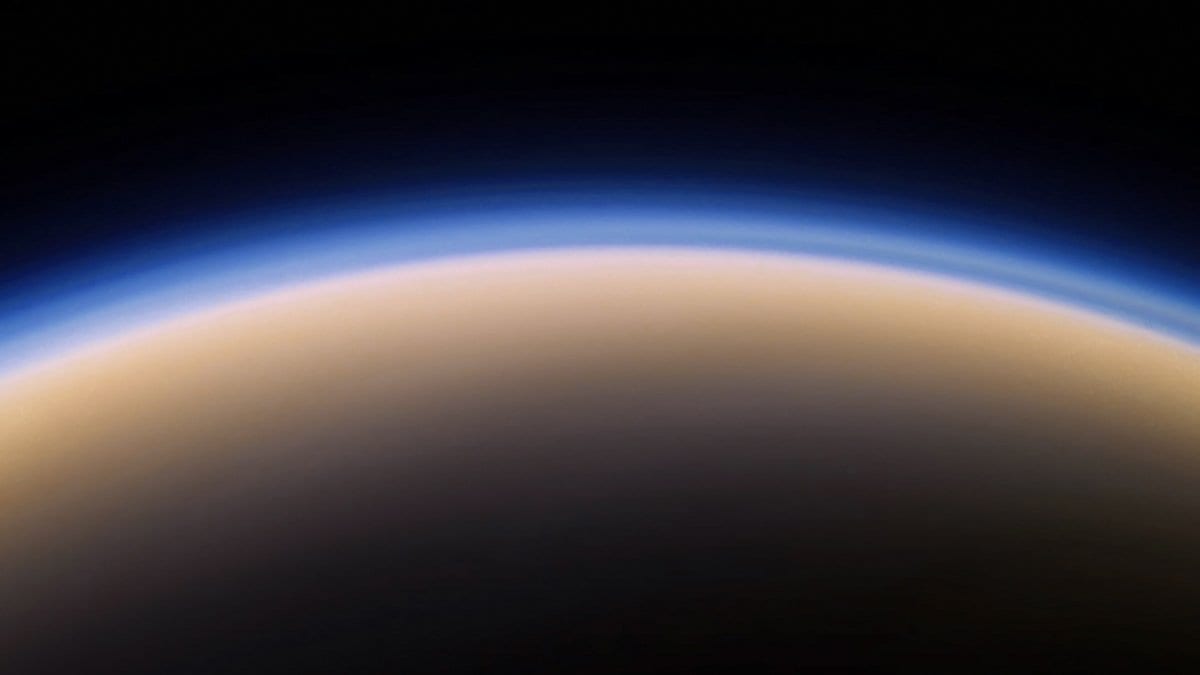
Titan is a world made largely of water ice, and almost none of the water in its atmosphere comes from the surface. Anything rising from the surface freezes out at the cold trap near the tropopause, long before it reaches the altitudes where the moon's chemistry takes place. Water in Titan's stratosphere is imported: it arrives from outside as water, hydroxyl (a fragment of a water molecule) or oxygen ions, then works its way down.
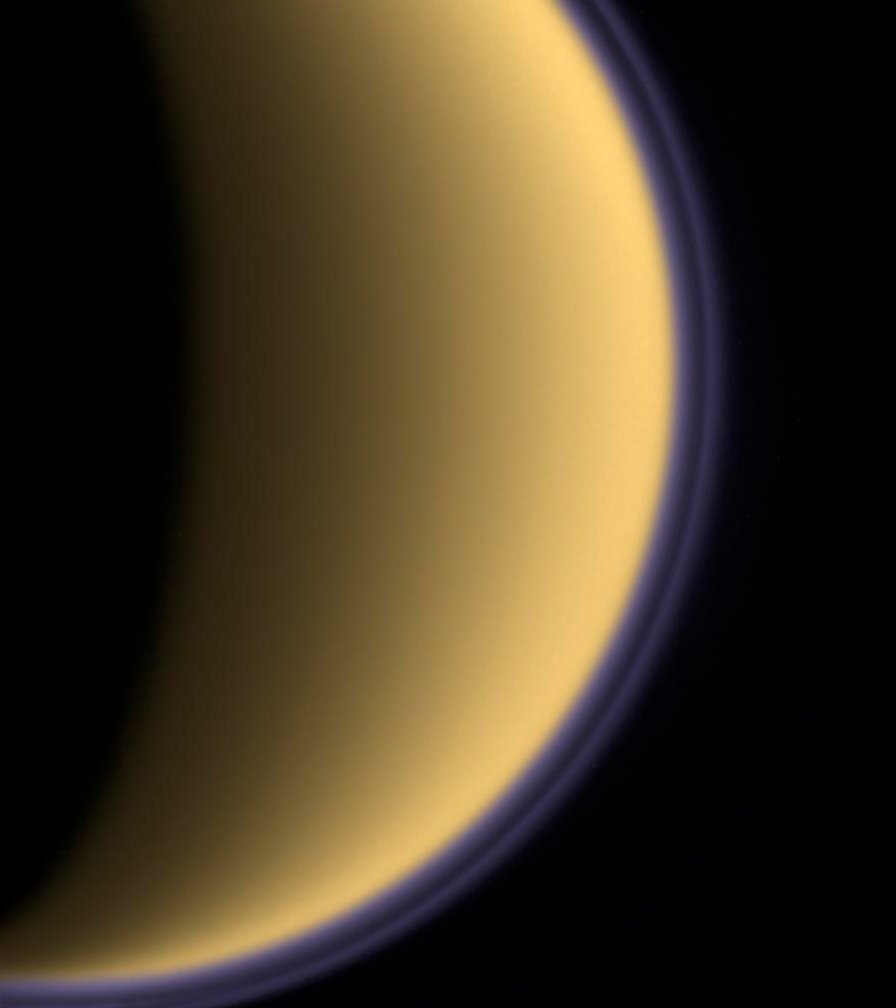
Only three oxygen-bearing molecules have ever been detected in Titan's atmosphere: carbon monoxide, carbon dioxide and water. Photochemical models predict others that have not yet been detected. Carbon monoxide and carbon dioxide are well mapped and barely change. Water is neither. Its infrared lines are faint, its abundance is tiny and Earth's own water vapor rules out measuring it from the ground, so every previous study had to average many observations over broad ranges of latitude and time to obtain a usable signal.
Joshua Ford and Nicholas Teanby of the University of Bristol set out to overcome that limit, with four co-authors at Bristol, NASA's Goddard Space Flight Center, the University of Oxford and Université Grenoble Alpes. Their paper, published Nov. 26, 2026, in The Planetary Science Journal, reports what the authors call "the first evidence for latitudinal and temporal variability in Titan's stratospheric water abundance". It rests on 157 far-infrared observations from Cassini's Composite Infrared Spectrometer, collected between 2004 and the spacecraft's final plunge into Saturn's atmosphere in 2017, covering almost the entire range of latitudes. The paper is open access, and its figures can be reused under a Creative Commons license.
The sharpest feature on that map sits over the winter north pole. What the retrieval constrains there is a scale factor, a multiplier applied to a modeled water profile, and the paper finds it "mildly enhanced by a factor of 3 compared to the mid-latitudes in northern winter". The authors interpret that as water-rich air subsiding inside the polar vortex at roughly 2 millimeters per second, an interpretation supported by the retrieved temperatures.
It does not mean three times as much water overhead. "In comparison to the heightened scale factors, the column abundance at the north pole is relatively unchanged compared to lower latitudes," the paper states, because the colder pole pushes the condensation level higher, leaving a shorter atmospheric column in which water can remain.
The swing is real, and the seasons are not behind it
Across the low and middle latitudes, the authors find no seasonal signal at all. A weighted test comparing winter with spring found no change in either the column abundances or the scale factors. What the same data do show is scatter. The column abundances range from 0.9 to 6.2 × 10¹⁴ molecules per square centimeter, a spread greater than the stated errors can account for, and a goodness-of-fit test against a single underlying value yields 4.83σ over the whole mission. Titan's water does not follow the seasons, and it does not sit still either.
The paper then works through the possibilities one at a time. Chemistry cannot account for it. An individual water molecule stays in the atmosphere for about 1.5 years, compared with roughly 1,000 years for chemical destruction and 3.5 years for atmospheric mixing, so water leaves before either process can significantly affect its abundance. Condensation cannot account for it either. The team computed what the column abundances would look like if temperature-driven condensation were the only factor changing, using temperatures from a circulation model developed by another group, but the real observations scatter far more than the simulated values. "This leads to the incoming source flux of Titan's water (OH) being the most plausible driver of the variability," the authors write.
A budget that fits, with a model on each side of it
That is an argument by elimination, and it points outward. Enceladus orbits much closer to Saturn and vents water ice from fissures near its south pole. The plume material spreads into a doughnut-shaped cloud of neutral gas, a torus, that reaches Titan's orbit in the form of hydroxyl and oxygen. The paper's abstract puts the influx needed to explain its retrievals at 0.16 to 1.32 × 10⁷ hydroxyl molecules per square centimeter per second. Its calculation of what the torus would deliver comes out at 2.52 × 10⁶, within that range.
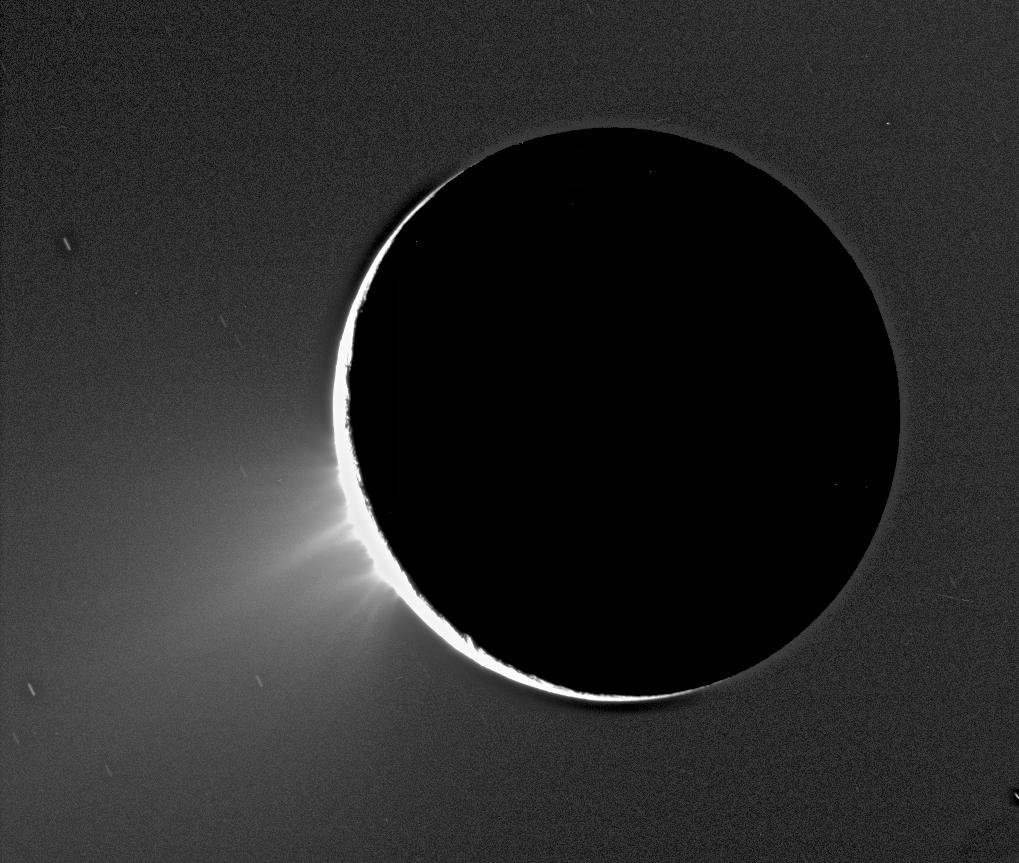
Both numbers are modeled rather than measured. The influx is the incoming flux assumed in a 2019 photochemical model of Titan, co-authored by one of the researchers on this paper, rescaled by the factors returned by the retrievals. The torus figure comes from another team's model of Saturn's gas tori, which assumes a molecular speed and accounts for Saturn's gravity focusing the infall. "The velocity of the OH molecules is difficult to estimate," the authors concede. The agreement between two modeled quantities is a real result, but it is not a measured flux matching a measured delivery rate.
The strongest claim the paper makes about Enceladus comes in its last paragraph, where the authors write that the study is "providing evidence supporting Enceladus as the dominant external source of oxygen". That evidence is the flux budget above, but identifying Enceladus as the source requires an assumption. The Conclusion frames it that way: drawing on the existing literature, the authors assume Enceladus to be the main source. Micrometeorites, interplanetary dust and cometary material are disfavored by citing earlier work, not by anything measured in this paper. One of the strongest of those studies, by one of the same authors, reported that "a mixture of sources could not be ruled out".
The test that could have tied Titan's water variability to Saturn's environment came back empty. The paper reports that "no correlations were found between the observed variability and solar flux, solar wind pressure, or plasma environment", and a comparison across six classified plasma states found no differences either. Enceladus itself offers no help over longer timescales: its plumes have been broadly steady for about two decades. The water torus turns over in roughly 35 days, leaving month-scale changes as the one candidate timescale fast enough to register in Titan's atmosphere.
What a map of Titan's water is for
Titan's oxygen chemistry has never had a water measurement resolved by latitude and time to test against, and that is what this work gives researchers building photochemical and circulation models of the moon. The authors are clear about why the timing matters: NASA's Dragonfly rotorcraft is due to arrive at Titan in 2034. Abundances retrieved from Cassini's spectrometer also run higher than those from Herschel, and a uniform reanalysis showed that the difference is not an artifact of processing. The spectra the team worked from have been in NASA's public archive of Cassini's Titan observations all along. What is new is the map.