Titanium Monoxide Turns up in a Star-Forming Region for the First Time

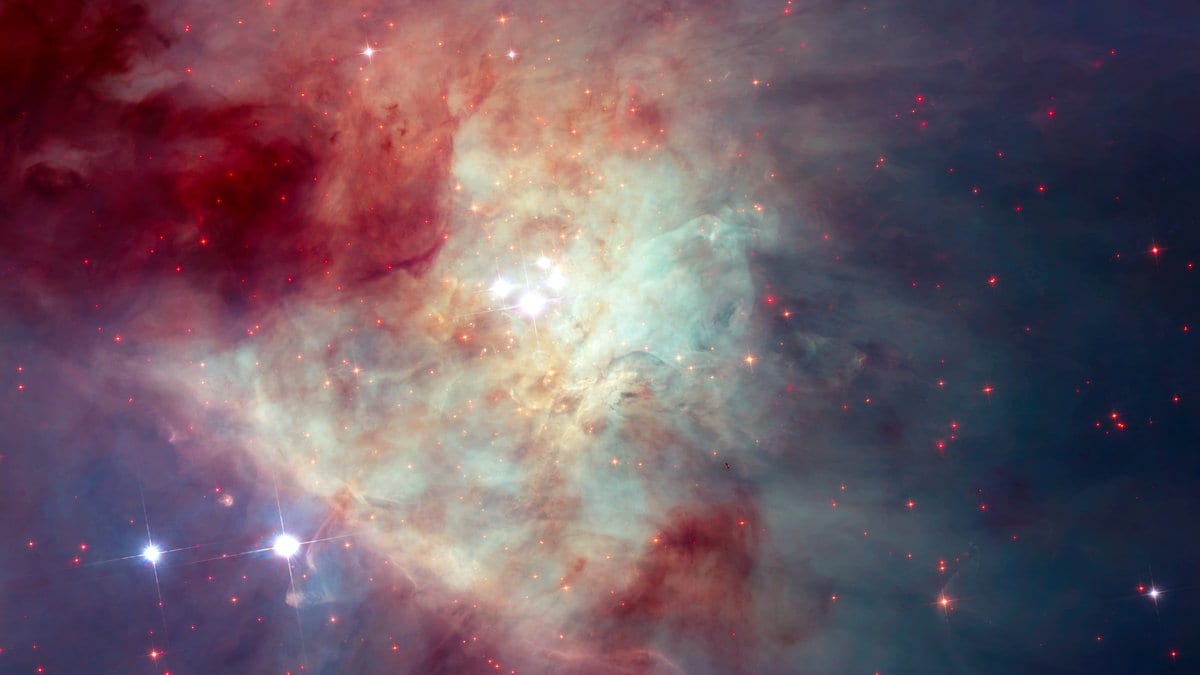
In the cold between the stars, titanium does not drift around on its own. It is one of the most stubbornly solid elements in the periodic table, and it spends almost all of its time inside mineral dust grains, bound up with oxygen and calcium in the kind of rock that survives in meteorites. Getting titanium into the gas phase means taking the rock apart.
Something close to Orion Source I appears to be doing exactly that. Ziwei E. Zhang and Nami Sakai of the RIKEN Pioneering Research Institute and their colleagues report detecting titanium monoxide, a molecule consisting of one titanium atom and one oxygen atom, in the gas around that young massive star. Their peer-reviewed Letter, published Oct. 23, 2026, in The Astrophysical Journal Letters, reports the first detection of titanium monoxide in a star-forming region. The paper places Orion Source I at about 415 parsecs, equivalent to roughly 1,350 light-years, as NAOJ and ALMA give in their announcements.
That last phrase carries the whole claim. Titanium monoxide itself is not new to astronomy: its absorption bands are a defining feature of cool red stars, and radio telescopes detected the molecule in gas around the red supergiant VY Canis Majoris in 2013. Detections of refractory molecules, the hard-to-vaporize kind, had previously been limited to evolved stars nearing the end of their lives. What had never been seen was titanium monoxide in a star-forming region: the environment is the new thing here, not the molecule.
The result comes out of the ALMA archive. For the Letter, Zhang, Sakai and colleagues assembled observations of Orion Source I from six observing programs, including recent observations of their own, that covered titanium monoxide transitions at comparable angular resolution. Nine of the molecule's rotational transitions, the radio signals emitted as it rotates, fall within those data; three were clearly detected, while the rest were blended with lines from other molecules or too faint to identify. Frequency alone was not enough to identify the molecule: each line also had to originate from the same compact region of the sky, share the same velocity gradient and appear where chemically similar molecules are found.
At the foot of the wind
Where the molecule sits is what makes it interesting. The emission is resolved within about 50 astronomical units of the protostar, each unit equivalent to the distance from Earth to the Sun, and the gas there moves rapidly in opposite directions on either side of the star. The paper places it at the base of the outflow, where material begins streaming away from the disk; the ALMA and NAOJ announcements call that structure a rotating disk wind.
Titanium monoxide is not the first refractory molecule to turn up in this object. Aluminum monoxide was detected near the same outflow launching region in 2019, and the disk itself contains sodium and potassium chloride, table salt and its chemical cousin. The new titanium monoxide maps closely resemble those of aluminum monoxide in both position and velocity, which helps support the identification. Both molecules are thought to contribute to dust formation: titanium monoxide can serve as a precursor to titanium dioxide, which may help solid grains form in hot gas, while aluminum monoxide is thought to play a similar role in forming aluminum oxides.
The number the authors hedge
How much titanium has made that crossing is the hardest number in the paper, and the authors hedge it with care. Those clean lines yield a titanium monoxide column density of about 3 quadrillion molecules per square centimeter along the line of sight, at an excitation temperature near 480 kelvin. That temperature describes the excitation of the molecule's transitions, not necessarily the actual temperature of the surrounding gas.
Compared with silicon monoxide, that works out to about 1.3 titanium monoxide molecules for every 100 silicon monoxide molecules, several times the titanium-to-silicon ratio of the most primitive meteorites. The excess supports the interpretation that dust near the protostar is being efficiently converted into gas, but this is where the authors are most careful. The derived ratio, they write, "could be considered as an upper limit." The silicon monoxide abundance they compare against was measured in 1987 over a much wider region of sky, and other silicon-bearing molecules in the same gas complicate the comparison. The estimate is "approximate, as only three transitions are applied," and the heat and radiation at the outflow base probably push the gas away from the equilibrium conditions assumed in the calculation.
What this has to do with meteorites
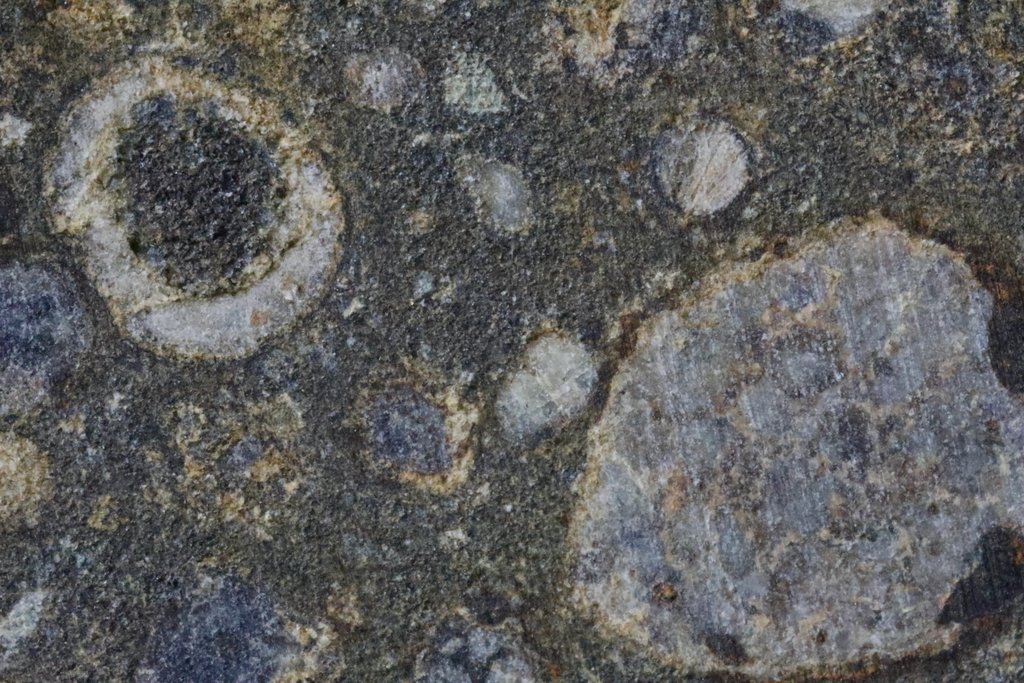
The oldest known solids in the solar system are calcium-aluminum-rich inclusions, pale blobs embedded in the most primitive meteorites, built from the same refractory elements: calcium, aluminum and titanium. They formed at high temperatures. The Letter notes that whether they condensed locally, in the disk around the young Sun, "is still under debate," and that part of the difficulty has been how little anyone had observed these dust-seeding molecules in regions where stars are actually forming. As the gas cools farther out, titanium monoxide is expected to condense into perovskite, a calcium-titanium mineral, and aluminum monoxide into corundum.
In the authors' framing, the detection offers a way to study the chemistry of refractory material in a place where it can be observed directly: the hot inner region of a protostar, where dust is destroyed and re-formed. That chemistry, they argue, matters for planet-forming systems in general, not only for this one. Orion Source I, one of the best-characterized massive protostars at the scale of its disk, now has an inventory ranging from salts in its disk to aluminum- and titanium-bearing molecules at the base of its wind.