Betelgeuse's Radio Disk Changes Shape in Step With a Probable Companion

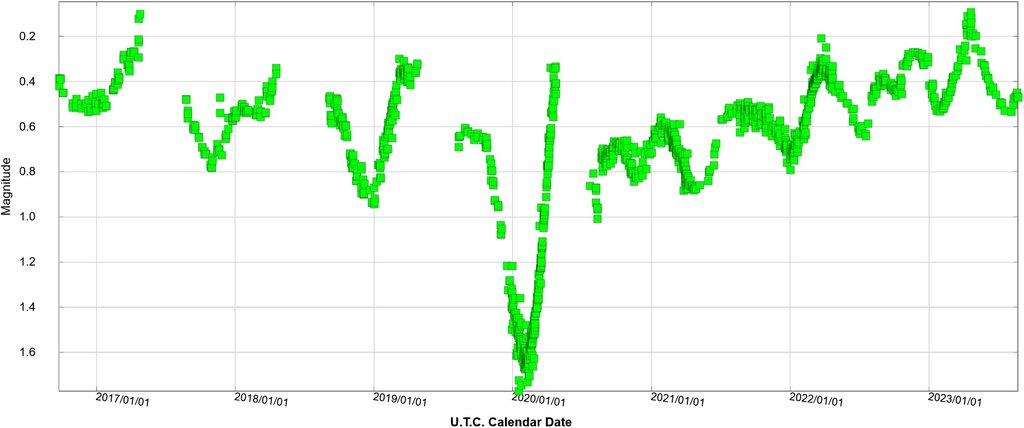
For a few months in late 2019 and early 2020, the most familiar red star in the northern sky stopped looking like itself. Betelgeuse, the bright point marking the shoulder of Orion, faded to its faintest in more than a century of record-keeping, and astronomers have debated what caused the dimming ever since. Lynn D. Matthews, a principal research scientist at MIT Haystack Observatory, was watching the star at radio wavelengths before that episode began. Matthews and three colleagues have now published maps from subsequent radio observations, showing changes in the star's brightness-temperature profile and atmospheric shape.
The work appeared Sept. 1 in The Astronomical Journal as an open-access paper. Radio observing has a particular advantage for a question like this: waves at different frequencies probe different depths in the atmosphere, so observing at multiple frequencies reveals different layers. The team mapped Betelgeuse at seven frequencies, using the Karl G. Jansky Very Large Array in New Mexico and the Atacama Large Millimeter/submillimeter Array in Chile, in observations spanning 2021 to 2026. The lowest frequencies probe the outermost gas; the highest reach closest to the visible surface.
The quantity they track is brightness temperature: the temperature a blackbody would need to have to produce the observed brightness. At the two lowest frequencies, 22 and 44 GHz, it has increased since the historic lows recorded in 2019, shortly before the dimming. That is a statement about those two frequencies, not about the atmosphere as a whole.
The warmest part of that atmosphere has also moved. The maps put the peak of the brightness temperature at a projected radius of about 2.7 times the star's radius, farther out than measurements made before 2016, and the authors interpret this as consistent with a possible change in how the atmosphere's density falls off with distance. Possible is their word, and it is carrying weight: a shifted peak is a measurement; a redistributed atmosphere is a reading of one.
Inward of that peak, the radio brightness temperature decreases rather than increases. The maps show a systematic decline, from about 3,500 K near that outer peak to about 2,220 K at around 1.2 stellar radii, just above the visible surface. The idea of a cool shelf down there is not new, and the paper claims only to confirm it: a temperature minimum between the visible surface and the hot chromosphere above it.
One finding holds at every frequency they observed, and it is a discrepancy. At all of them, the radio brightness temperature is lower than the temperatures inferred from ultraviolet measurements at comparable radii. The authors take that as a sign that cool gas, no hotter than the star's effective temperature, is still mixed in with the hotter chromospheric material rather than cleared out of it. For a red supergiant, that is not a cosmetic detail: how much cool gas sits in the outer atmosphere, and where, can affect how the star sheds mass in the final stages of its life.
The shape of the radio spectrum, by contrast, looks untouched. A single spectral index of 1.35 ± 0.03 fits the measurements, with no evidence of a change across more than two decades in frequency.
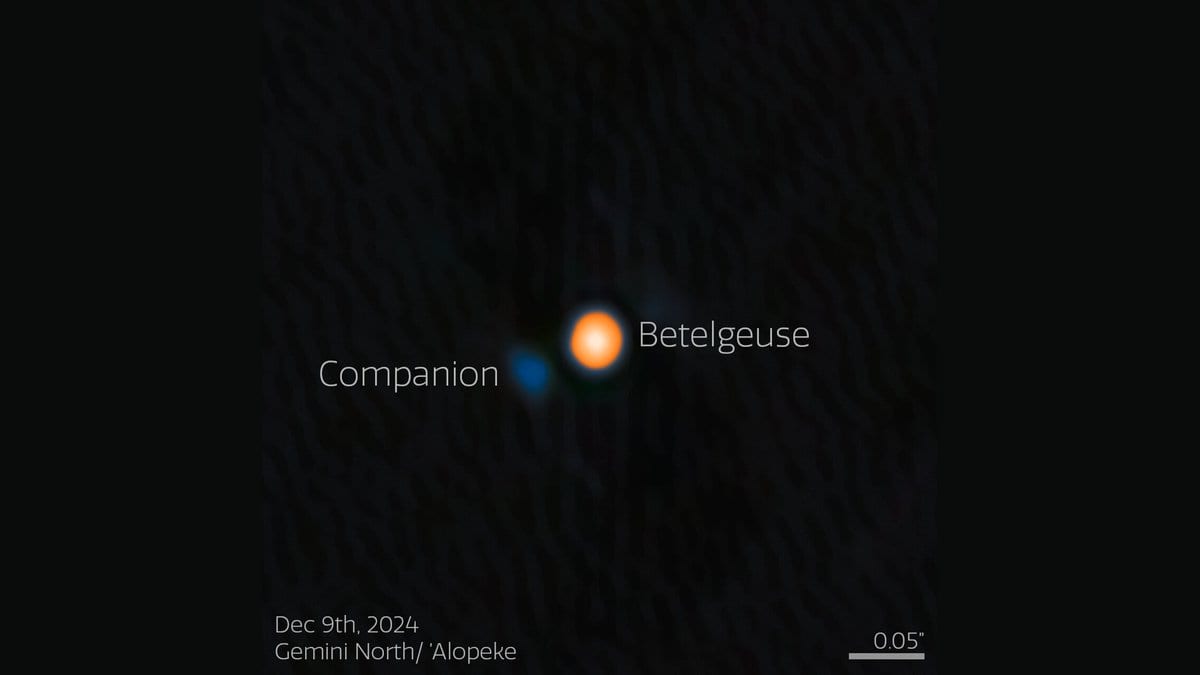
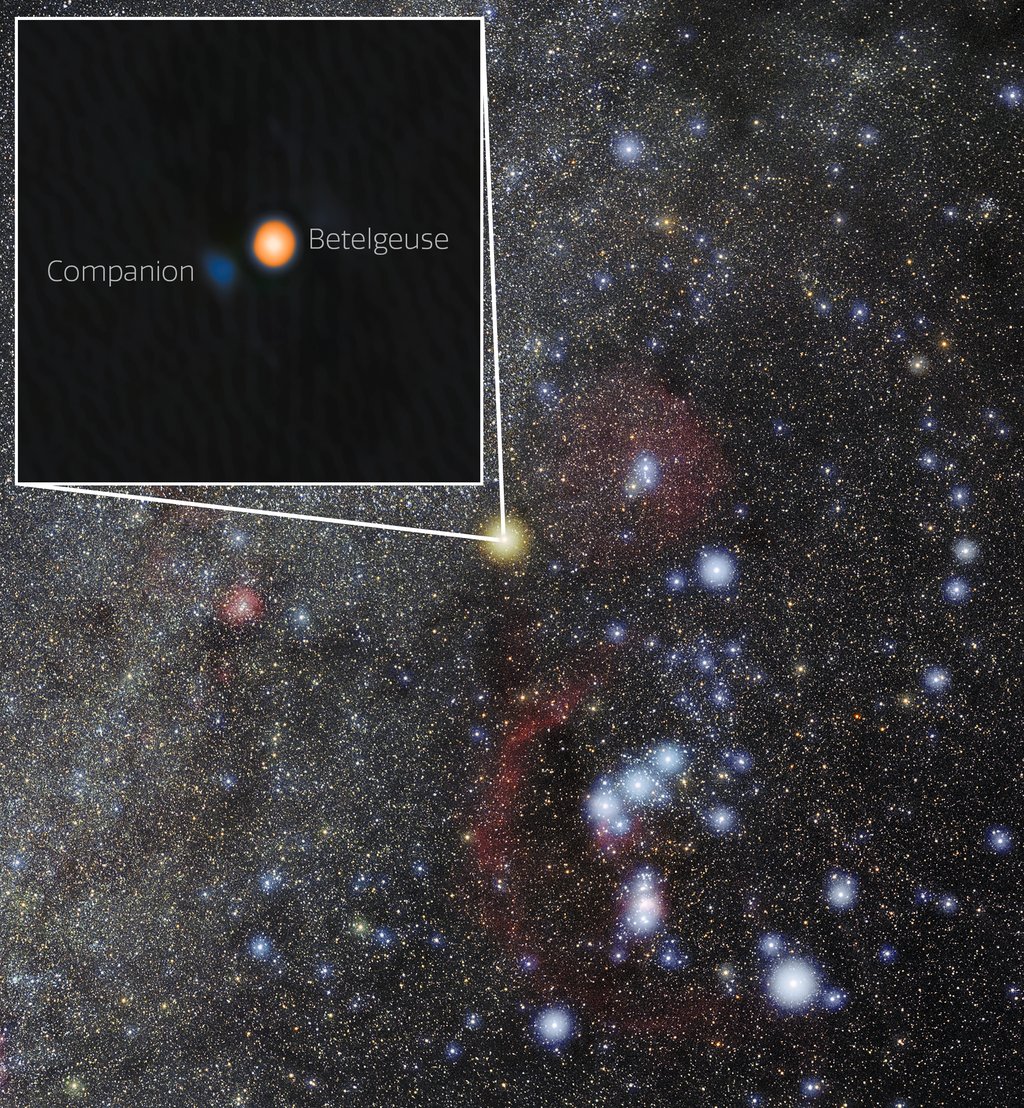
Then there is the companion, which is not this paper's finding. In 2025 a different group reported what it called a probable direct-imaging detection. Steve B. Howell and colleagues used speckle imaging on the Gemini North telescope and saw a faint point beside Betelgeuse in 2024. No companion was detected in their 2020 observations, when it was predicted to be almost directly in line with the star and therefore unobservable. The authors describe the object as putative and presumed, and say the detection has a significance of only 1.5σ, which is weak by the standards astronomers usually insist on.
In July, however, Miguel Montargès and colleagues reported stronger evidence: they directly imaged the suspected companion in December 2024 using the SPHERE instrument on the European Southern Observatory's Very Large Telescope, although they said further observations were needed to confirm its orbital motion.Three other lines of evidence point the same way: the long-term swing in the star's brightness, variations in its measured radial velocity and small shifts in its position on the sky.
Matthews and co-authors treat the companion as an independently reported result. Their paper notes that evidence for a close-in companion has been reported, with a semimajor axis of about 2.3 stellar radii, and that number is what makes the rest interesting. It puts the orbit inside the extended atmosphere traced by the radio maps. The National Radio Astronomy Observatory's release of Oct. 26 quotes Matthews on the geometry: "This companion is orbiting so close to the star that it actually passes through its extended atmosphere." The release also gives the companion a name, Siwarha, after an Arabic phrase meaning "her bracelet."
The paper's own new result is a correlation. Betelgeuse's radio disk is not perfectly round, and its degree of elongation tracks the companion's expected orbital phase. The release describes the star as more elongated near the times when the companion is expected to be at its greatest apparent separation, and rounder when it is expected to pass in front of or behind the star. The authors pitch the conclusion one notch below that: the results are consistent with periodic perturbations of the atmosphere by the companion. It is a correlation reported as a correlation.
What would settle it is better coverage of the orbit. In the release, the team says that observations covering a fuller range of the companion's circuit, particularly at frequencies not yet well sampled, are needed to confirm and refine the result. The release ties the companion to a 2,100-day cycle in Betelgeuse's brightness, and the radio observations span roughly one such cycle. More observations covering orbital phases not yet adequately sampled are the test.