Drained Peatlands Account for 2.7% of Industrial-Era Heating
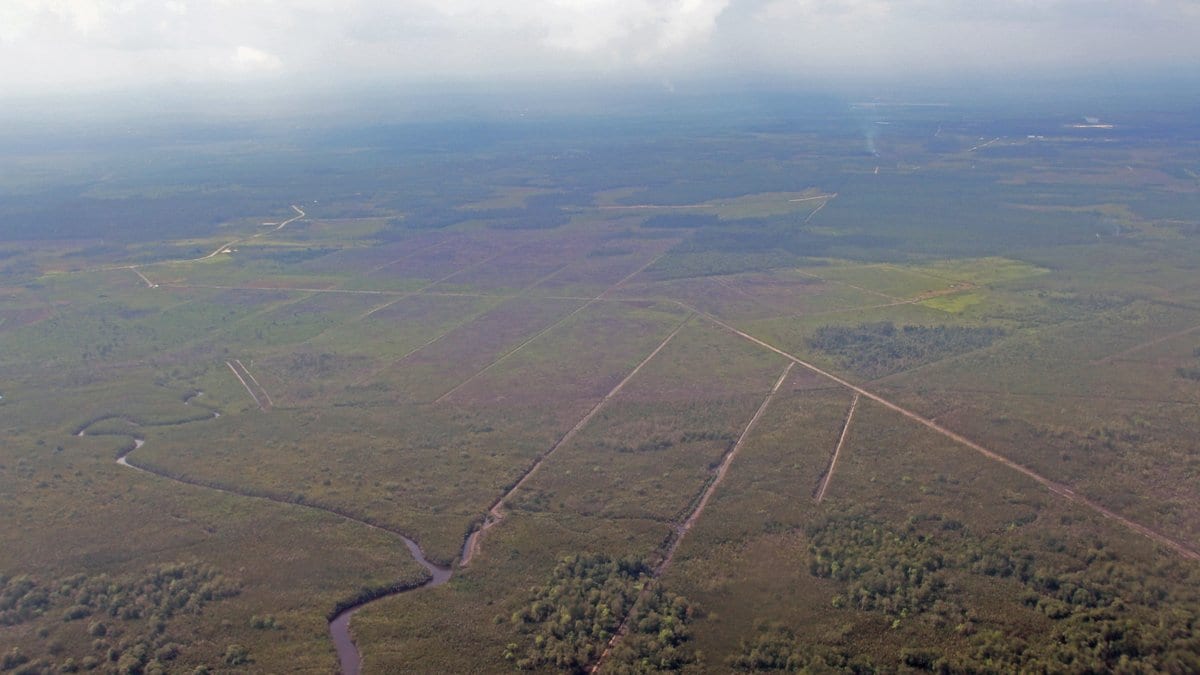
A reconstruction of two centuries of peatland drainage puts its net heating effect at 73 milliwatts per square meter (48 to 99), or 2.7% (1.8% to 3.6%) of all the heating human activity has added since the industrial era began. The drained ground covers 0.4% to 0.5% of the world's land area. Jevan B. Yu and César Terrer of the Massachusetts Institute of Technology and colleagues published the work Nov. 25, 2026, in Nature.
Peatlands have taken hundreds of gigatons of carbon dioxide out of the air over thousands of years while returning part of it as methane — a slow net cooling. The authors write that drainage reverses the first half of that exchange: the drying peat decomposes and releases carbon dioxide again, while the drier ground gives off less methane, leaving a net climatic effect that had not been well quantified at the global scale. Their reconstruction, covering 1800 to 2020, puts a number on that balance.
The paper reports the net figure as the sum of two opposing terms: +83 milliwatts per square meter (52 to 110) from the carbon dioxide that drainage releases, and −9 (−15 to −2) from the methane it prevents. The reconstruction combines a new dataset of measured fluxes, models in which carbon dioxide and methane emissions follow the depth of the water table, and a hindcast of how widely and how deeply peatlands were drained.
The authors report that even with no further expansion of drainage, keeping today's drained areas drained could almost double the cumulative warming by 2100. The paper's own title calls this an enduring climatic burden from past peatland drainage, and the authors describe the legacy effects of historical drainage as strong.
The raw data and the processed outputs are deposited on Zenodo, with the R code used to analyze them.
Sources
- NaturePeer-reviewed