A True Sugar Turns up in a Cloud Near the Galaxy's Heart

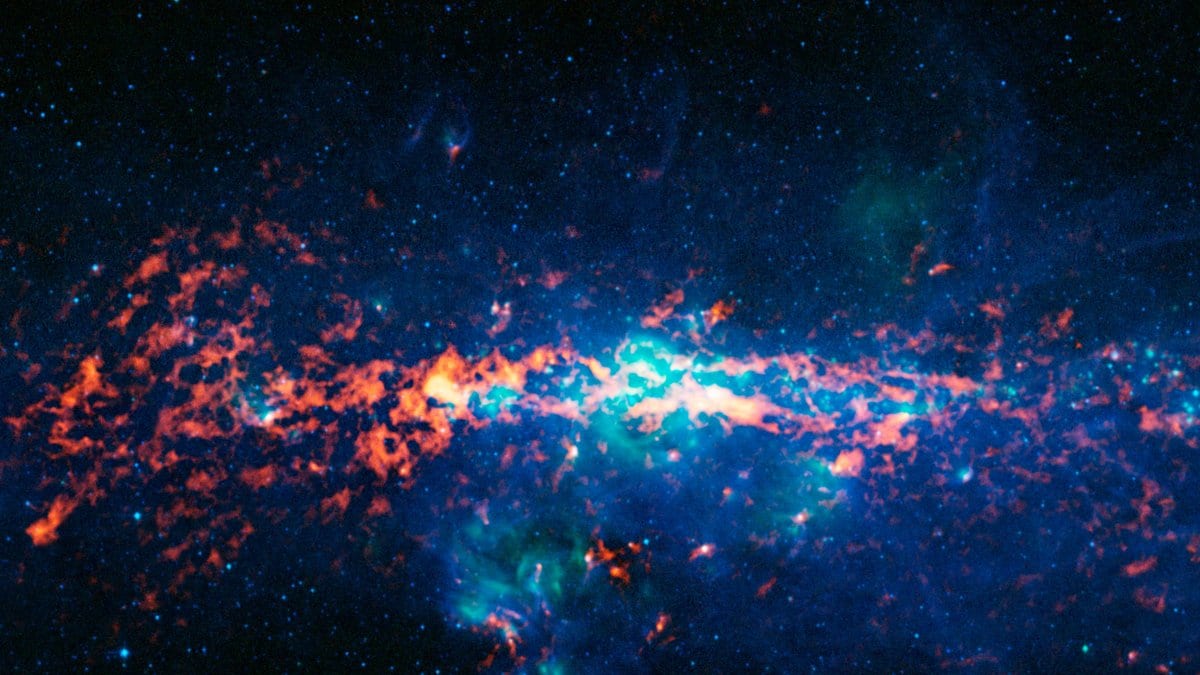
Chemists have a name for the kind of molecule they had never quite caught in space: a true sugar, a carbohydrate with the right skeleton to slot into the chemistry of living things. Simpler sugar-like fragments had turned up in molecular clouds for years, but the genuine article kept slipping past. Now a team led by Izaskun Jiménez-Serra has found one, and it is bigger than anyone expected to see first.
The molecule is erythrulose, a four-carbon ketose. Writing in Nature Astronomy, the researchers report its spectral fingerprint in G+0.693−0.027, a cold, dense cloud drifting near the heart of the Milky Way. Every molecule tumbling through such a cloud broadcasts a set of radio frequencies as distinctive as a barcode. To read erythrulose's, the team pointed two instruments in Spain at the cloud: the Yebes 40-metre dish and the IRAM 30-metre telescope. Matching the pattern of faint lines against laboratory measurements is what lets astronomers claim a specific molecule rather than a vague family of them.
What surprised the team was not just that a four-carbon sugar was there, but that it seemed to crowd out the smaller ones. Glycolaldehyde and its three-carbon cousins are the sugars chemists would expect to find most easily. Yet in this cloud the shorter chains stayed invisible. The paper infers that erythrulose is at least eight times more abundant than those analogous three-carbon sugars. That comparison is drawn from the modelling and chemistry rather than a direct side-by-side count, since the smaller molecules were never detected to measure against.
Why would the bigger molecule win? The authors point to how these sugars are likely built: on the icy surfaces of interstellar dust grains, assembled step by step from simpler two-carbon aldehydes and alcohols. That pathway appears to favour the four-carbon ketose. And a ketose has a useful trick: in water, ketoses readily rearrange into aldoses, the sugar form that biology actually runs on. So a ketose forged in space is not a chemical dead end; it is a molecule one watery step away from something a cell could use.
That is where the origin-of-life question enters. One long-standing puzzle is where early Earth got its sugars at all: laboratory attempts to brew them under plausible prebiotic conditions tend to yield too little to matter. An outside supply would help. The authors suggest that interstellar erythrulose could have contributed to the sugar inventory available for early metabolic and replication chemistry, perhaps delivered by the comets and dust that rained onto the young planet. They frame this as a plausible contribution, not a proven history; the detection tells us the molecule exists out there, not that any of it reached us.
Still, the direction of travel is striking. Each new molecule pulled out of these Galactic-Centre clouds makes the interstellar medium look less like empty space and more like a working chemistry set, one that was assembling the vocabulary of life while the Sun was still a cloud of its own.
Sources
- Nature AstronomyPeer-reviewed
- Nature AstronomyPeer-reviewed