The 'Earliest Galaxy' That Was Really an Exploding Star

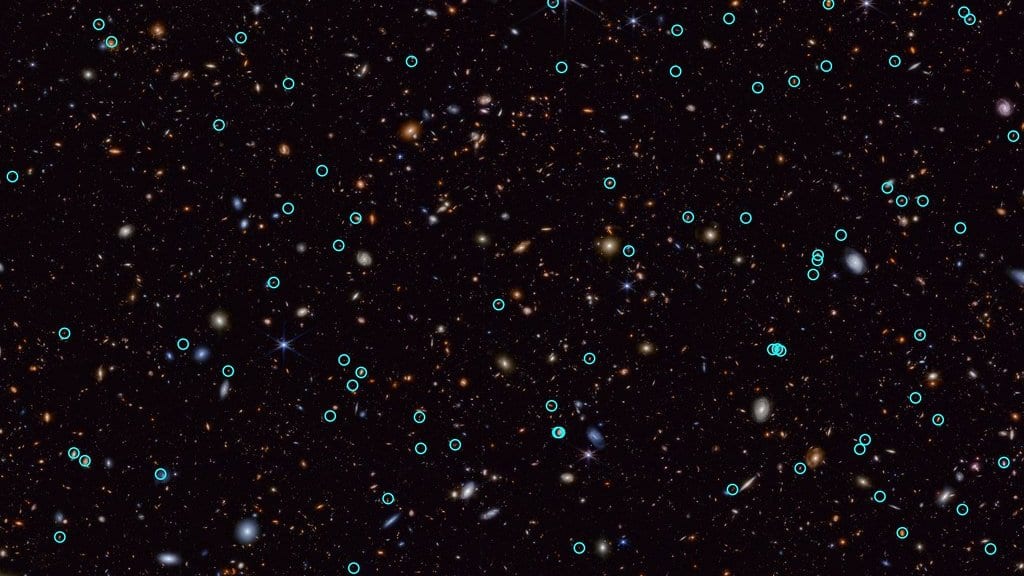
A record at the frontier of astronomy tends to arrive wearing a warning label, and the story of an object catalogued as beacon_1420-5253_4770 is a good reminder why. When it first surfaced in James Webb Space Telescope imaging, it looked like a prize: a galaxy at a redshift of about 14, meaning its light had traveled from a time when the cosmos was barely 300 million years old. That would have placed it among the most distant galaxies ever seen. Instead, a team led by Seiji Toshikage, with Takahiro Morishita, Masaomi Tanaka, Charlotte Mason, Andrew Bunker, Tommaso Treu and colleagues, argues in a preprint posted to arXiv that the "galaxy" was almost certainly an exploding star much closer to home, at a redshift of roughly 4.3.
The clue that unraveled the record was disarmingly simple. A galaxy is a fixed feature of the sky. Point a telescope at the same patch a year earlier and a year later, and it should still be there. This source was not. It appeared in a single JWST epoch and was absent both before and after. Persistent things do not blink on and off like that. Transient ones, such as supernovae, do.
So why did the object masquerade as one of the earliest galaxies in the first place? The answer lies in how astronomers hunt for cosmic dawn. Light from the most distant galaxies gets stretched by the expansion of the universe, and along the way, intervening hydrogen absorbs everything shorter than a certain wavelength. The result is the Lyman break: a sharp cliff in a galaxy's spectrum, bright on one side and dark on the other. Find that cliff, measure where it falls, and you have a distance. It is one of the most trusted tricks in the field.
The trouble is that a cliff can be counterfeited. Type Ia supernovae, the thermonuclear detonations of white dwarf stars, forge enormous quantities of iron-group elements, and those elements drink up light across a broad band of the blue and ultraviolet. Seen at the right distance, that iron curtain produces a drop in the spectrum that looks, to the eye and to the fitting software, remarkably like a Lyman break. Toshikage's team ran the object's colors, brightness, light curve and full spectral shape against a library of templates, and the profile that matched best was not a young galaxy at the dawn of time. It was a Type Ia supernova at z~4.3, a cosmic age of only about 1.5 billion years.
The classification remains tentative, based on a single study that has yet to undergo peer review, and the authors present it as a candidate rather than a settled finding. But the phenomenon it points to is already well known in the field. Deep JWST surveys have found that a meaningful fraction of their faint, distant galaxy candidates turn out to be interlopers of one kind or another, and transient contamination has been flagged before in the very redshift range where the record-holders live. This object is a vivid new example of a problem astronomers have learned to expect.
There is a consolation prize buried in the disappointment, and it may be the more interesting result. If the source really is a Type Ia supernova at that distance, its light left when the universe was only about 1.5 billion years old. That sets a clock. Type Ia supernovae come from white dwarfs, which are the burned-out cores of stars that took time to live and die first, so there is a minimum "delay time" between a burst of star formation and the first such explosion. Catching one this early, the authors argue, implies that delay can be shorter than a billion years. In a field where the timing of these explosions feeds directly into how astronomers weigh the chemical enrichment of galaxies, that is a genuine constraint, not a footnote.
For now, the object sits in a familiar category at the edge of what JWST can see: a beautiful candidate that dissolved on a second look. The next generation of cosmic-dawn surveys will have to keep asking a question that sounds almost too basic for frontier astronomy. Is that faint smudge a galaxy from the beginning of everything, or is it a star that just happened to explode while the shutter was open?
Sources
- arXivPreprint