Life's First Genetic Code May Still Be Written Inside the Molecules That Carry It

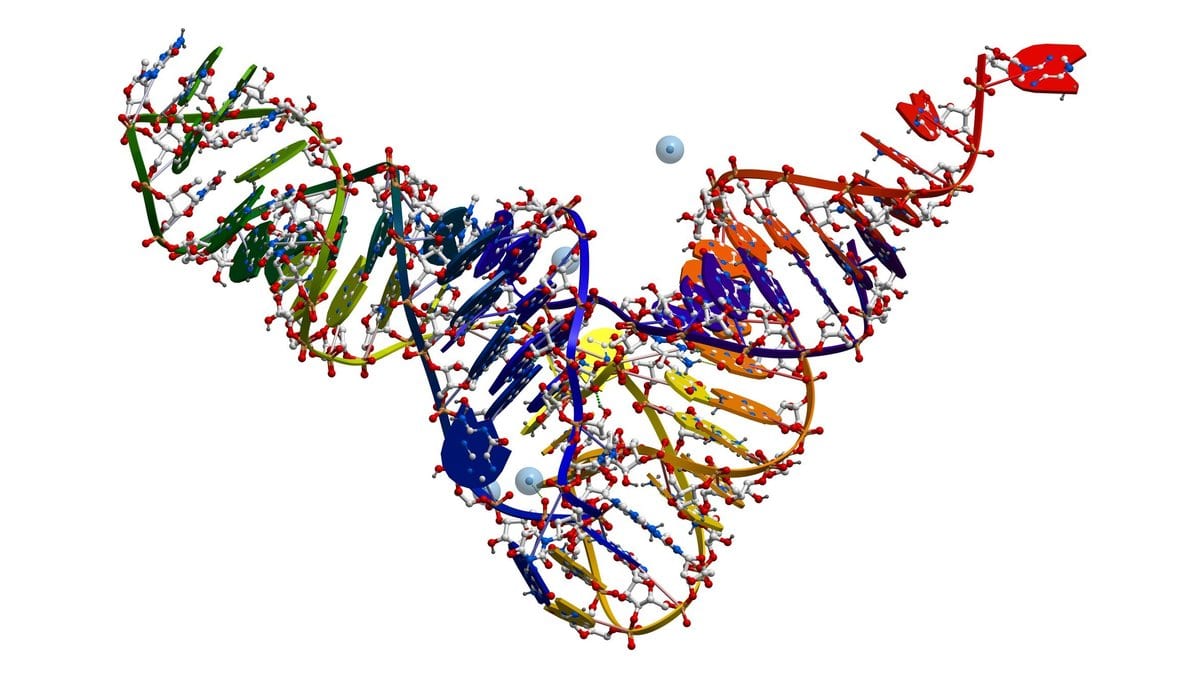
Transfer RNA works at both ends at once. One tip carries the anticodon, the three-base patch that reads the code. The other tip is the acceptor stem, a short paired stretch of RNA where the amino acid itself attaches. Two ends, two jobs, and a question that has sat in molecular biology for decades: which of them is older?
That question has now been put to the sequence record rather than to a bench. Ash Nova Royo, Lluís Ribas de Pouplana and colleagues at the Institute for Research in Biomedicine in Barcelona report that the acceptor stem of modern transfer RNA still looks as though it once did some reading of its own. Their paper appeared in PNAS on Oct. 21, 2026. For a subset of amino acids, that is, and not for all twenty.
The older arrangement goes under the heading of minihelix models. They hold that transfer RNA began as something far smaller: a stubby RNA hairpin resembling an acceptor stem on its own, with no anticodon arm attached, and that some of those stubs could already be loaded with one particular amino acid. The models make a prediction that can be checked, and the paper states it plainly. If coding started that way, vestiges of those old pairings should still sit in the acceptor stems of present-day transfer RNA, and they should survive correction for the structural rules that constrain such a sequence.
So the search was for anticodons in the wrong place. The question the analysis asks is whether the triplet matching a given amino acid turns up in the non-anticodon parts of that amino acid's own transfer RNAs more often than it should. Working out what "should" means is the hard part. An RNA molecule that has to fold into a working shape cannot carry an arbitrary sequence, and base composition differs from organism to organism. The team ran the test over a curated dataset of 77,335 canonical transfer RNA sequences, a deliberately restricted set, using what it calls a structure-aware statistical framework.
The answer, in the paper's own wording, is that "for a subset of amino acids cognate anticodon-like triplets are significantly enriched in acceptor stems and, to a lesser extent, in other structural domains." Both halves of that sentence carry weight. The signal is strongest at the acceptor stem, and the acceptor stem is not the only place it shows up. And it is a subset: some amino acids, not the genetic code as a whole.
Two further claims sit on top of that one. The strongest of the acceptor-stem signals survive what the paper calls structure-preserving null models, statistical stand-ins built to imitate the structure of a transfer RNA. The strongest, not all of them. The authors also report that the signals cluster nonrandomly against proposed chronologies of the order in which amino acids entered the genetic code. Those chronologies are plural and are argued over in the field; one recent attempt at the order, from a separate group, worked from protein domains traceable to the last common ancestor of all life.
How patchy that subset is can be seen directly, because the group deposited its acceptor-stem results openly at Zenodo under a CC BY license. The file runs one line per anticodon family, 61 of them, setting each family's observed triplet frequency beside the average of 10,000 simulation runs. Alanine's GGC family is one of the unambiguous hits: an observed frequency of 0.651 against 0.298 from the simulations. Most of the other families do not clear the significance threshold the authors apply, and a substantial number land below what the simulations expect rather than above. The subset in the abstract is a description of the data, then, and not a hedge.
The overlap with much older bench work is what the paper flags as notable, and it comes with a wrinkle. Among the amino acids showing the signal are ones already known to support the specific loading of a bare minihelix. Hou and Schimmel reported in Nature in 1988 that a single structural feature largely sets a transfer RNA's identity, and Francklyn and Schimmel followed in 1989 with the charging of RNA minihelices with alanine. Alanine is among the families with a clear acceptor-stem signal in the new sweep. The overlap was noticed after the fact, though: neither 1980s paper predicted which amino acids a sequence survey would light up. And Paul Schimmel, of MIT and Scripps Research, is an author of this paper and of both of those, which makes the continuity a real one and makes it something other than outside confirmation.
The paper's own ceiling is set in its last sentence. It says the findings identify "molecular fossils within modern tRNAs consistent with the persistence of an ancestral operational code," and that they "provide refined statistical support for the notion that" today's pairings of codon and amino acid grew out of early systems that loaded amino acids onto RNA minihelices. Consistent with. Refined statistical support for the notion that. Nothing here was charged at a bench: this is arithmetic on public sequence data, peer-reviewed and published, and the arithmetic is sitting in an open file for anyone who wants to run it again.