Skip to content
See the World Through ScienceA project of ALLATRA
Source: Peer-reviewedScientific Reports1 source

Van Gogh's Starry Night May Show a Real Dawn Sky From July 1889
Space

Republish this story

Our work is licensed under Creative Commons BY-NC 4.0. You may republish this piece for free — with credit to ALLATRA Media and a link to the original, unedited beyond length trims, and not for commercial use.

Read the full license

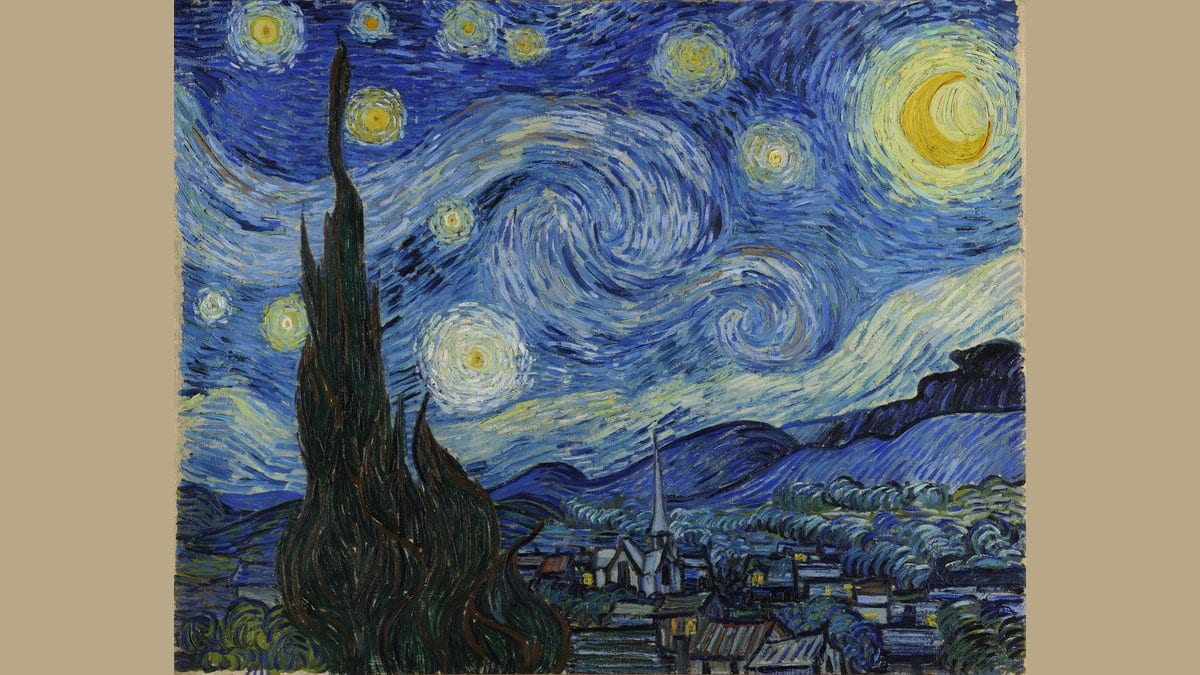
Vincent van Gogh's oil painting The Starry Night: a swirling blue night sky with a thin crescent Moon at upper right, a dark cypress at left and a village below.
The canvas Van Gogh painted at Saint-Rémy in 1889; the crescent at upper right is the Moon the study dates to a dawn in late July."The Starry Night" by Vincent van Gogh, via Wikimedia Commons, CC BY-SA 4.0

Vincent van Gogh's The Starry Night matches a sky that really stood over southern France, researchers in South Korea report: the predawn hours of about July 22, 1889, when a thin waning crescent Moon, Venus and the Hyades star cluster gathered in one narrow patch of sky above Saint-Rémy.

Elijah Jeong-hyun Kim and Ho Jin of Kyung Hee University in Yongin and colleagues write in the paper, published Oct. 22, 2026, in Scientific Reports, that the question of invention or observation has gone unanswered for more than a century and that the painting's stars had never been tested by measurement. The canvas is conventionally dated to June 1889, and they write that the result calls for reconsidering that date.

The test turns on how much sky the painter was looking at. The group recovered his frame from F1541v, an earlier drawing of the same ridge southwest of the asylum where he lived, registered against photographs of the site: a view 18.4 degrees across the diagonal.
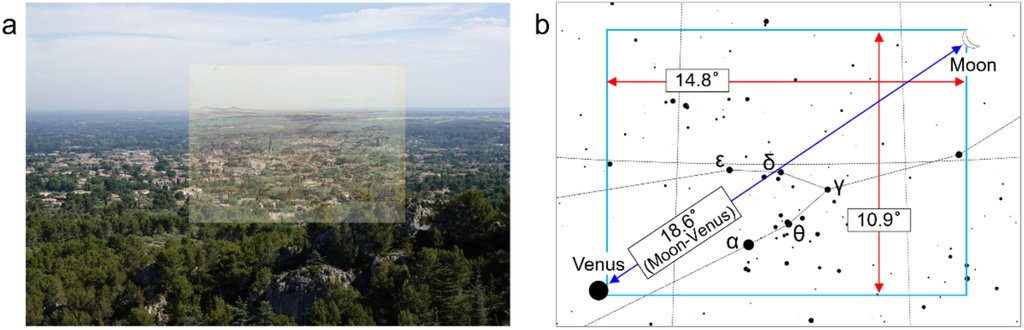
Left, a faint drawing registered onto a photograph of the valley below the ridge; right, a simulated star map with a narrow rectangular frame drawn across it and the Moon and Venus near opposite corners.
The narrow frame the authors recovered from Van Gogh's earlier drawing of the same ridge, applied in panel b to the simulated sky over Saint-Rémy at 3 a.m. on July 22, 1889. Figure Fig3 from Elijah Jeong-hyun Kim, Suna Kang, Jungwoo Song, Ho Jin (2026), "The actual sky of Van Gogh’s Starry Night: a multidisciplinary reconstruction", Scientific Reports — CC BY-NC-ND 4.0, resized

Among the June and July 1889 dawns on which the Moon stood above Venus, as in the painting, the authors report that both fall inside that frame on only three. On July 22 they were 18.6 degrees apart, nearly its full diagonal, with the Hyades at the center.

The Moon is also their case against June. On June 19, 1889, the dawn an earlier astronomical reading proposed, it was 63.10% lit, past half and far from the sharp crescent on the canvas. On July 22 it was 28.44% lit.

A second test compared five points in the painting's central star group with the five stars forming the V of the Hyades. The authors report that of the 120 ways to pair them, the cluster's real arrangement fits best, and that Van Gogh's own black-and-white copy of the painting reproduces its shape more accurately than the oil does.
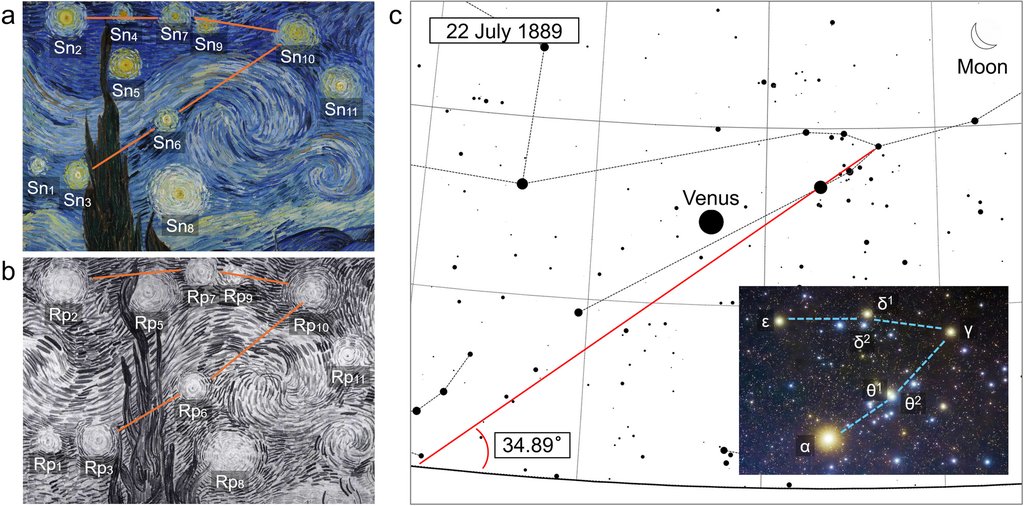
Three panels: the central star group in the painting, the same group in a black-and-white replica, and a simulation of the Hyades cluster, each with five points marked.
The five points matched in the shape test: the painting's central star group in panel a, Van Gogh's own replica in panel b, and the Hyades in the simulated sky in panel c. Figure Fig4 from Elijah Jeong-hyun Kim, Suna Kang, Jungwoo Song, Ho Jin (2026), "The actual sky of Van Gogh’s Starry Night: a multidisciplinary reconstruction", Scientific Reports — CC BY-NC-ND 4.0, resized

Kim and colleagues write that the painting did not invent a sky, but carried an observed one onto canvas through stylistic amplification. They stop short of naming a single night: impressions from several neighboring dawns may have been combined, they write, and July 22 is the center of a window from July 20 to 24.
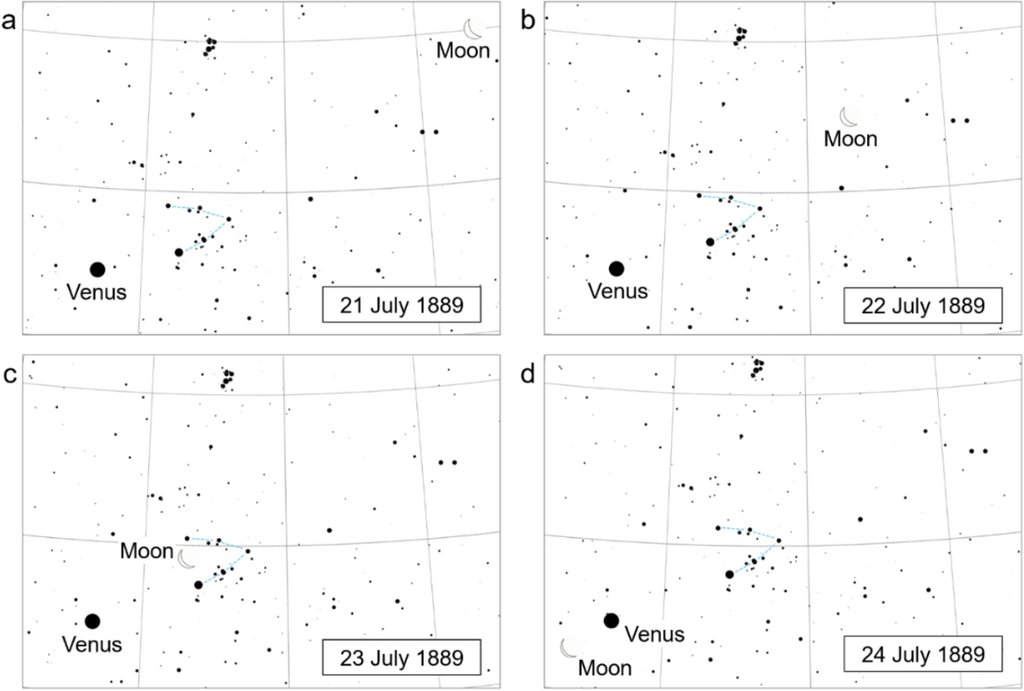
Four simulated views of the eastern sky showing the Moon and Venus closing together on four successive mornings.
Simulated positions of the Moon and Venus over Saint-Rémy at 3 a.m. on four successive mornings. The authors report a separation of 18.6 degrees on July 22, 1889, close to the diagonal of the recovered frame. Figure Fig7 from Elijah Jeong-hyun Kim, Suna Kang, Jungwoo Song, Ho Jin (2026), "The actual sky of Van Gogh’s Starry Night: a multidisciplinary reconstruction", Scientific Reports — CC BY-NC-ND 4.0, resized

The paper carries a competing-interest declaration: Kim founded and runs SLLAB, a Yongin company where two of his co-authors work, and it states that SLLAB may pursue commercial activities derived from the work.

Sources

Spot an error?

Spot an error?

Report an error

Spotted a mistake on this page? Tell us what's wrong and our editors will take a look.

What kind of problem?

Only if you'd like us to be able to follow up. We won't use it for anything else.

We correct mistakes openly. Select any text to flag it. Fixes are logged under our Corrections Policy.

Report an error

Reporting on

Van Gogh's Starry Night May Show a Real Dawn Sky From July 1889

What kind of problem?

Only if you'd like us to be able to follow up. We won't use it for anything else.

We read every report. Corrections are logged publicly.