Mercury Has a Radiation Belt After All, and the Solar Wind Can Switch It Off

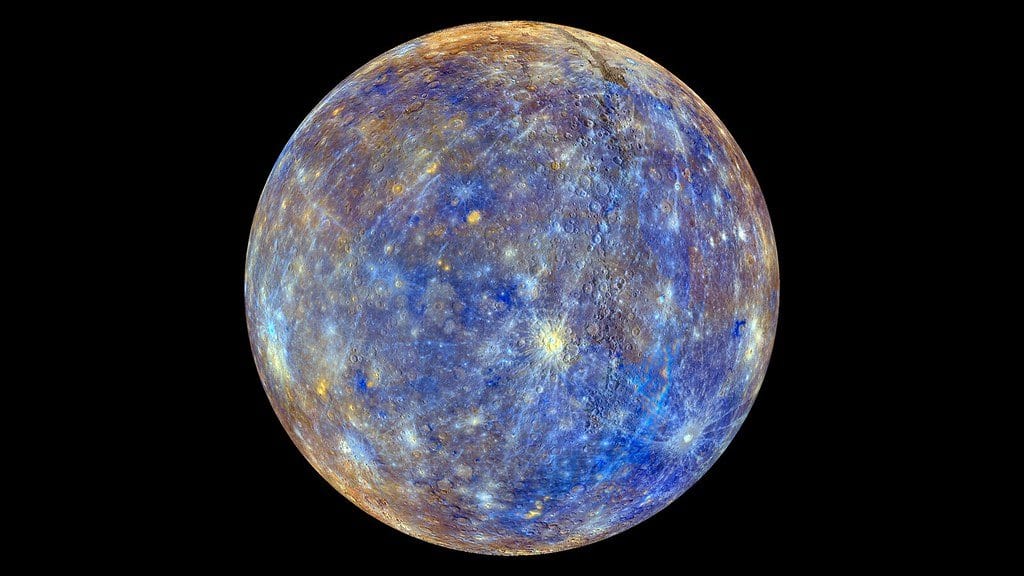
In March 1974, as Mariner 10 swept past Mercury for the first time, its instruments recorded something nobody had ordered: bursts of energetic electrons, arriving in gusts, around a planet that had no business holding on to anything. The natural reading at the time was that Mercury, like Earth, kept a reservoir of trapped particles wrapped around itself. Then MESSENGER arrived four decades later, spent four years in orbit, and could not find one. The tidy story fell apart, and whether the smallest planet in the solar system carries a radiation belt turned into one of those arguments that outlives the careers of the people who start it.
It now has an answer, and the answer came out of MESSENGER's own archive. Writing in Nature Astronomy, Jiutong Zhao, Ryan Dewey, Weijie Sun, James Slavin and five colleagues report a structured electron radiation belt at Mercury whose shape shifts with solar wind activity. The crucial thing to understand about the result is that no spacecraft flew through this belt and measured it. The team took MESSENGER's more sensitive indirect measurements of energetic electrons, ran them through new analysis techniques, and combined the output with particle simulations and theory. The paper appeared on 27 July.
Why anyone doubted it
A radiation belt is the simplest violent thing a planetary magnetic field can do. Charged particles caught in one spiral along the field lines, bounce back and forth between the poles, and drift slowly around the planet. Where the field is stable enough, they stay for months or years. Earth's Van Allen belts are the textbook case and a practical nuisance besides: mission planners route spacecraft around them, and satellite electronics are hardened to survive them. Most magnetised planets have belts of some kind. Jupiter's are ferocious.
Mercury looked like the exception, and for good reasons. Its magnetic field is roughly a hundredth the strength of Earth's, and the magnetosphere it inflates against the solar wind is correspondingly cramped, a bubble a few Mercury radii across where Earth's stretches to tens of Earth radii. Trapping needs room. An electron has to complete a full drift around the planet without being scraped off at the boundary or dumped into the ground, and Mercury offers almost no room, no atmosphere worth the name, and a surface that swallows whatever reaches it. MESSENGER's energetic particle measurements showed bursts rather than a reservoir, and the field settled into a consensus: no durable trapping here.
What the reanalysis found
The belt in the new work is not a static ring. The authors describe a structured population whose morphology varies with what the solar wind is doing, and the two states are strikingly different. Under weak forcing, the belt "can persist for several Earth days and, thus, seems to be quasi-permanent," as the paper puts it. That unit is worth pausing on. Several Earth days is an enormous span at Mercury, where a trapped electron circles the planet in a small fraction of the time the same trip takes at Earth. It is also far shorter than a single Mercury day, which runs to about 176 Earth days.
Then the wind picks up and the belt comes apart. The mechanism the team identify has a name: drift-orbit bifurcation. On the dayside, where the solar wind squashes the magnetosphere hardest, the field near the magnetic equator gets distorted enough that a drifting electron's path splits in two, one branch above the equator and one below, instead of a single orbit carrying it cleanly around the planet. Particles shunted onto the split paths lose the orderly bounce motion that kept them confined, and they are "rapidly lost." How rapidly, the study does not say; no loss timescale is quoted.
Two conclusions follow, and the authors state both flatly. The first is general: even compact magnetospheres can host radiation belts. That is a claim about planets and exoplanets everywhere, not only about this one. The second is that Mercury is unusually useful to physicists. The filling and draining of Earth's belts unfolds over weeks, which makes some of the underlying physics hard to isolate. At Mercury, driven hard and reset often, the same processes run fast enough to watch a full cycle. The paper calls the planet "a natural laboratory for radiation-belt physics usually inaccessible at Earth."
The independent piece of the puzzle
One earlier result makes the picture easier to accept. In 2023, the Mio orbiter riding with the ESA and JAXA BepiColombo mission detected whistler-mode chorus waves in Mercury's dawn sector during two flybys. Chorus is the wave mode that accelerates electrons to radiation-belt energies at Earth, and it also scatters them out again. Different spacecraft, different instrument, different dataset. The machinery for producing energetic electrons at Mercury was already known to be running. What nobody had shown was that any of them stayed put.
This is a single study, and it overturns a published consensus using data from the very spacecraft that produced the consensus. The measurement is indirect. The authors write that they set out "to discover" a structured belt, and they describe the question as one that "has been a subject of debate for decades"; they do not claim to have closed it. Neither should anyone else, on the strength of one reanalysis. Peer review in Nature Astronomy puts this on firmer ground than most of what crosses an astronomy desk in a given week, but the replication that matters here comes from a different instrument, not a second reader.
A test with a date on it
That instrument is nearly there. BepiColombo, launched in 2018 and pushed back by a thruster fault in 2024, reaches Mercury orbit in November 2026. Its two spacecraft separate on arrival, and one of them, the Mercury Magnetospheric Orbiter, was built to characterise exactly the particle and field environment Zhao and colleagues have reconstructed from a decade-old dataset. A belt that is quasi-permanent when the solar wind is calm and destroyed when it is not should be visible as something appearing and vanishing, on a schedule set by the Sun.
Mariner 10 got minutes at Mercury. MESSENGER got four years and came away doubting. BepiColombo arrives in November carrying instruments built for this exact question, and it will either find the belt under quiet solar wind conditions or it will not.
Sources
- Nature AstronomyPeer-reviewed