Webb Found Signs of Water Ice in All Five Debris Disks It Surveyed

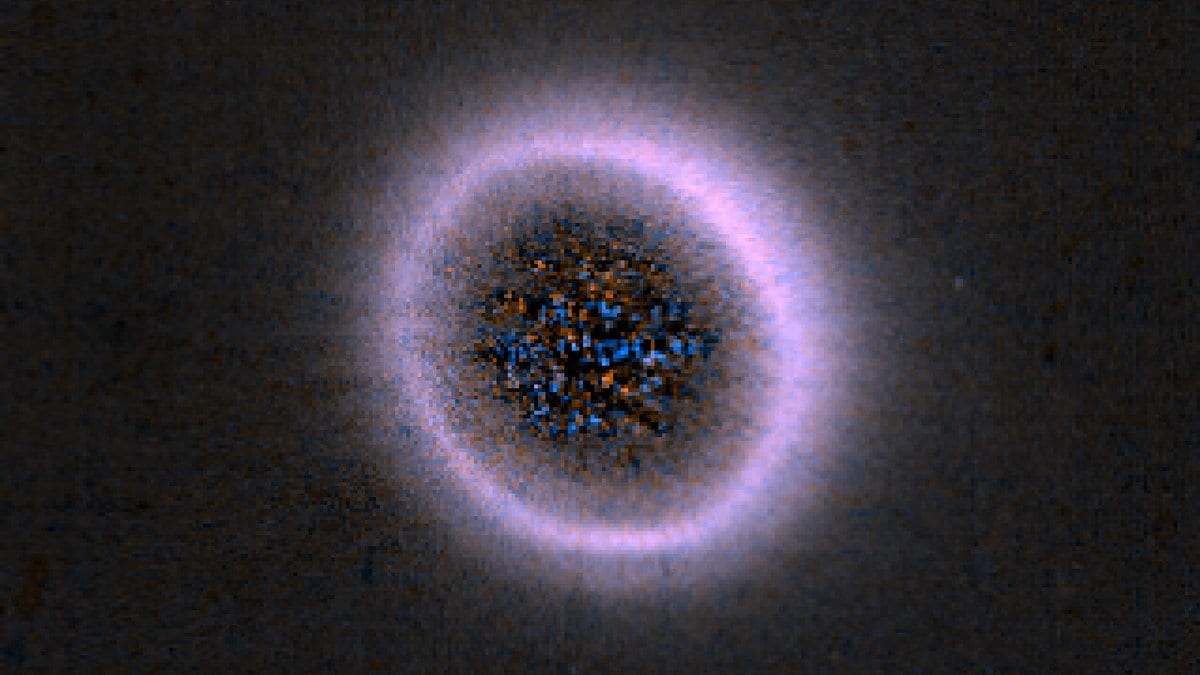
Point a telescope at a nearby star and, mostly, the star is all you get. The ring of rock, boulders and collision dust around it — the leftover scaffolding of planet building, the same kind of belt that circles our own Sun beyond Neptune — are buried in the glare. To see the ring you have to blot out the star first, and then work out what the ring is made of from the little starlight its grains bounce back.
That is what a team led by András Gáspár, of the Steward Observatory at the University of Arizona, has now done five times over. In a paper posted on Aug. 27 and accepted for publication in The Astrophysical Journal, Gáspár and colleagues report the results of guaranteed-time program 2780 on the James Webb Space Telescope: coronagraphic images of five debris disks, each taken through six filters. All five show evidence for water ice. In most of them the signature is strongest not in the bright ring itself but in the faint halo of fine grains drifting outward around it.
The five targets, HD 10647, HD 32297, HD 61005, HD 107146 and HD 181327, were picked for a reason: they are exceptionally bright at optical wavelengths, which is what makes a scattered-light measurement possible at all. The program is NIRCam's own: Marcia Rieke, the instrument's principal investigator, is among the co-authors.
Six filters are the trick. They run from about 1.8 to 4.4 microns, and one of them, F300M, is at three microns, where water ice absorbs. The others bracket it. Each pixel of each image therefore carries a crude six-point spectrum, and that turns a yes-or-no question about composition into a map: not just whether a system has ice, but where in the system it sits.
The authors are careful about the word. They write that the systems "show evidence for water ice", not that they detected it, and the individual results explain the caution. In HD 10647 there is no significant three-micron dip across the disk as a whole, though ice does appear at scattering angles above 20 degrees. In HD 32297 the dip is present, but at low significance.
This halo result gives the survey its shape. Around each ring there is an extended halo of very tiny grains, small enough that the star's radiation pushes them outward instead of gravity keeping them in place. Those halos are where the ice signature tends to be strongest, which is less strange than it sounds. Near-infrared observations measure light scattered off grain surfaces, and fine grains carry enormously more surface for their mass than boulders do, so a thin veil of small icy particles can dominate the signal over the far greater mass sitting in the ring.
In the two systems the team could analyze, the dust behaves in a familiar way. The scattering phase function (how much light a grain throws in which direction) resembles the behavior of dust in the Solar System, and in the halos the scattering runs strongly forward, which is what very small particles do. Two of five is not a survey-wide result and the authors say so, but it is an independent line of evidence that the halos really are built from the fine grains the ice argument needs them to be.
Two of the systems were also imaged with MIRI, Webb's mid-infrared instrument, and there the disks look more centrally concentrated than they do at shorter wavelengths. The team reads that as a hint of larger grains being dragged inward toward the star rather than pushed out.
One of the five had water ice on its record already. In 2025 a team led by Chen Xie used a different Webb instrument, the NIRSpec spectrograph, to pick the solid-state ice band out of the disk around HD 181327 directly, a result published in Nature and widely described as the first definitive detection of water ice in a debris disk beyond the Solar System. Gáspár was a co-author on that paper too. The new survey offers a faster, coarser measurement agreeing with the careful one on the single star where the careful one exists.
A spectrum tells you what a disk contains, precisely, in one place at a time. Six filters across a whole coronagraphic image give up precision and buy coverage: a full disk, halo included, and five systems in a single observing program. If the ice really does gather in the outer halos, that says something about where the volatile material in a finished planetary system ends up.
Sources
- arXivPreprint