The Wobble-Hunters' Method That Found the First Exoplanet Is Now Chasing Moons

In 1995, two Swiss astronomers watched a star named 51 Pegasi lurch toward and away from Earth on a four-day beat, and read in that tiny rhythm the presence of an unseen planet. The wobble was the giveaway: a body in orbit tugs its host back and forth, and the host's light shifts blue then red in step. Radial velocity, as the method is known, went on to find hundreds of worlds and earn a Nobel Prize.
Thirty years later, a team led by Kevin Hoy, with Alice Zurlo, Pablo A. Peña R., Jana Köhler and colleagues, has pointed the same trick at a much stranger target, and at a much smaller quarry. Instead of watching a star for the pull of a planet, they watched a brown dwarf for the pull of a moon. In a paper accepted at Nature and recently posted to the arXiv preprint server, they report evidence for a satellite orbiting the directly-imaged brown dwarf CD-35 2722 B, a candidate "exosatellite" of at least 0.74 Jupiter masses.
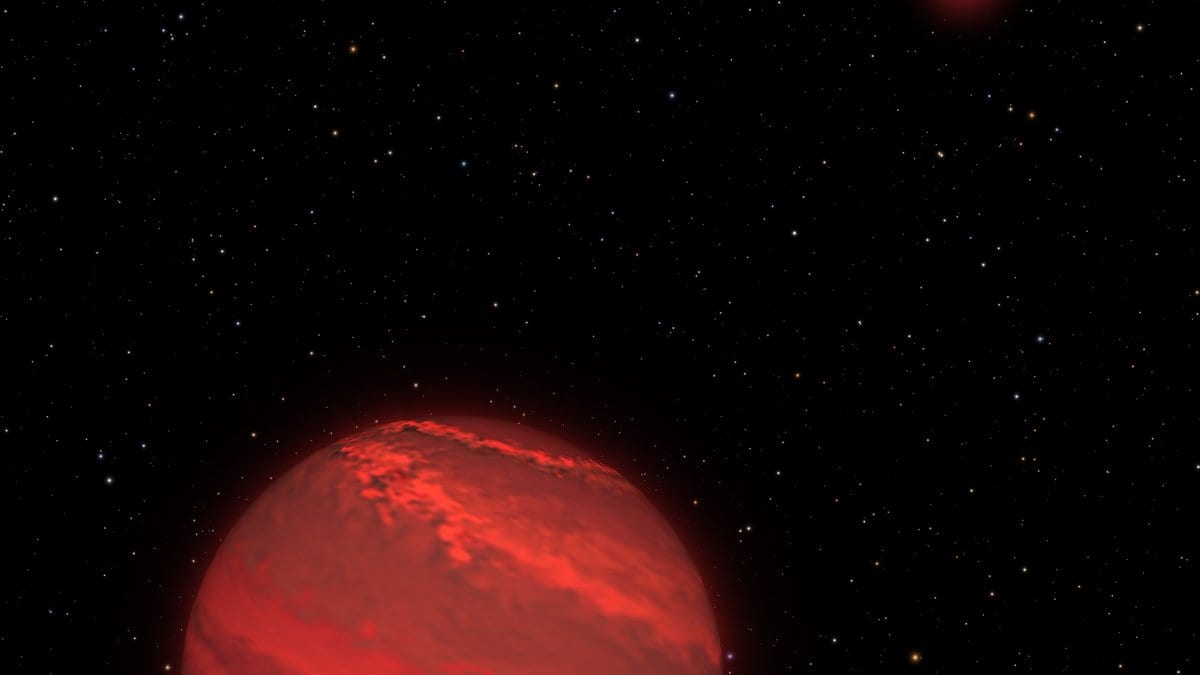
CD-35 2722 B is not a planet and not quite a star. It is a brown dwarf of roughly 31 Jupiter masses, orbiting a red-dwarf star about 70 light-years away, and it is one of the rare substellar bodies that telescopes can photograph directly rather than infer. That directness is what makes it a workable laboratory. Because the object can be isolated in an image, its own light can be fed into a spectrograph and watched for the same telltale shimmy that betrays a companion.
Reading a moon in the light of a not-quite-star
The instrument doing the reading is CRIRES+, a high-resolution infrared spectrograph on the European Southern Observatory's Very Large Telescope in Chile. Over a series of observations, the team measured the brown dwarf's radial velocity (its motion toward and away from us) with enough precision to catch a periodic signal riding on top of it. The best explanation for that signal, they argue, is a body of minimum mass 0.743 Jupiter masses circling CD-35 2722 B every 169 days.
There is a hint of a second one, too. The data suggest a smaller companion of about 0.277 Jupiter masses on an 87-day orbit. Two periods in that ratio (169 and 87 days) sit very near a 2:1 mean-motion resonance, meaning the inner body would complete two laps for every one of the outer. That is not an idle coincidence to an astronomer. The same locked cadence governs Jupiter's Galilean moons Io, Europa and Ganymede, whose orbits are tuned into a resonant chain. Finding an echo of that architecture around a body in another star system is the kind of detail that makes a result feel physically real rather than statistical.
The masses are worth pausing on. At three-quarters of Jupiter's mass, the primary candidate is not a moon in any Solar-System sense; it is heftier than most planets. Calling it a "satellite" is a statement about what it orbits, not about its size. A body that massive circling a 31-Jupiter-mass brown dwarf blurs the tidy categories of planet, moon and star, which is part of why the system is interesting: it is a scaled-down version of planet formation playing out around an object that never became a star.
Why "candidate" is the load-bearing word
Here the caution has to be stated plainly. This is not a confirmed exomoon. The authors themselves frame the satellites as candidates, and the version now circulating is the pre-peer-review manuscript submitted to Nature. The arXiv note explicitly asks readers to wait for the final published paper before drawing firm conclusions. A radial-velocity signal is an inference: it says something is tugging on the brown dwarf with a particular period, and an orbiting satellite is the best available explanation, but stellar or instrumental effects can masquerade as a periodic wobble, which is exactly what peer review exists to probe.
The novelty claim needs the same care. This appears to be the first time radial velocity has produced evidence of satellites around a directly-imaged substellar object, a genuine first for the method. But it is evidence, not proof, and the field has been burned before. The most famous exomoon candidates, flagged around distant transiting planets by the Kepler and Hubble telescopes, remain disputed years after their announcement. Extraordinary claims about moons beyond the Solar System have a habit of not surviving contact with more data.
A new door, if it stays open
The broader significance lies in the method rather than the single object. If radial velocity can be pushed down to the mass of a moon around a directly-imaged companion, then a whole population of substellar objects (the brown dwarfs and giant planets that telescopes can already photograph) becomes fair game for satellite hunting. That matters because moons are where a lot of the action is thought to be: they can host oceans, tides and, in principle, environments friendly to life. A method that can weigh them from Earth would turn a theoretical question about how satellites assemble around massive companions into something observable.
For now, the honest summary is a modest one. A team applied a thirty-year-old wobble-hunting technique to a new kind of target, saw a signal that looks like a moon, and saw a hint of a second moon in a resonance that recalls Jupiter's own. It is accepted at Nature, it is the first of its kind, and it is still a candidate. Whether it becomes the first confirmed exosatellite will be settled not by this study but by the scrutiny that comes next.