A Faint Colour in Old Cassini Data Hints at Organics on Enceladus, but Only Hints

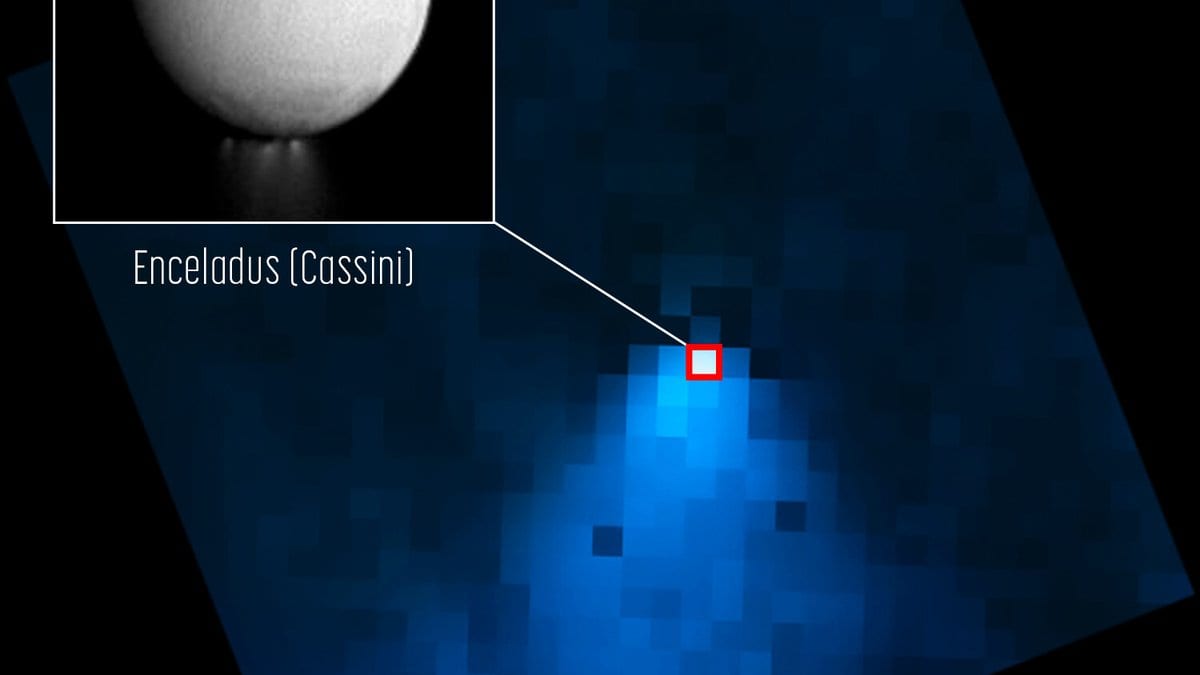
Enceladus keeps its most interesting chemistry hidden under an ice shell and vents a little of it into space. Geysers at the moon's south pole spray water ice, salts and gas from a subsurface ocean, and some of that spray escapes to form Saturn's diffuse E ring. So when Matthew Hedman and Shannon MacKenzie went back through data from NASA's Cassini mission, they were, in effect, sampling an alien ocean from a distance.
What they found is faint. Across visible wavelengths, the brightness of the plume and E-ring particles shifts slope around 0.5 microns. A comparable colour change has been seen on the surfaces of Saturn's rings and moons, where it has been attributed to either organic compounds or iron-bearing minerals. On that reading, the strength of the feature would be roughly consistent with the amount of organic material that Cassini's instruments measured directly when they flew through the plume years ago.
Here is the catch the authors themselves put front and centre. The same slope could arise with no special chemistry at all, simply from a deficit of sub-micron particles, the tiniest grains, in the material they looked at. Their paper is titled "Potential evidence," and they lean toward presenting the measurement as a diagnostic tool that future work could use to gauge plume composition rather than a detection to bank. A tentative hint of a second, weaker absorption band near 0.45 microns might eventually help settle which explanation wins, but it, too, is only a hint for now.
The work has been accepted for publication in the journal JGR: Planets. It has not yet appeared in final peer-reviewed form, and no independent team has reproduced the result. Enceladus already ranks among the Solar System's most promising places to look for the ingredients of life. That is exactly why a faint colour in decade-old data deserves to be read carefully, and slowly.
Sources
- arXivPreprint