Gas Enough for a Small Galaxy, and Not One Star in It

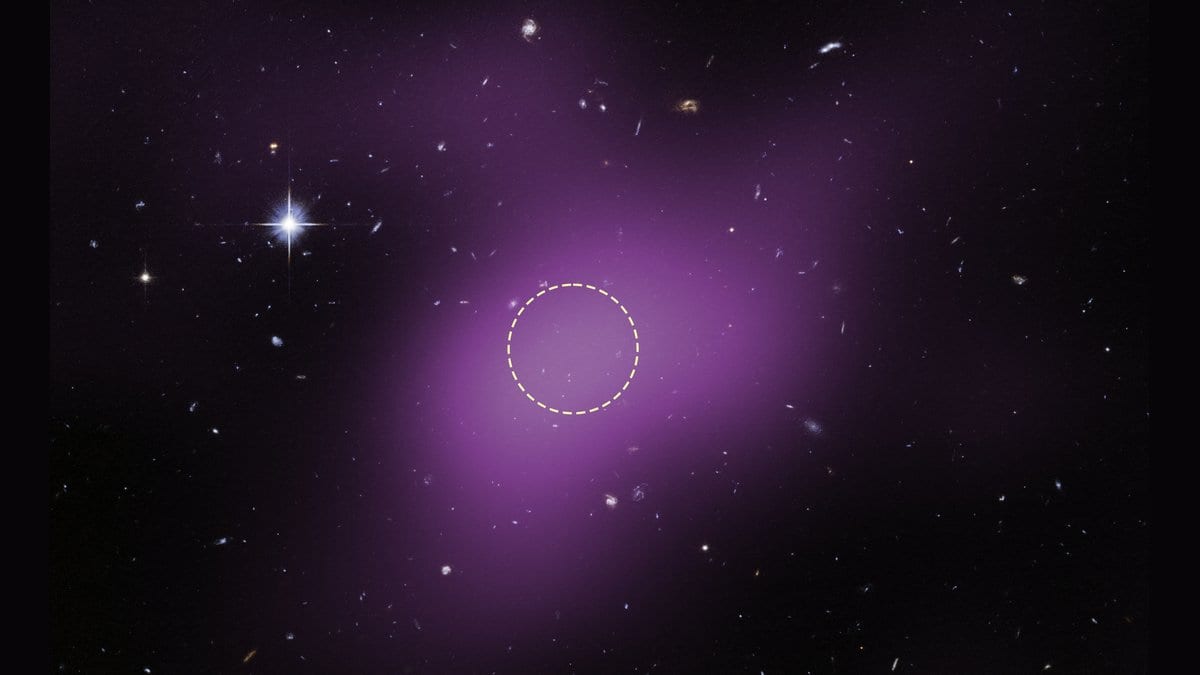
In June a camera on the Gran Telescopio Canarias stared for two nights at a patch of sky beside the spiral galaxy M94. Ignacio Trujillo, who led the observation from the Instituto de Astrofísica de Canarias, was looking for stars he half expected not to find. He did not find them, and that absence is the result.
The target's name sounds like a joke; its description does not. Cloud-9 is a compact, almost spherical knot of neutral hydrogen roughly 15 million light-years away, discovered by China's FAST radio dish and confirmed by the Green Bank Telescope and the Very Large Array. It holds about a million suns' worth of gas. To keep that gas from dispersing, it needs something like five billion solar masses of dark matter around it, and, as far as anyone can tell, it contains not one star.
That combination is why anyone bothers with it. Standard cosmology predicts a large population of small dark-matter halos that captured gas and never turned any of it into stars, because the ultraviolet glow left over from the early universe kept that gas too warm to collapse. Astronomers call them reionization-limited hydrogen clouds, and Cloud-9 is the best candidate anyone has found.
Ruling out a faint stellar population means looking very deep. The June images reach a surface-brightness limit of 31.4 magnitudes per square arcsecond in green light (a measure of the faintest diffuse glow that can be pulled out of the sky background), about ten times fainter than previous deep imaging of the region could register. Across the middle of the cloud, nothing appears. The frame is not perfectly clean: scattered light from a bright star just outside the field brightens the lower-left corner, and the wide dithering pattern leaves the edges noisier. The center, where Cloud-9 sits, is blank.
From that limit follows a ceiling on how much starlight could be hiding beneath it. Assuming the hardest population to see (old stars, poor in heavy elements), the total stellar mass in that region comes to no more than about 16,000 times the mass of the Sun. The figure is conditional on that assumption; a younger or more metal-rich population would shine more brightly for its mass and be easier to exclude. Set against the hydrogen in the same cloud, a stellar component that small is a rounding error.
The note reporting it went online on Aug. 26 in Research Notes of the AAS, which the American Astronomical Society describes as "non-peer reviewed" and "moderated but not edited," built to put work in progress on the record within days of acceptance. This one was accepted three days after it was submitted. The method is routine ultra-deep photometry and the arithmetic is public, but no referee read it.
That matters for how the number is read. It is the strongest constraint on Cloud-9's stellar mass yet derived from integrated light, and it is not the strongest constraint that exists. The note places its own figure between two others: about 130,000 solar masses from DESI Legacy Survey imaging, and about 3,200 from deep Hubble exposures in which individual stars were counted one by one. The Hubble bound is the tighter of the two. What the new work adds is independence: a second route to the same verdict, reading the diffuse glow of a population instead of resolving its members.
The note also picks a quiet fight with that tighter number. Counting stars against a limit requires a comparison object, and the Hubble analysis used Leo T, a nearby dwarf that is compact for its brightness. Local Group dwarfs of similar luminosity can be four or five times larger, spreading the same light over more sky and sinking further into the background. If Cloud-9's hypothetical stars were spread out like those, Trujillo and colleagues argue, the Hubble limit is looser than it looks. That is their reading of a peer-reviewed result, not a settled correction to it.
Trujillo put the emphasis on the blankness rather than the number. "Most objects in the universe leave some trace of light. Cloud-9 does not," he told Space.com. "That silence is, in its own way, the most compelling result we could have obtained."
Nobody involved is calling the case closed. Starless hydrogen clouds have been explained before as tidal debris, as fast-moving clouds in a galaxy's halo, or as structures too short-lived to matter. The note lists all of them. Trujillo has said that deeper space-based imaging would be "particularly valuable because resolving individual stars avoids many of the problems associated with diffuse-light measurements." For now Cloud-9 is what it has been since the radio survey turned it up: a candidate that keeps surviving harder tests.