Where a Nuclear Blast Hits a Lumpy Asteroid Changes How Far It Moves

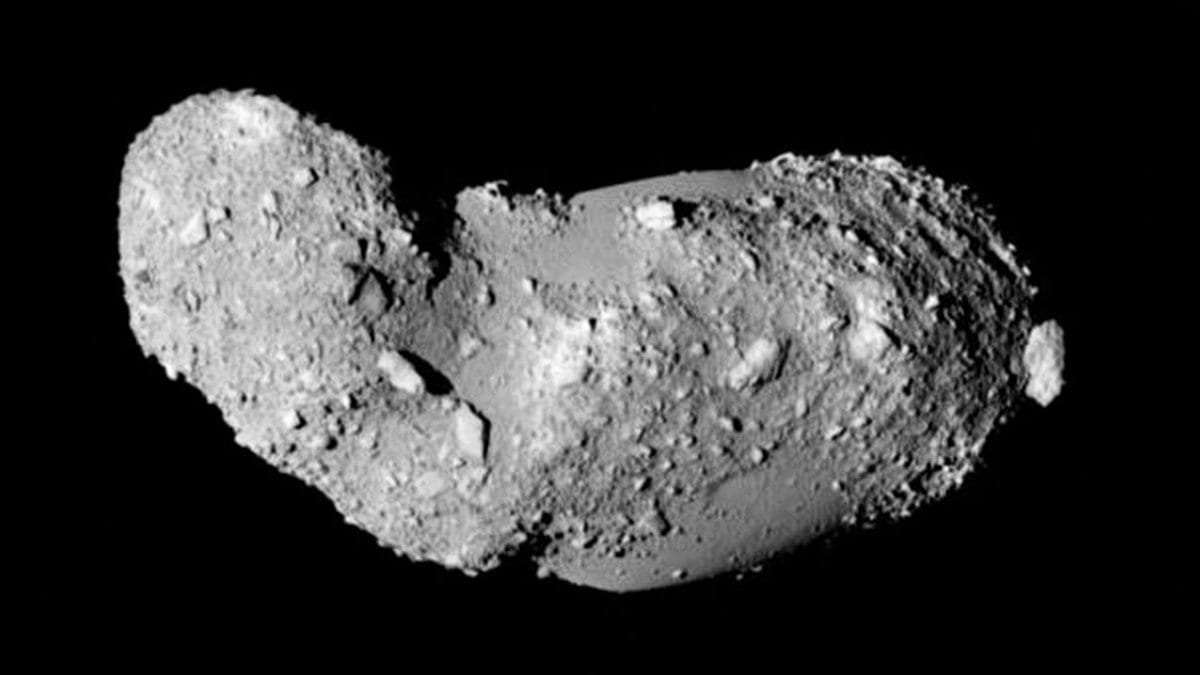
The hard part of pushing an asteroid off a collision course is not the explosion. It is the rock. Deflection calculations have mostly been run on spheres, because a sphere is computationally inexpensive and a real asteroid is not. A new set of simulations has repeated the calculation using the measured shapes of three asteroids, and the shapes changed the answer: hit one side and the rock moves, hit another and much of the push goes into spin.
The scenario is a stand-off burst: a nuclear device set off at a distance from the asteroid, so that its X-ray pulse rather than any contact does the work. The pulse vaporizes a thin layer of surface rock, the vapor blows off, and the asteroid recoils. On a sphere, that recoil points neatly through the center of mass. On a lopsided body, it does not. The study was published Oct. 24, in Icarus, and Sandia National Laboratories announced it Nov. 3.
The authors give the size of that effect one asteroid at a time rather than as a single number. The orientation of the body at the time of intercept, they write, "can increase the deflection velocity by up to nearly 2x for Bennu, 4x for Itokawa, and 5x for Golevka, compared to the minimum response for each body." The comparator carries the finding: each figure is one rock against its own worst aim, not against a sphere and not against another asteroid. The spread is the point: there is no single multiplier, because the penalty for a bad shot is a property of the individual body, and effectiveness, as the paper puts it, "hinges critically on surface topography, which is often unknown."
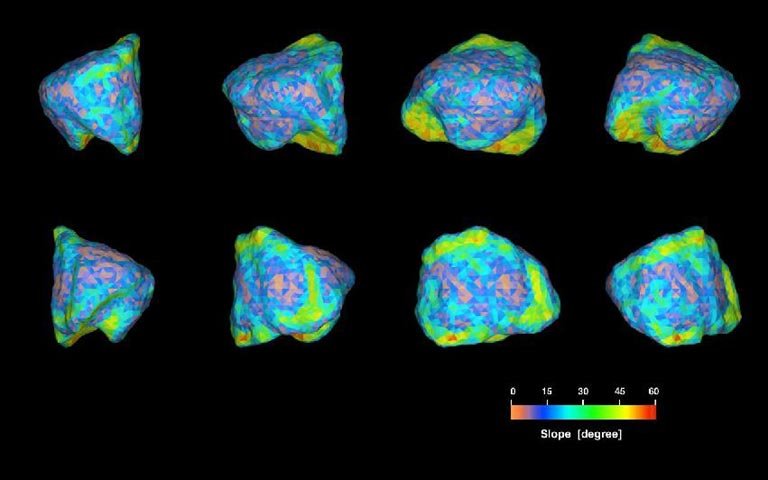
"We expected aim to matter," said Nathan Moore, a physicist at Sandia National Laboratories who led the research. The laboratory's announcement leads with a different number, from a single simulation: the deflection velocity came out at 3.9 millimeters per second from one angle and 0.8 millimeters per second from another, a nearly fivefold difference. That is one case out of the sweep, and the announcement does not say which of the three asteroids it was.
Spin was more sensitive still. For a different asteroid, the laboratory says, the change in rotational speed after deflection varied by a factor of 17. Which body that was is not stated, and Sandia is explicit that it is not the one behind the linear-speed figures.
What made a fully three-dimensional version affordable was combining two existing Sandia codes. ALEGRA, normally used for fast, high-energy experiments such as magnetically imploding wires, handles the radiation-hydrodynamics of the initial heating and vapor generation; SPARTA, a direct simulation Monte Carlo code for modeling rarefied gases, such as the gas that causes drag on a satellite, follows the vapor as it expands and calculates the pressure it exerts across the asteroid's surface. "Our new algorithm is over 1,600 times faster, which was critical to this breakthrough," Moore said of his team's method. The output includes a map of surface pressure, from which the team calculates the asteroid's deflection and change in rotation. The researchers also use the pressure fields to examine the ejection of fractured rock and loose surface material.
Sandia describes the result as the most accurate asteroid deflection model to date and the most detailed look yet at the problem. The paper's own claim is narrower. The approach, the authors write, "improves on earlier methods by accounting for the actual topography of the asteroid fully in three dimensions without unacceptably increasing computational cost or reducing accuracy." Moore's account of what came before is that most models used spheres because they made the math easier.
Any real use of this would need the rock's shape accurately mapped from all sides before the shot, and that is where the paper ends up. Mapping the pressure fields onto a loosely compacted, Itokawa-like assembly of boulders, the authors find that the solid and rubble ejecta are also highly asymmetric, which they take as further reason to map hazardous near-Earth objects properly. Sandia's own list of caveats begins in the same place: the simulation needs reasonably accurate shape data from all sides, and there may be no time to get it.
The speeds in play are small, which is ordinary: deflection works on long lead times rather than large pushes. When NASA's DART spacecraft hit the moonlet Dimorphos in 2022, the measured change in its orbital speed was 2.70 millimeters per second.
All of it is simulation. No asteroid has been moved by X-rays, and the laboratory experiment underlying this line of research belongs to the same group: in 2024, Moore and colleagues reported in Nature Physics that a pulse from Sandia's Z machine had deflected a small sample of asteroid-analogue material in the laboratory. The physics the new model scales up has therefore not been independently validated against measurements from another laboratory. Sandia is a Department of Energy national security laboratory, and the study was funded through its Laboratory Directed Research and Development program.
The model also does not yet settle the thing a planner would most want settled. "Right now, our computer model only considers breakup of rocks on the surface. We can't predict breakup of the entire asteroid body accurately yet," Moore said. Shattering a dangerous asteroid into several smaller but still dangerous pieces is the outcome this approach is meant to avoid. What the work offers is narrower and still useful: given a three-dimensional shape model, it says which side to aim at. "Pick the right side and you win. Guess wrong and it could be a bad day," Moore said.
Sources
- IcarusPeer-reviewed
- newsreleases.sandia.gov
- Nature Physics
- Nature