A Comet Older Than the Sun: 3I/ATLAS's Atoms Point to an Ancient Star

Every atom carries a kind of birth certificate. The exact mix of heavier and lighter versions of an element, its isotopes, is set by where and when that material was forged, and it barely changes over billions of years. Read those ratios carefully and you can, in principle, work out something about the cradle a lump of matter came from, even if that cradle vanished long ago.
Astronomers have just read the birth certificate of a visitor from another star system, and it does not look like anything from home.
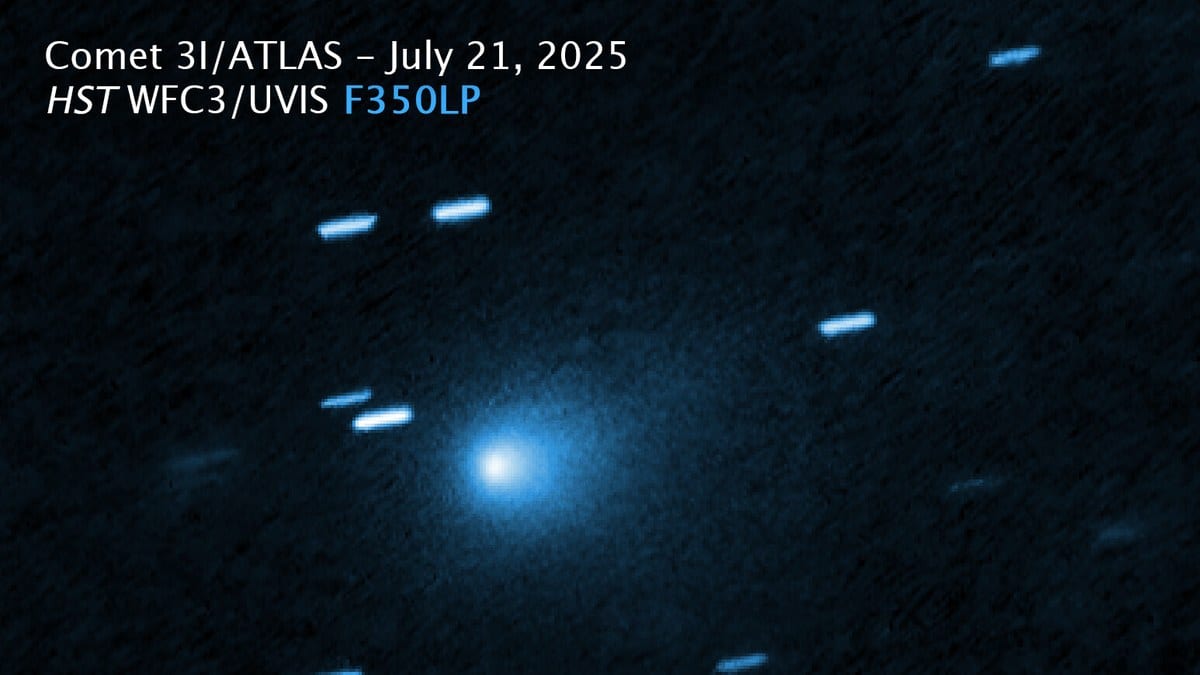
The object is 3I/ATLAS, only the third interstellar body ever caught crossing the Solar System, after 'Oumuamua in 2017 and comet Borisov in 2019. As it swung through on its one-way passage, a team led by Cyrielle Opitom of the University of Edinburgh trained the UVES spectrograph on ESO's Very Large Telescope in Chile at the faint glow of gas boiling off its surface. In the light of cyanide (CN) molecules in that coma, they measured the ratios of carbon and nitrogen isotopes, the first such measurement ever made for a comet born around another star. The work is now published in Nature Astronomy.
What the atoms say
The two numbers that matter are the ratio of carbon-12 to carbon-13, and of nitrogen-14 to nitrogen-15. In 3I/ATLAS, the team found a ¹²C/¹³C ratio of about 147 and a ¹⁴N/¹⁵N ratio of about 343.
The carbon value sits only marginally above what is typically seen in Solar System comets. The nitrogen value is the eye-catcher: comets from our own system usually cluster around 150, so a ratio near 343 is strikingly high. It resembles instead the nitrogen found in cold interstellar clouds and pre-stellar cores, the frigid, dark stages of gas just before a star ignites.
That points somewhere specific. As the ESO announcement puts it, the signature is consistent with 3I/ATLAS having formed in the outer disk of an old, low-metallicity star, one born when the Milky Way was younger and had been seeded with fewer of the heavy elements that later generations of stars, including the Sun, inherited. By that reading, the comet could be more than twice the age of the Solar System, a chunk of ice and dust that has been drifting between the stars since long before the Sun existed.
How firmly to hold it
This is a genuinely rare kind of measurement, and it is worth being honest about how tight it is. The uncertainties are large. The carbon ratio of 147 carries an error range of roughly +87 and -40; the nitrogen ratio of 343 spans from a little over 200 to nearly 800 at the edges of its error bars. Interstellar objects are faint and fast, and there is only so much light to work with before they recede back into the dark. The high nitrogen ratio is a real and interesting signal, but the specific origin story, an old, metal-poor parent star, is an inference drawn from it, not something the spectrograph read off directly.
That caveat does not undercut the result so much as frame it. What Opitom and colleagues have demonstrated is that this measurement can be made at all, that a passing interstellar comet will hold still long enough, chemically speaking, to give up isotope ratios. That is a capability, not just a data point.
Why isotopes are the right tool
Bulk chemistry, which molecules a comet carries, tells you something, but it is easily reshuffled by heat and radiation. Isotope ratios are far more stubborn. The balance of nitrogen-14 to nitrogen-15, in particular, is sensitive to the temperature at which molecules first formed: the colder and more shielded the environment, the more the heavier isotope tends to concentrate. So an unusually high or low nitrogen ratio is close to a thermometer for a comet's birthplace, one that still works billions of years and light-years later.
For objects from our own Solar System, astronomers have built up these measurements over decades and use them to reconstruct conditions in the disk that made the planets. Doing the same for an interstellar comet extends that method across the galaxy. It turns 3I/ATLAS from a curiosity, a rock that happened to pass through, into a test of whether planet formation elsewhere ran on the same chemistry as it did here. On this first data point, the answer is: not quite.
The longer trail
One note for readers following the story: the science here is not brand new to specialists. The core result first appeared as a preprint on arXiv in early March 2026, shortly after the observations, and was widely discussed at the time. What changed is that it has now cleared peer review at Nature Astronomy, the stage at which independent referees have scrutinized the analysis and the journal has put its name to it. For an isotope measurement with wide error bars and a big claim attached, that validation is the substantive development, and the origin angle, a comet older than the Sun, is what makes it worth revisiting.
Three interstellar visitors in less than a decade suggest such objects are common, and that future ones will be caught earlier and studied harder. Each is a free sample from another planetary system, delivered to a telescope's doorstep. 3I/ATLAS is the first whose atoms we have learned to read. It will not be the last.
Sources
- Nature AstronomyPeer-reviewed
- www.eso.org
- arXivPreprint