Watching an Interstellar Comet Breathe: 3I/ATLAS Shifts From CO₂ to Water at the Sun

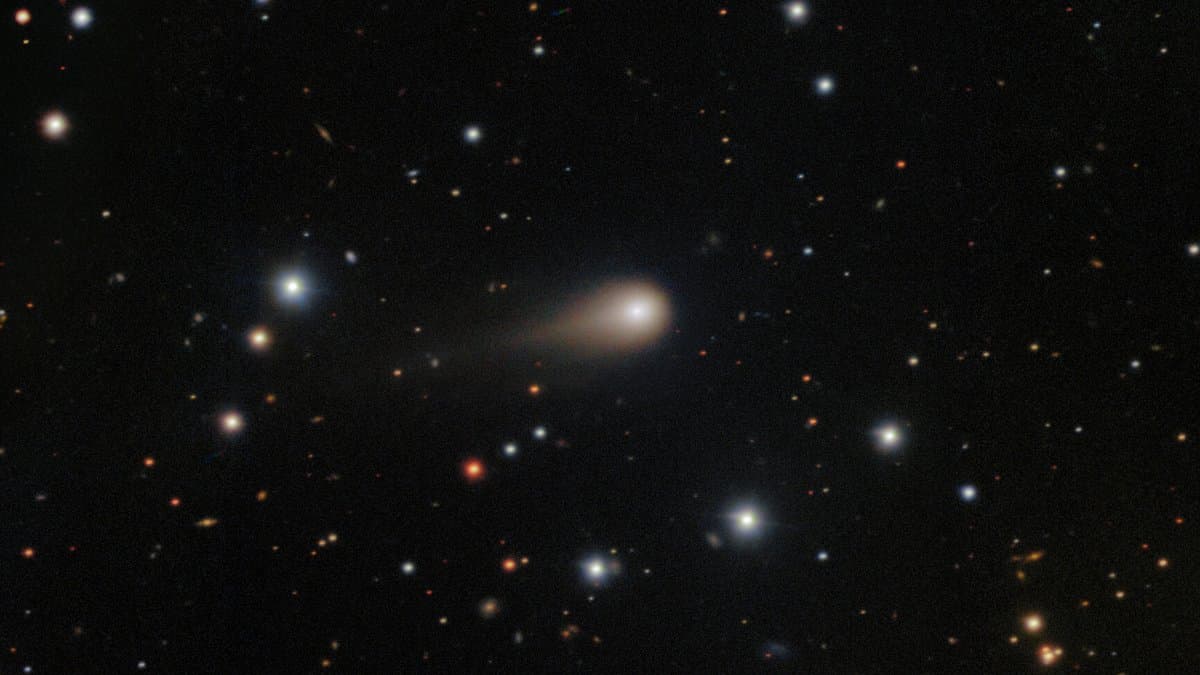
For most of its life, an interstellar comet is a frozen relic drifting between the stars, its ices locked solid in the cold. Then it falls toward a sun that isn't its own and starts to breathe. Astronomers just watched that happen to 3I/ATLAS.
Over 23 separate nights, a team led by Baltasar Luco pointed the Very Large Telescope's ESPRESSO spectrograph at the comet as it swung through its closest approach to the Sun. ESPRESSO was built to hunt for Earth-like planets by splitting starlight into exquisitely fine detail. Here that same precision resolved the faint glow of the comet's gas coma line by line, night after night, from heliocentric distances of roughly 2.4 astronomical units inward.
What the record shows is a comet changing its exhalations as it warms. Early on, the coma looked carbon-dioxide-rich. Nearer perihelion, reached on Oct. 29, 2025, at about 1.36 au from the Sun, it turned progressively water-dominated, with the carbon-dioxide-to-water proxy climbing across the run. That ordered handoff is what you would expect as more volatile ices sublimate first and water takes over closer in, and it matches what other instruments saw over the same passage. The full analysis appears in the third paper of the VLT's 3I/ATLAS series, accepted for publication in Astronomy & Astrophysics.
The high-resolution spectra also picked out neutral nickel and iron in the coma. Both metals had already been flagged in this comet before perihelion; here they were tracked on the way out, with their production rates measured. And the team released CometSpec, a public Python package for modelling this kind of fluorescent glow, so the work done for one interstellar visitor is ready for the next.
Sources
- PreprintarXiv