The Elements Earth and Mars Are Missing Best Fit Two Opposite Recipes

Line up the rocky part of Earth against the Sun, element for element, and most of the list matches. Then you reach the elements that boil off easily, the ones that need somewhere cool and quiet to condense, and Earth turns out to be badly short of them. Mars is short too, by a different amount. The shortfall is not a defect. It is a record of what each planet was assembled from, and a Copenhagen-led team has built a model to read it.
The yardstick is the Sun. The star and the planets condensed out of the same cloud, so the Sun's composition stands in for the raw material, and both rocky planets hold far less of the easily vaporized elements than that raw material did. The same shortfall turns up in rocky planets around other stars.
Two accounts of how a rocky planet gets built have been competing for years. In one, a young world grows by sweeping up a steady rain of millimeter-scale pebbles spiraling inward through the gas disk around the newborn Sun. In the other, it grows by collision, gathering up rocks the size of asteroids and small moons. The work is led by Haiyang S. Wang at the Center for Star and Planet Formation in Copenhagen, with nine colleagues at institutions in Denmark, Switzerland and the United States. Among them is Dante Lauretta, principal investigator of NASA's OSIRIS-REx asteroid sample mission. They assumed both routes operated, and set out to find in what proportion.
The two routes leave different chemistry behind because of heat. A protoplanet massive enough to hold on to disk gas wraps itself in a hot envelope, and a pebble falling through that envelope reaches temperatures high enough to vaporize its more volatile ingredients. Convection lifts the vapor. Large-scale flows reaching in from the surrounding disk then sweep it away for good. The most stubborn elements, aluminum and calcium and titanium, stay put, held as vapor over the magma ocean by a radiative layer that blocks the exit. So a planet built mainly from pebbles should end up depleted in a predictable pattern.
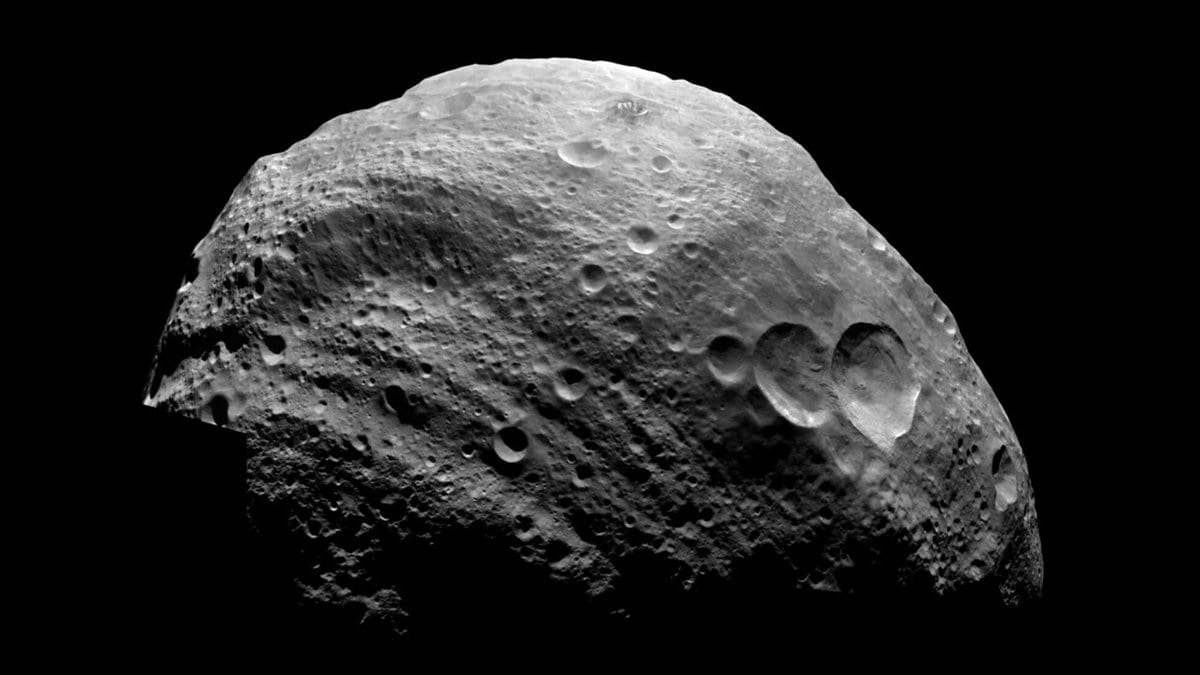
The other ingredient has a face. Vesta, the differentiated asteroid NASA's Dawn spacecraft orbited and mapped, is sampled here on Earth as a well-studied family of meteorites, and it is strongly depleted in elements that sublimate below about 1,200 K. The team takes it as the stand-in for a population of early planetesimals that cooked off their volatiles long before anything larger swept them up. Why Vesta lost them, whether to a hot disk or to its own magma ocean, is something nobody yet knows.
Fitting that two-ingredient model to each planet's measured bulk chemistry by Bayesian inference produced a lopsided answer twice, in opposite directions. Earth's silicate portion is best reproduced when at least about three-quarters of it comes from two protoplanets that grew by pebble accretion, one of them the proto-Earth and the other the impactor that struck it and made the Moon, with up to about a quarter added by Vesta-like planetesimals. Mars comes out close to the mirror image: 27 ± 5 percent pebble-accreted material and 73 ± 5 percent Vesta-like rubble. The analysis is set out in an author manuscript accepted for publication in Nature Astronomy and posted to arXiv.
Anders Johansen, the paper's second author, helped build the pebble-accretion account of the inner solar system, and a 2021 version of it had Mars growing chiefly from pebbles. His own group's fit now puts Mars at roughly a quarter. Whether the terrestrial planets formed by pebble accretion at all is still openly disputed.
The Earth figure is the softer of the two, and the paper says why. Its accretion model for Earth assumes that the Moon-forming giant impact cost the planet none of its moderately volatile elements, an assumption a good part of the field disputes, reading Earth's potassium and zinc isotopes as a sign that the collision did strip volatiles away. If that assumption fails, Earth's split moves with it. Substituting a different curve for how depleted the arriving planetesimals were, one that no known meteorite parent body actually shows, lifts the planetesimal share of Earth to about 40 percent; the authors present that curve as a sensitivity test rather than as a rival answer. They also state that volatile loss in collisions during the disk phase is still poorly understood.
What the work is really proposing is a method: that the elements a rocky planet failed to keep can be turned into an estimate of how it was put together. That matters most where nothing can be sampled. The bulk composition of a rocky exoplanet is inferred rather than measured, and a firm link between missing volatiles and formation history would give those inferences something to hold on to.
Sources
- arXivPreprint