Seismometers Built to Feel Earthquakes Are Now Catching Shooting Stars

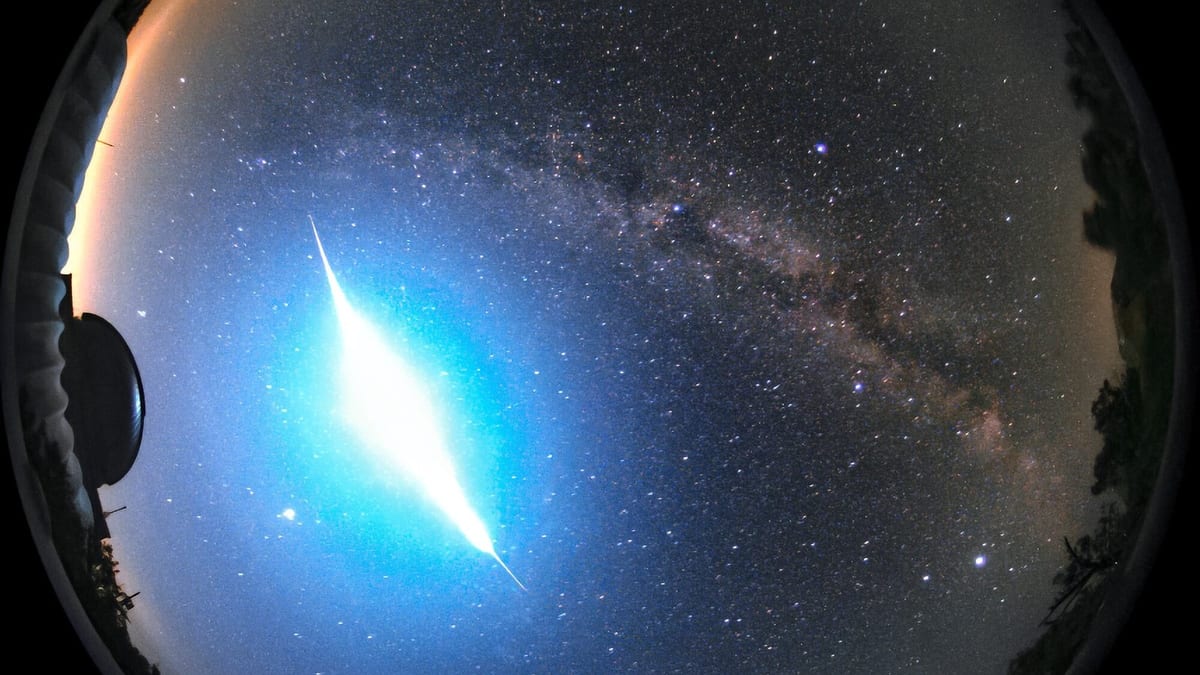
On a night in April 2025, something bright tore across the sky over the Adriatic. To the few people who looked up in time, it was a fireball: a fragment of interplanetary rock burning through the upper atmosphere in a handful of brilliant seconds. But the flash was only half the story. As the meteoroid's shockwave punched down through the air and pressed into the ground, it left a second, quieter signature that no eye could catch. Seismometers, the instruments engineers install to record earthquakes, twitched. Buried in their traces was a record of a visitor from space.
For decades, those twitches went mostly unread. A seismic network is tuned to the deep, slow groan of shifting faults, not to the sharp, high-frequency slap of an airburst overhead. The signals were there; the tools to find them, at scale, were not. Now a team at the Karlsruhe Institute of Technology has set out to change that, and in the process turned a global web of earthquake sensors into an accidental meteor-detection system.
Their work, published on 3 July 2026 in the journal Seismica, centers on a resource with an unwieldy name and a simple purpose: SMORD, the Seismo-acoustic Meteoroid Observation Recording Database. Dario Eickhoff, Runa Ostermeier, and Joachim Ritter, all of KIT's Geophysical Institute, cross-referenced existing meteoroid catalogs against decades of archived seismic recordings, then did the painstaking part by hand. Where a documented fireball lined up with a station that should have felt it, they went into the waveform and marked the exact moment the air-to-ground shock arrived.
The result is, by the authors' account, the first openly accessible dataset of its kind. SMORD version 1.0 holds 310 meteoroid events and 3,295 individually labeled seismic arrivals, drawn from stations spread around the world. Each onset was graded under a quality-assessment scheme built for these peculiar signals, which do not behave like the earthquake waves seismologists know well. An airburst is a source in the sky, not in the crust; the energy couples into the ground from above, producing a distinctive high-frequency pulse that a person can learn to recognize but that no standard earthquake-detection algorithm is looking for.
That is where the second half of the project comes in. A catalog of 3,295 examples is exactly the kind of thing a modern machine-learning model can learn from. The team trained one to do the recognizing automatically. They adapted PhaseNet, a deep-learning "phase picker" widely used in seismology to flag the arrival times of earthquake waves, and retrained it on the meteoroid signals using SeisBench, an open toolkit for this class of models. To keep the test honest, they split the data by station, so the model was judged on sensors it had never seen during training, and they augmented the examples to broaden what it could handle.
The retrained picker performs well. At its standard decision threshold it reaches roughly 91% precision and 94% recall, with an area-under-curve score of 0.89, meaning it catches the large majority of real meteoroid arrivals while raising relatively few false alarms. Its timing is sharper still: the median error between the model's pick and the human-marked onset is about two-hundredths of a second, and nine out of ten of its picks land within roughly a third of a second of the actual signal onset. For reconstructing where and when a fireball passed, that precision matters enormously, because the whole method rests on comparing arrival times across a scattered set of stations.
Which brings the story back to the Adriatic. As a demonstration, the team fed the April 2025 fireball through their automated pipeline (letting the model, rather than a human analyst, pick the onsets across the recording stations) and reconstructed the object's trajectory from the ground shaking alone. No camera network, no radar return, no eyewitness triangulation; just the pattern of a shockwave sweeping across a field of seismometers, decoded after the fact.
The appeal of that capability is easy to state. Optical fireball cameras are powerful, but they see nothing through cloud and nothing in daylight, and they only cover the patches of sky someone thought to point them at. Radar has its own blind spots. Seismic networks, by contrast, are already dense across much of the planet, already running around the clock, and already archiving everything they hear. If a bright meteoroid detonates over a region with decent station coverage, the data needed to reconstruct it may already exist. The challenge has been finding the signal and interpreting it quickly. An automated picker trained on a shared, open dataset tackles both parts of that problem at once.
The idea that a meteoroid's airburst can shake the ground and register on seismic instruments is itself long established; researchers have picked apart individual events this way before. What SMORD adds is scale and openness: a labeled corpus large enough to train and fairly test a detector, released for anyone to build on, rather than a one-off analysis locked to a single event.
That openness is arguably the quiet point of the whole exercise. Automated seismic pickers only became routine in earthquake monitoring once large labeled catalogs existed to train them; the meteoroid problem has lacked an equivalent starting line. By assembling one and handing it over, the KIT group is betting that other groups will extend the catalog, sharpen the model, and eventually fold meteoroid detection into the same networks that watch for earthquakes. Then the next fireball over the Adriatic, or anywhere else with a few good seismometers within earshot, could have its path traced from the ground up.
Sources
- seismica.library.mcgill.ca
- SeismicaPeer-reviewed