Do Galaxies Remember the Early Universe?

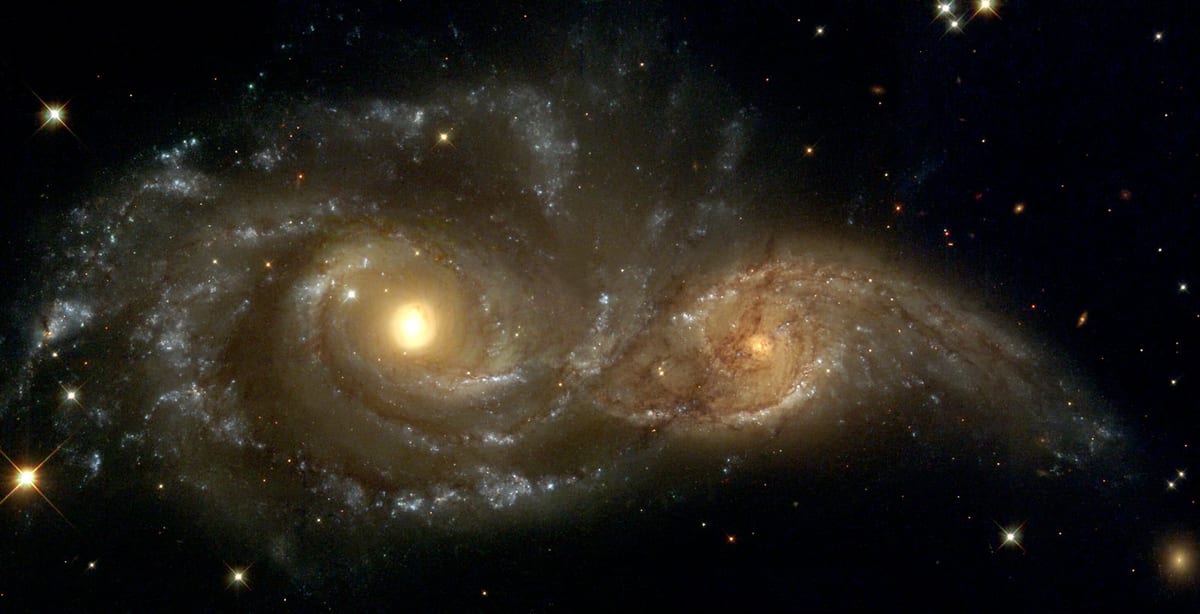
When we look at a galaxy today, do we see only the outcome of the last several billion years of its life, or does its rotation still carry information about the Universe as it was before the galaxy itself existed?
The young Universe had neither stellar disks nor spiral arms. Matter was distributed almost uniformly, but some regions were slightly denser than their surroundings. Even before galaxies appeared, neighboring concentrations of matter accelerated different parts of these regions by different amounts. This gravitational influence could impart angular momentum, a vector measure of rotational motion, to the matter that would eventually form galaxies. The direction of this vector indicates both the orientation of the rotation axis and the sense in which the matter rotates. Over time, these initial inhomogeneities grew into galaxies and larger structures.
Over billions of years, galaxies accumulated gas, formed stars, and merged with other galaxies. These processes changed the direction of their angular momentum. Have today's galaxies retained even a weak connection to their original rotation directions? In August 2026, Nature Astronomy published a study by Ming-Jie Sheng of Xiamen University and ten coauthors that presented observational evidence for such a connection. It was clearest in the ionized gas of massive elliptical galaxies that occupy the centers of their groups: the gas angular momentum directions projected onto the sky showed a statistical alignment with directions calculated from the reconstructed gravitational field of the early Universe.
The rotation of a single galaxy cannot reliably reveal its early history. The researchers therefore compared hundreds of galaxies. For each one, they paired the direction measured today with the calculated early direction and tested how often a similar result arose when such pairs were assembled at random. This prediction rests on a theory of how angular momentum arose in the early Universe.
What Set Matter Spinning Even Before Galaxies Were Born?
Imagine a region of matter slightly denser than its surroundings. At first, it is still expanding with the Universe, but its own gravity increasingly slows that expansion, setting the stage for eventual contraction. If the region were perfectly spherical and the surrounding mass were distributed in perfect symmetry, that gravitational pull would not generate rotation. In the real young Universe, the structures that would become galaxies had irregular shapes, and neighboring concentrations of matter broke the symmetry of their surroundings.
The gravitational pull of neighboring concentrations accelerated different parts of such a region differently. Depending on how mass was distributed within and around the protogalactic region, external forces could exert a torque. In everyday mechanics, a similar principle helps turn a door: a force applied to the handle, far from the hinges, changes the door's rotation. A protogalactic region had no hinges, but an external torque could change the motion of its matter around its common center of mass.
These spatial differences in gravitational acceleration are described by the tidal field. We are familiar with such differences from tides on Earth, although cosmology deals with much larger scales. When the principal axes of the mass distribution in a protogalactic region are misaligned with the principal directions of the external tidal field, a torque can arise. At an early stage, while the region was still expanding with the Universe, this torque gradually increased its angular momentum. As expansion gave way to contraction, the mechanism became less efficient. Even so, the acquired rotation direction could partly survive after the galaxy formed.
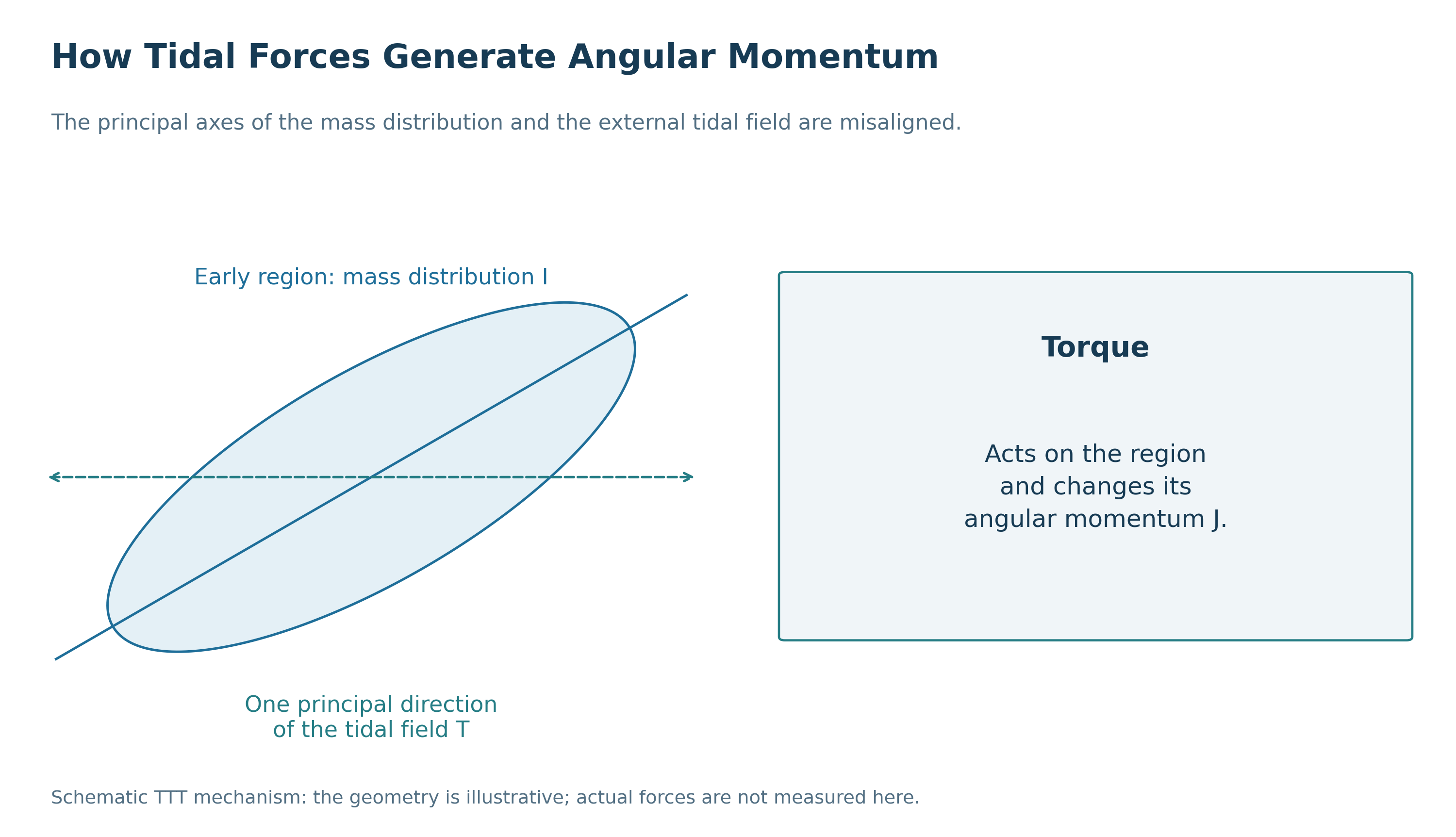
Physicists describe the mass distribution of a protogalactic region using the inertia tensor I, and spatial variations in gravitational acceleration using the tidal tensor T. The latter describes how acceleration changes from point to point along different directions. In the linear approximation, which applies to the early stages of structure growth, the angular momentum components are related to these quantities as follows:
Here J is the angular momentum vector and is the Levi-Civita symbol. In this expression, it gives the vector's direction from the relative orientation of the mass distribution and the tidal field. The indices denote spatial components, with summation over repeated indices. If the principal axes of the two tensors coincide, the contribution to angular momentum described by this formula is zero. Their misalignment is the basis of tidal-torque theory, or TTT.
This theory does not prescribe a common rotation direction for the entire Universe: each future galaxy occupied its own gravitational environment. The axes of different systems can therefore have different orientations. The descriptions “clockwise” and “counterclockwise” also depend on which side we view the system from. An image of a galaxy can show which way its spiral arms wind, but that alone does not unambiguously establish its rotation direction. Such an inference requires the assumption that the arms trail the motion of the matter. Doppler shifts of spectral lines provide more direct information about the motion of gas and stars along the line of sight.
Different components of the same galaxy can also rotate differently. In a spiral disk, gas and stars orbit at different distances from the center; in an elliptical system, stellar orbits are much more complex. A galaxy is surrounded by a halo, a massive structure composed mainly of dark matter. The angular momentum directions of the gas, stars, and halo need not coincide. The new study therefore analyzed gas and stars separately. For brevity, the authors refer to the angular momentum direction as “spin”; here, the term has nothing to do with the quantum spin of an individual particle.
Eighty Years Between an Idea and an Observation
As early as the 1949 Paris symposium, Fred Hoyle discussed how inhomogeneities in matter could give rise to galactic rotation; his contribution was published in 1951. In 1969, Jim Peebles calculated the growth of angular momentum in an expanding Universe. In 1970, Andrei Doroshkevich showed how nonspherical protogalactic regions begin to rotate even when the initial inhomogeneities are small. Later, Simon White refined the analytical description of early angular momentum growth and tested it against numerical simulations. The theory explained how matter acquires angular momentum at an early stage. What remained unclear was how much its direction changes as galaxies continue to grow.
A galaxy forms inside a dark matter halo. As the halo grows, the simple description of its early evolution ceases to apply: particle trajectories cross, gas cools, and the mass distribution becomes more complex. New matter enters the halo, the central galaxy absorbs satellites, and large systems sometimes merge. During these interactions, gas, stars, and dark matter exchange angular momentum, so the rotation direction of each component can change noticeably.
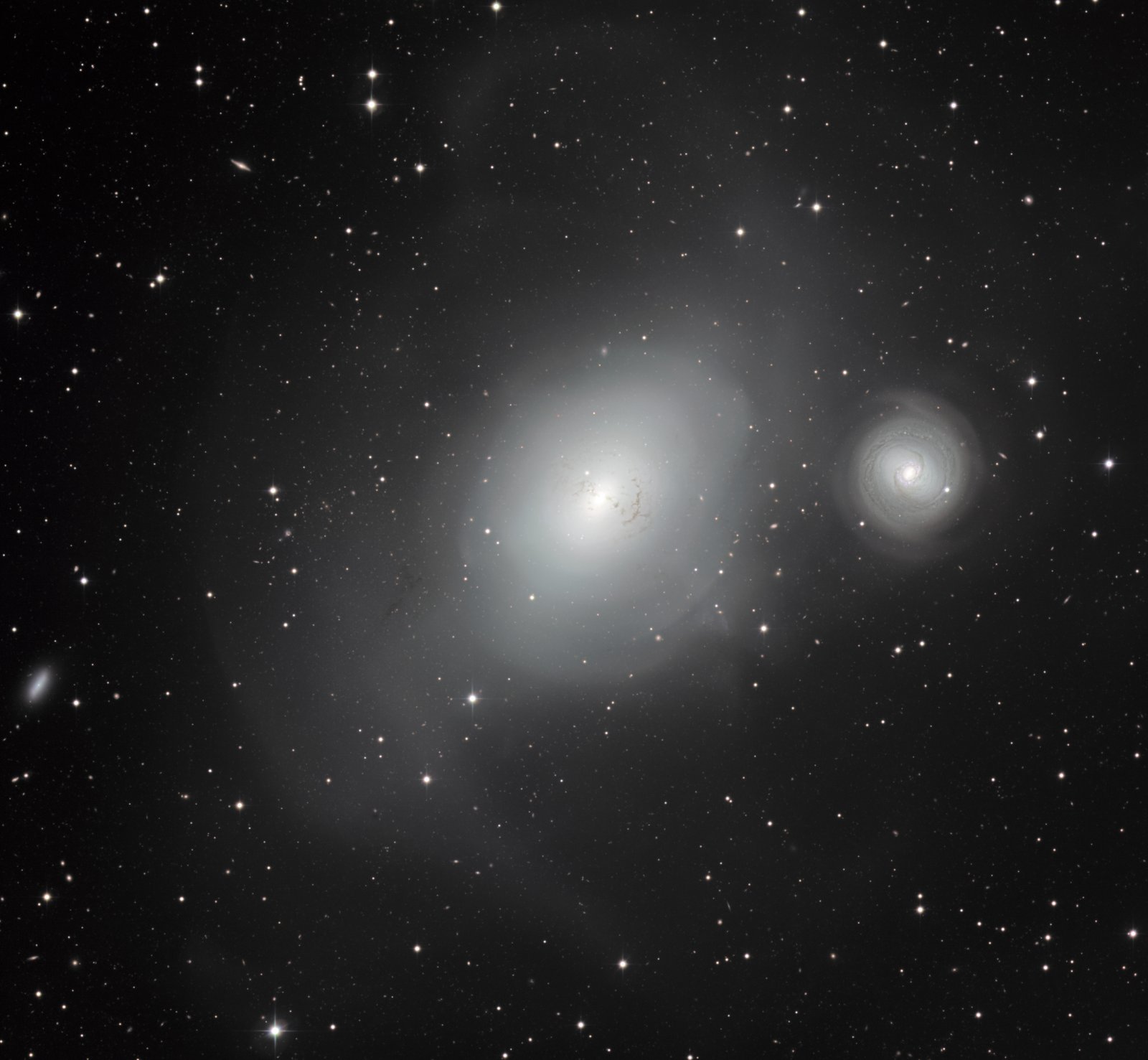
In 2002, Cristiano Porciani, Avishai Dekel, and Yehuda Hoffman compared tidal-torque theory's predictions with the results of an N-body simulation. By the present epoch, the predicted angular momentum direction of a dark matter halo differed from the simulated direction by about 50 degrees on average. This was an estimate for simulated halos, not an angle measured for the gas or stars of observed galaxies. Yet even at the halo level, the early prediction was too imprecise for present-day rotation to reliably reveal the history of an individual halo. In hydrodynamical models, which include gas and stars, evolution became even more complicated: gas cooling, star formation, and mergers along the filaments of the cosmic web further changed angular momentum directions.
Even with such large deviations for individual halos, a weak statistical connection could have survived. It can be detected if the present-day rotation directions of many galaxies are, on average, closer to the calculated early directions than they would be under random pairing. Such a test requires a separate prediction of the early direction for each observed system.
How to Map a Universe That No Longer Exists
Reconstruction begins with the present-day distribution of galaxies. Cosmologists use it to recover the initial distribution of matter by finding initial conditions for which a model of cosmic expansion and gravitational growth reproduces the structures observed today.
These data cannot yield a unique, exact picture of the past. Gravitational structures evolved nonlinearly, and the measurements contain uncertainties and trace only part of the matter. Researchers therefore consider possible initial distributions and test which ones, when evolved forward in time, agree better with the observations.
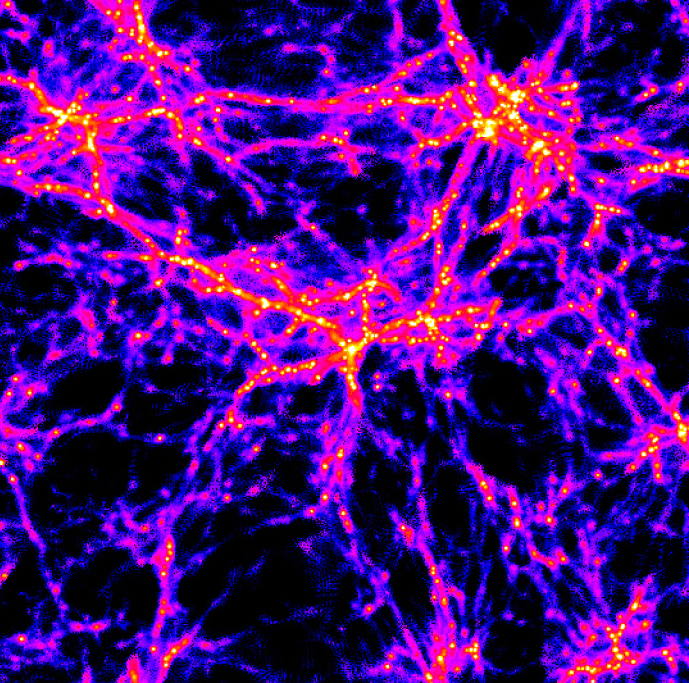
In 2013, Jens Jasche and Benjamin Wandelt developed a Bayesian approach to reconstructing the initial density field from present-day observations. The ELUCID project developed a different approach, using data from the Sloan Digital Sky Survey (SDSS). In 2016, the ELUCID team followed the evolution of the reconstructed dark matter distribution in a computer simulation with simulation particles, nearly 29 billion. Simulation particles are computational elements of the model. Each represents a certain amount of dark matter, and its motion is calculated under the influence of gravity. Initial conditions derived from the survey data tied the simulation to a specific observed volume. The large number of particles allowed the motion of matter to be modeled in greater detail.
For the 2026 study, Sheng and colleagues took the ELUCID initial conditions and ran a separate gravitational simulation using CUBE2. It contained such simulation particles (125 million). The ELUCID reconstruction supplied the early matter distribution, while the CUBE2 simulation showed how that matter moved toward the present epoch. The researchers used these displacements to estimate where the progenitors of the observed halos had been located.
The initial region of matter from which a halo formed is called its Lagrangian region, or proto-halo. In a simulation, one can select the particles belonging to a halo at a later epoch and trace their motion backward. For real halos, Sheng and colleagues used an approximate procedure: they averaged the inverse displacements of particles in the simulation and used the resulting field to estimate the initial position of each halo's center. This method estimated only the position of the proto-halo's center, not which individual particles belonged to it or where its boundaries lay. The authors then calculated the tidal field around the estimated initial center and predicted the early angular momentum direction.
The accuracy of this remapping matters. If the initial location of a halo's matter is estimated incorrectly, its observed rotation will be compared with the tidal field of a different initial region. Position errors have an especially strong effect on low-mass halos: their proto-halos occupied smaller volumes, so the same position error more severely distorts the correspondence between the present-day object and its early environment. Accurate reconstruction of the past is only part of the task, however. It is equally important to correctly determine the present-day rotation of the galaxies against which the prediction for the early Universe will be tested.
The Processing Error That Weakened an Earlier Result
One early attempt to connect present-day galactic rotation with the primordial tidal field had to be revised because of a data-processing error. A study by Pavel Motloch, Hao-Ran Yu, Ue-Li Pen, and Yuanbo Xie, published in December 2020, reported a tentative correlation between present-day galactic rotation and the reconstructed early field. After publication, an error was discovered in the way the calculations read velocity maps from the MaNGA and SAMI surveys: the program interchanged the rows and columns of the numerical arrays. Velocity values were assigned to the wrong points on the map, distorting the inferred orientation of rotation.
In March 2021, the authors published an official correction, thanking the colleagues who had identified the problem. The study also used data from Galaxy Zoo. Participants in that project examined images of spiral galaxies and recorded whether their arms wound clockwise or counterclockwise. This apparent winding allowed the researchers to infer the galaxies' rotation directions indirectly. That did not require velocity maps, so the error did not affect the Galaxy Zoo data.
After the correction, the estimated statistical significance of the overall result fell from about 3 to 2.7. The combined analysis of MaNGA and SAMI without the Galaxy Zoo data no longer gave a statistically significant result. The signal obtained using Galaxy Zoo, meanwhile, largely remained. The authors softened their conclusion about the strength of the evidence for the detected connection.
This case shows how important it is to determine galactic rotation directions correctly and to check the processing of observational data. In examining the new study, it is therefore important to follow both paths: how spectra yield the present-day rotation direction, and how the early direction is calculated for the same galaxy.
Two Directions for One Galaxy
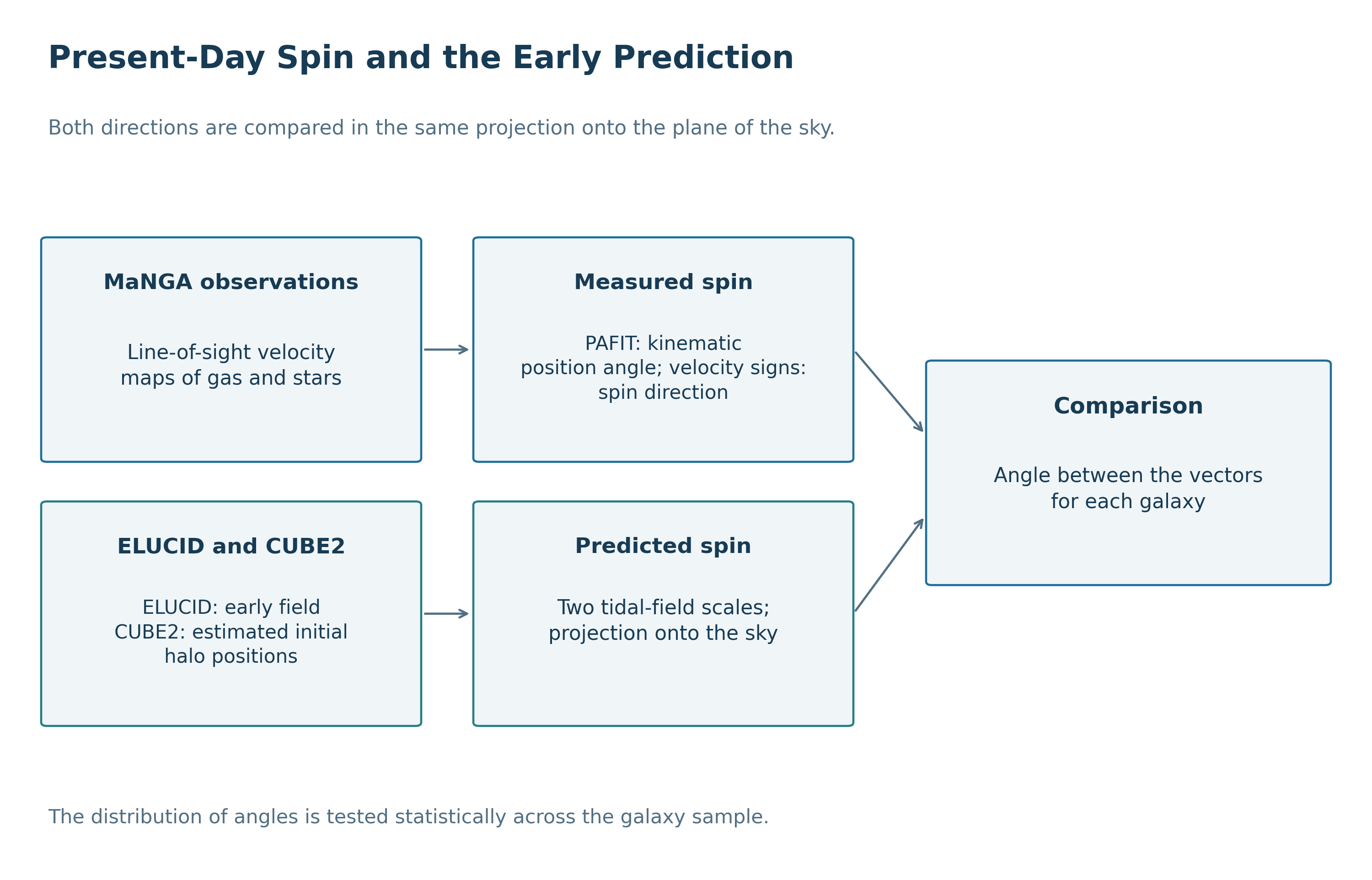
To measure the present-day rotation of gas and stars in galaxies, Sheng and colleagues used MaNGA data: spectra of the light reaching us from nearby galaxies. On the 2.5-meter telescope at Apache Point Observatory, bundles of optical fibers collected light from different parts of each galaxy and fed it to two BOSS spectrographs. This produced many spectra with known positions on the sky.
The Doppler shifts of spectral lines were used to determine the line-of-sight velocity, that is, the velocity component directed toward or away from the observer. The motion of ionized gas was traced using the hydrogen H emission line, while stellar motion was traced using absorption lines in the integrated stellar spectrum. Processing these measurements produced separate two-dimensional velocity maps for gas and stars.
The galaxy's systemic velocity, its line-of-sight motion as a whole, was subtracted from the measured line-of-sight velocities. In such a map, one side of a rotating system moves toward the observer and the other moves away, relative to the galaxy's center. Both sides may nevertheless be receding from Earth: one more slowly and the other more rapidly than the galaxy as a whole.
For each map, the PAFIT program determined the kinematic position angle: the orientation of the line along which rotation produces the largest line-of-sight speeds on either side of the center. The perpendicular to this line defined the projection of the rotation axis onto the plane of the sky. To choose one of the two opposite directions along that axis and obtain a spin vector, the authors took into account which side of the map was approaching and which was receding. In this way, they estimated gas and stellar spins separately.
The analysis included central galaxies, which are the main galaxies of their groups and are associated with the centers of the groups' common halos. The authors selected galaxies within the reconstructed ELUCID volume whose halo masses were at least solar masses. Galaxies were required to have kinematic position-angle uncertainties of no more than 20°. The gas-rotation analysis included only galaxies with sufficiently reliable H measurements. The results therefore cannot be extended without further testing to elliptical galaxies in which this emission is too weak.
The gas sample contained 781 elliptical and 815 spiral galaxies; reliable measurements of stellar motion were available for 635 ellipticals and 812 spirals. Because the quality of the gas and stellar maps was assessed separately, a galaxy could pass the selection criteria for gas-rotation measurements but not for stellar rotation, or vice versa.
Each galaxy was matched to its group in the catalog by Yang and colleagues used for the ELUCID reconstruction. The mass of the common halo was taken from estimates based on the luminosities of the group's galaxies and abundance matching between groups and halos of different masses. The reconstruction and simulation were then used to locate the initial center of the proto-halo and calculate the early spin direction. The calculated vector was projected onto the plane of the sky so that it could be compared with the observed vector in the same projection.
Matching galaxies to the initial positions of their groups' common halos proved important for detecting the connection. The authors also tested an alternative, using the reconstructed initial positions of individual galaxies, but the correlation was substantially weaker in that case. The initial regions of group halos occupy larger volumes, allowing the ELUCID reconstruction to locate them more reliably in the young Universe.
However, the early rotation direction could not be calculated directly from the original tidal-torque formula. The exact shape of a real proto-halo is unknown, so its inertia tensor cannot simply be inserted into the TTT formula. The authors used an approximation tested in simulations: they smoothed the reconstructed tidal field on two nearby scales, averaging over fine details in its structure. On the smaller scale, the field characterized the distribution of matter around the proto-halo and served as an approximate proxy for information about its shape. On the larger scale, it described the external tidal environment. The early spin was calculated from the misalignment of the principal directions of the two smoothed fields.
This prediction is not equally reliable for all galaxies. The dimensionless parameter characterizes the efficiency of primordial tidal torquing and depends on how the field differs among directions and how its orientation changes between scales. In simulations, a larger corresponds to a more accurate spin-direction prediction. The statistical comparison therefore assigned each galaxy a weight of : objects with more reliable early predictions contributed more strongly to the overall result.
The authors illustrated the method with the central elliptical galaxy MaNGA 1-436574. Its stellar mass is about two hundred billion solar masses, and the estimated mass of its group's common halo is about forty trillion solar masses. The researchers used the ionized-gas velocity map to determine the projected present-day spin. They then estimated the initial position of the proto-halo's center, calculated the surrounding tidal field, and predicted the early spin in the same projection. This produced a pair of directions for one galaxy, while the existence of a connection was tested across the entire sample.
Weak Alignment, Strong Statistical Evidence
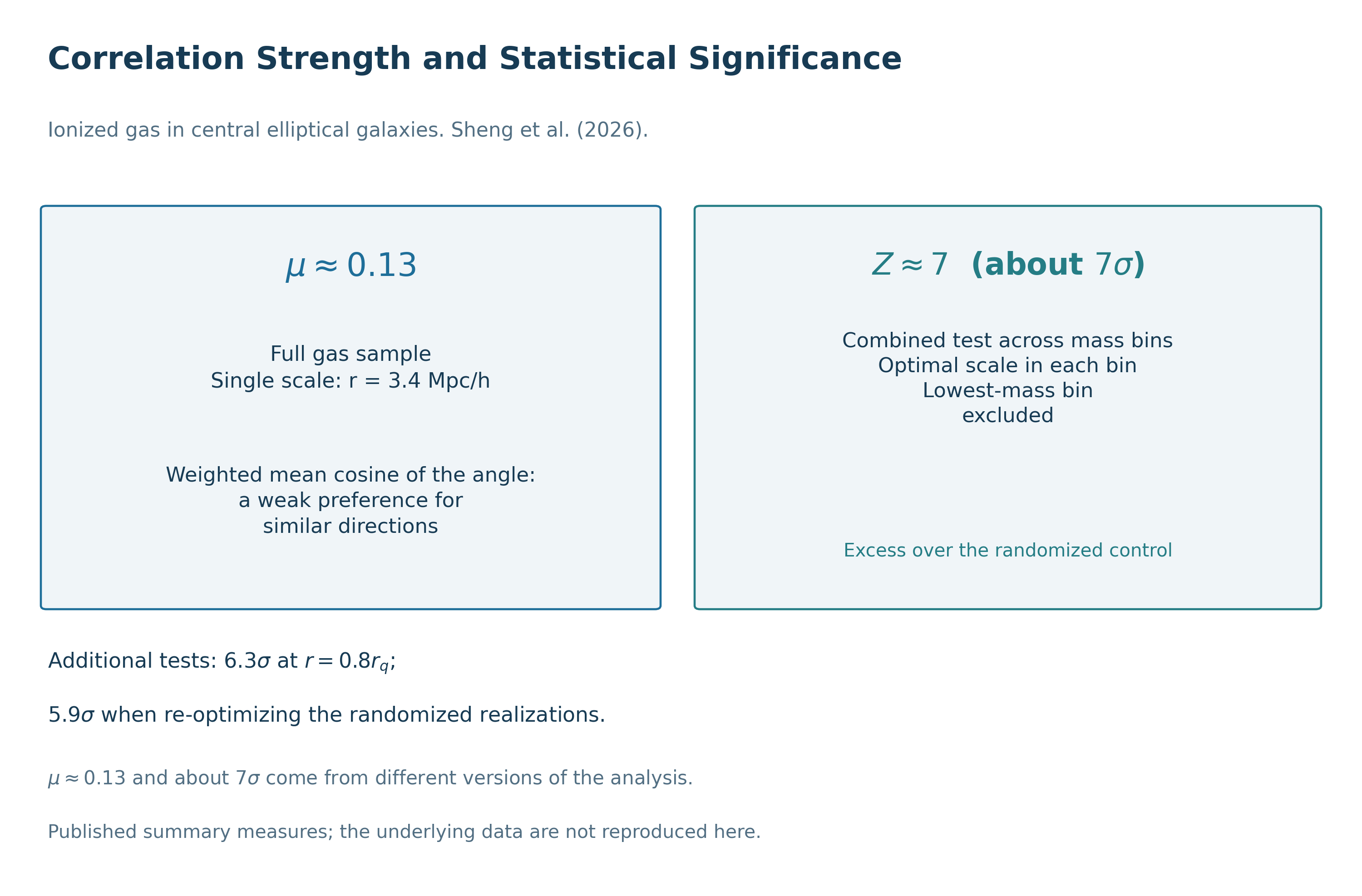
To test whether a connection had survived between present-day galactic rotation and the calculated early direction, the researchers computed the cosine of the angle between the two spin vectors for each galaxy. It equals one if the vectors point in the same direction and minus one if they point in opposite directions. For independent directions distributed uniformly in angle, the mean cosine is zero. In a real sample, however, directions may be distributed nonuniformly even in the absence of the connection being sought. The researchers therefore used control permutations to estimate the chance level of alignment. They characterized the connection itself by the weighted mean of the cosines, denoted by .
The clearest connection appeared in the gas of central elliptical galaxies; correlations were generally weaker in spiral systems and in the stellar components of both ellipticals and spirals. In the sample of 781 elliptical galaxies, reached about 0.13 at a single smoothing scale applied to the entire sample, r = 3.4 Mpc/h (Mpc stands for megaparsec, about 3.26 million light-years). Here h expresses the present-day Hubble constant in units of 100 km/s/Mpc. The scale is given in comoving coordinates, which factor out the overall expansion of the Universe. The value 0.13 indicates a weak preference for similar directions in the sample; an individual galaxy's measured spin may differ greatly from the early prediction.
To test how unusual this correlation was, the researchers shuffled the observed spins among galaxies within each halo mass bin 40,000 times. This preserved the set of observed directions and the mass distribution, but assigned each galaxy another galaxy's measured direction. The connection between its own rotation and its reconstructed past was broken. For each such realization, the authors recalculated the correlation using the same statistical weights.
In a separate analysis, they selected the smoothing scale that maximized the correlation in each halo mass bin. The lowest-mass bin was excluded from the combined test because of large errors in reconstructing initial positions. For the remaining bins, the measured correlations were compared with the mean values from the randomized realizations. The excesses above these means were then summed and compared with the expected combined scatter. For the gas in central elliptical galaxies, the combined estimate gave Z 7, which the authors describe as a significance of about 7.
The symbol denotes the standard deviation, a measure of the scatter in the results. Here, about 7 is an approximate combined estimate across several mass bins. It was calculated from the means and scatter of the randomized realizations; 40,000 permutations alone are insufficient to directly measure the probability of such a rare deviation. The value 0.13 and the estimate of about 7 refer to different versions of the analysis: the former describes the strength of the connection at a single smoothing scale, while the latter is the combined significance when a separate scale is chosen for each mass bin.
The authors also tested how much the result depended on scale selection. Choosing the scale according to the predefined rule r = 0. gives a combined significance of 6.3. Here is the Lagrangian radius, the characteristic size of the initial region calculated from the halo mass and the mean matter density. Like r, it is expressed in comoving coordinates. The rule is the same for all halos, but the radius itself depends on mass. In another test, the optimal scale was allowed to be reselected for each randomized realization; the estimate then fell to 5.9. The lowest-mass bin was excluded in all three tests. The values of about 7, 6.3, and 5.9 show how the estimate of a single signal changes under different comparison rules.
The scale at which the connection was strongest also changed with mass: the more massive the halo, the larger the smoothing scale that gave the best result. For most mass bins, this dependence agreed with the prediction r 0.. The observations thus tested not only the presence of an early imprint but also the characteristic spatial scale on which it originated.
When combining the results, the authors added the variances of the randomized realizations without accounting for possible dependencies between mass bins. The galaxies in these bins are distinct, but the early spins of all objects are calculated from the same reconstructed tidal field. Reconstruction errors may therefore correlate the results across bins. For this reason, the authors themselves regard the combined Z estimates as approximate. Independent galaxy samples and new reconstructions will help test the robustness of the connection.
Why the Connection Is Stronger in the Gas of Elliptical Galaxies
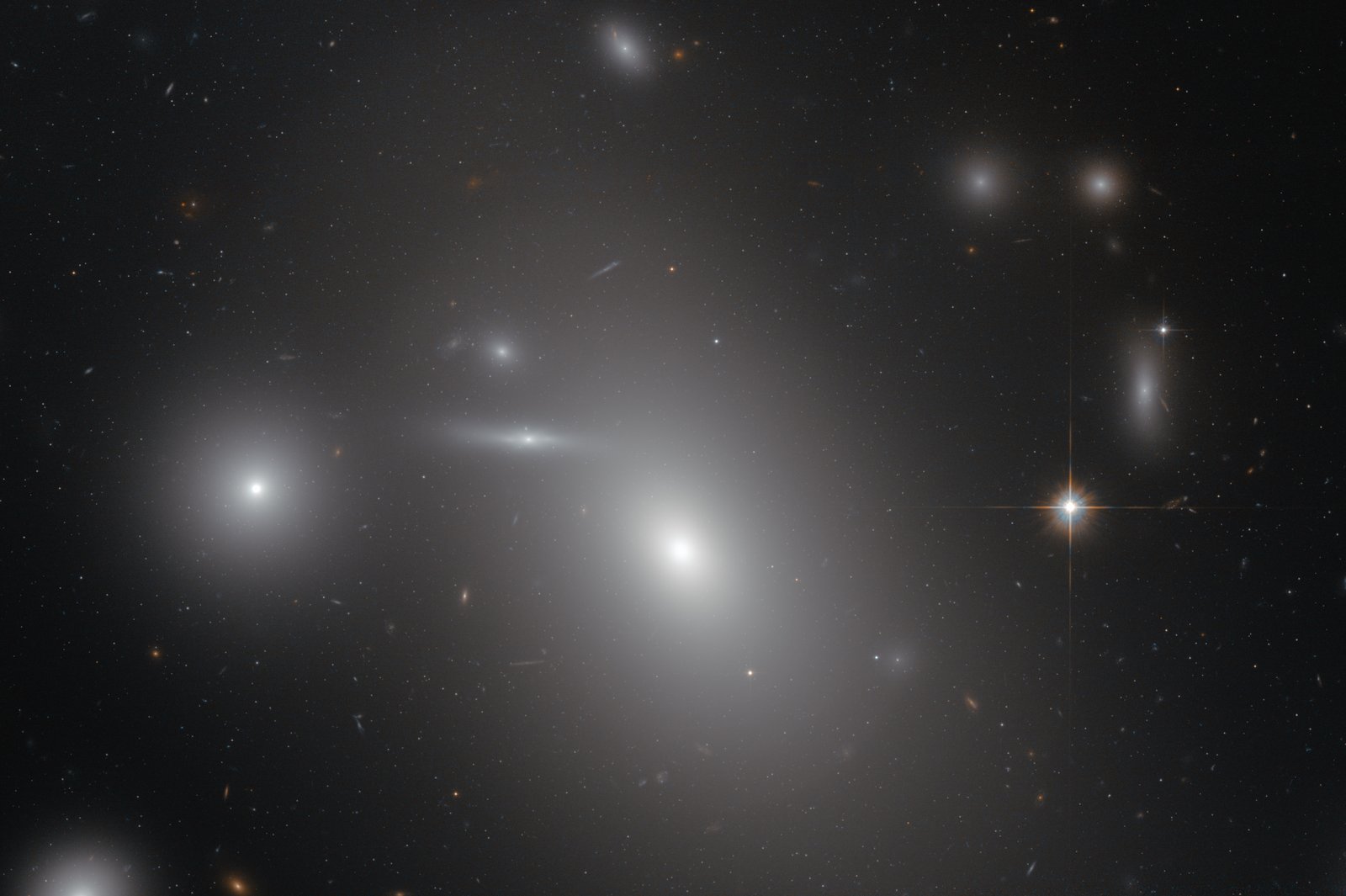
It is easy to picture a spiral galaxy's rotation from its disk, where gas and stars move in a relatively orderly way. Elliptical galaxies have often undergone mergers, and the motions of their stars are far more varied. Yet it was in the ionized gas of massive central elliptical galaxies that Sheng and colleagues found the clearest statistical connection between the present-day angular momentum direction and the prediction based on the early tidal field.
The clearer connection in the gas of elliptical galaxies could partly reflect the masses of their surrounding halos. In the sample studied, elliptical galaxies tended to reside in more massive halos than spiral galaxies did. The initial positions of massive halos are reconstructed more accurately, and simulations show that such halos retain a closer connection to the early tidal field. When spiral galaxies in the lowest-mass halos were excluded from the analysis, their correlation also became more apparent. However, when compared within the same mass bins, elliptical systems still showed a stronger connection. The difference in mass alone cannot explain the result.
Gas and stars may also evolve differently. Gas accretes from the surrounding space, cools, and exchanges angular momentum with other galactic components differently from stars. Earlier numerical studies show that the gas spin direction sometimes retains a closer connection to the early direction.
For the selected elliptical galaxies, the gas kinematic position angle measured from H had a smaller uncertainty than that of the stellar component. More precise measurements dilute a weak correlation less. This advantage applies to the particular sample after the data-quality cuts.
It remains unclear which factor has the strongest influence on the result: halo mass, merger history, differences in the evolution of gas and stars, or measurement precision. These factors may act together. Further observations and calculations will help disentangle their contributions.
What Memory Has the Universe Retained?
The study by Sheng and colleagues gives reason to think that an imprint of early gravitational influences may have survived in the rotation of present-day galaxies. This “memory,” however, appears only statistically: comparing many systems reveals a weak alignment between present-day directions and calculated early ones. The rotation of a single galaxy cannot reliably reveal its original axis.
Reconstructing the initial positions of the common halos of galaxy groups played an important role in detecting this connection. This approach helped match present-day galaxies more accurately to their early gravitational environments. Using the reconstructed initial positions of individual galaxies gave a weaker correlation.
The result requires further testing. The estimated correlation is affected by uncertainties in the reconstruction of the early tidal field, measurements of present-day rotation directions, and the details of galaxy selection. Random errors usually weaken the connection, whereas systematic biases can change its estimated strength in either direction. Random-permutation tests therefore do not replace an analysis of possible systematic errors.
In the future, rotation directions could provide an additional source of information for reconstructing the early Universe. Small spatial scales are of particular interest, because recovering the past from the distribution of matter is difficult on those scales. Eventually, such information could help probe the growth of cosmic structures, including the effects of neutrino mass: the free streaming of these particles suppresses the growth of inhomogeneities on small scales. This will require more accurate models of angular momentum evolution and independent observations.
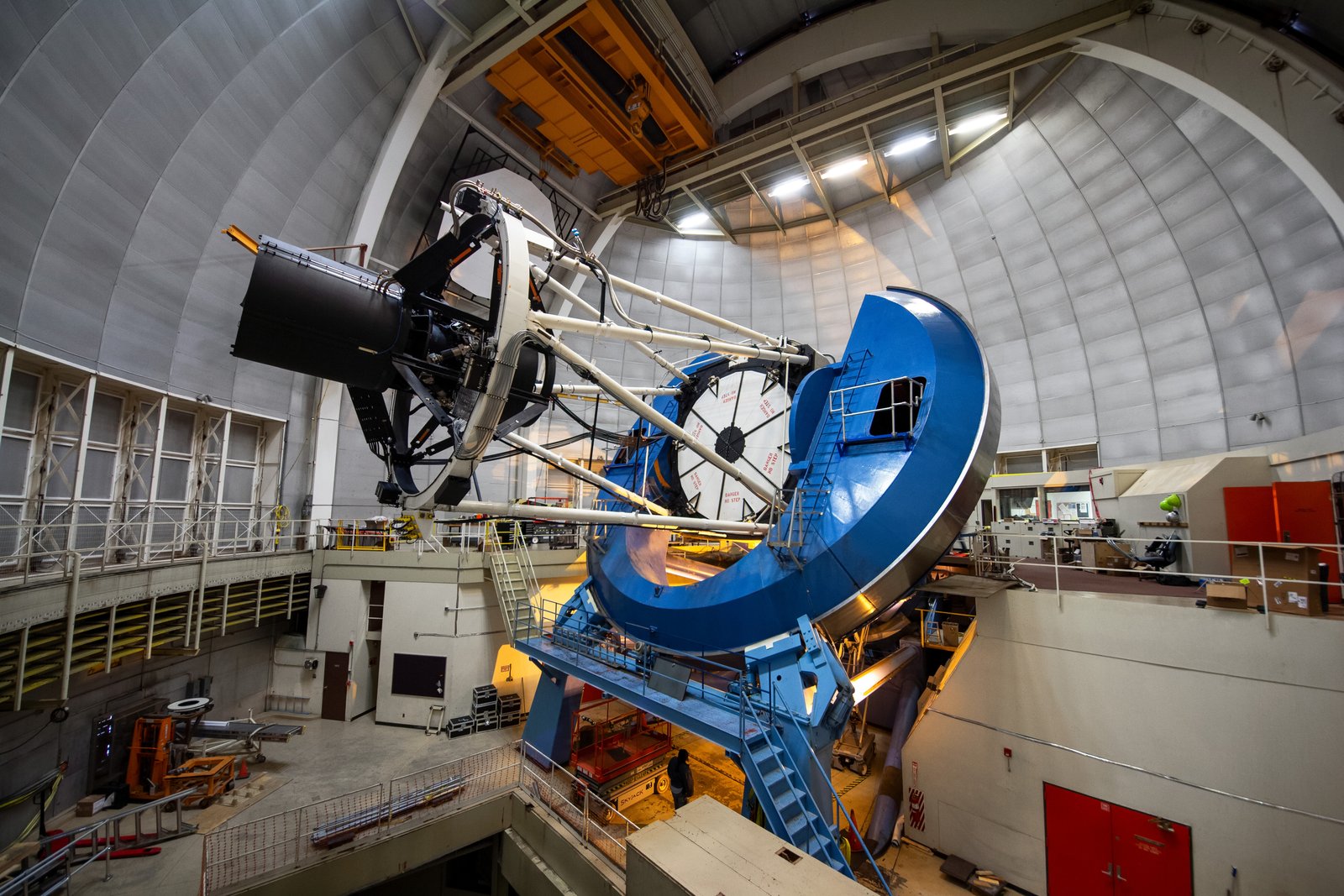
DESI, a spectroscopic instrument on the 4-meter Mayall telescope, could expand the observational sample. Unlike MaNGA, which maps the motion of gas and stars within galaxies in detail, DESI typically obtains a spectrum from only a small region of each system. Sheng and colleagues propose estimating rotation directions from two to four measurements at separated locations within bright central galaxies in clusters. If this method proves sufficiently reliable, researchers will be able to test the detected connection in a much larger sample.
Nearly eighty years ago, astronomers were trying to understand how gravity imparts angular momentum to the matter that will form galaxies. Today, the direction of that rotation is being considered as a possible source of information about conditions in the young Universe. The study by Sheng and colleagues showed that searching for such an imprint in observations is worthwhile. Independent observations and further advances in cosmological reconstruction will show how useful this new way of studying the past can become.
Sources
- Sheng M.-J. et al. (2026). A high-significance detection of primordial tidal torque imprints. Nature Astronomy.
- Hoyle F. (1951). The Origin of the Rotations of the Galaxies. In Problems of Cosmical Aerodynamics.
- Peebles P. J. E. (1969). Origin of the Angular Momentum of Galaxies. Astrophysical Journal 155, 393.
- Doroshkevich A. G. (1970). Spatial Structure of Perturbations and the Origin of Galactic Rotation in Fluctuation Theory. Astrofizika 6, 581–600.
- White S. D. M. (1984). Angular momentum growth in protogalaxies. Astrophysical Journal 286, 38–41.
- Porciani C., Dekel A., Hoffman Y. (2002). Testing tidal-torque theory. I. Spin amplitude and direction. MNRAS 332, 325–338.
- Welker C. et al. (2014). Mergers drive spin swings along the cosmic web. MNRAS Letters 445, L46–L50.
- Jasche J., Wandelt B. D. (2013). Bayesian physical reconstruction of initial conditions from large-scale structure surveys. MNRAS 432, 894–913.
- Wang H. et al. (2016). ELUCID III: Constrained Simulation in the SDSS Volume. Astrophysical Journal 831, 164.
- Motloch P. et al. (2021). An observed correlation between galaxy spins and initial conditions. Nature Astronomy 5, 283–288.
- Motloch P. et al. (2021). Author Correction: An observed correlation between galaxy spins and initial conditions. Nature Astronomy 5, 520–521.
- Yu H.-R. et al. (2020). Probing Primordial Chirality with Galaxy Spins. Physical Review Letters 124, 101302.
- Sheng M.-J. et al. (2023). Baryonic Effects on Lagrangian Clustering and Angular Momentum Reconstruction. Astrophysical Journal 943, 128.
- Li S. et al. (2024). Lagrangian space remapping and the angular momentum reconstruction from cosmic structures. Physical Review D 110, 023512.
- Wang P. (2025). Observational Evidence for Spin Alignment between Galaxy Groups and Their Central Galaxies. Astrophysical Journal Letters 992, L17.
- Kang X. (2026). Persistent primordial signature in present-day galaxies. Nature Astronomy, News & Views.
- SDSS. MaNGA DR17 Overview — survey data and methods.
- SDSS. MaNGA Fiber Feed — fiber system and BOSS spectrographs.
- Cappellari M. PAFIT — documentation for the kinematic position angle fitting program.
- DESI. Official description of the spectroscopic instrument.
- Yang X. et al. (2007). Galaxy groups in the SDSS DR4. I. The catalog and basic properties. Astrophysical Journal 671, 153–170.