A Review Traces the Sign of Static Charge to the History of a Surface

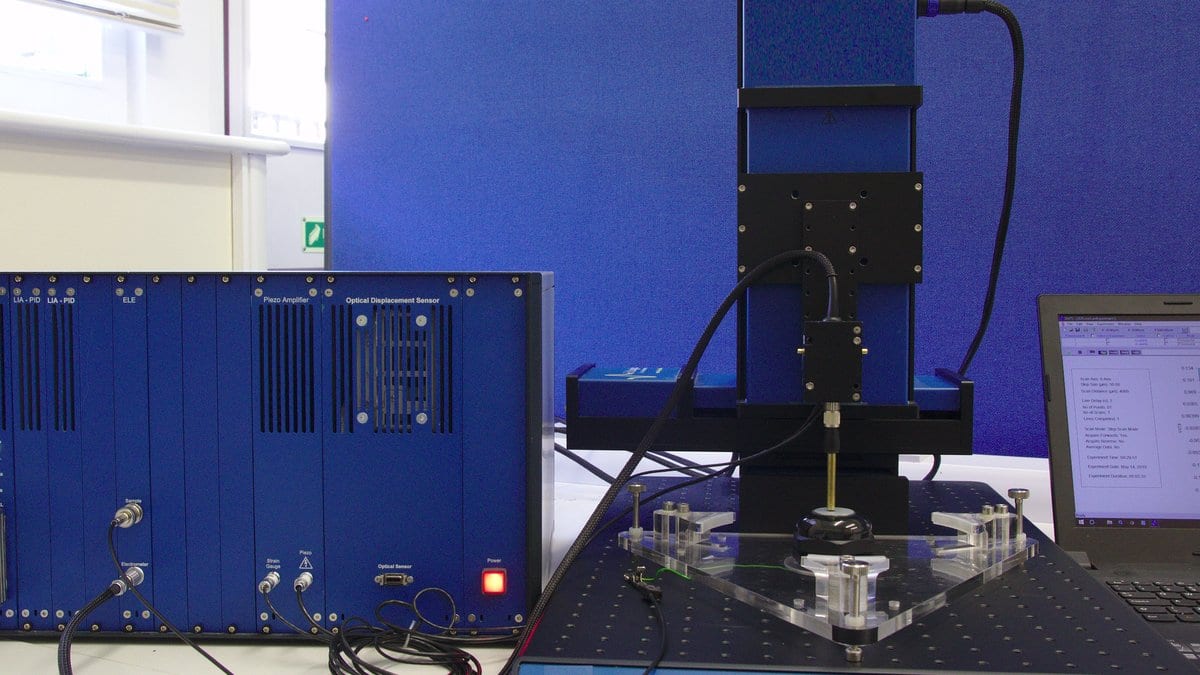
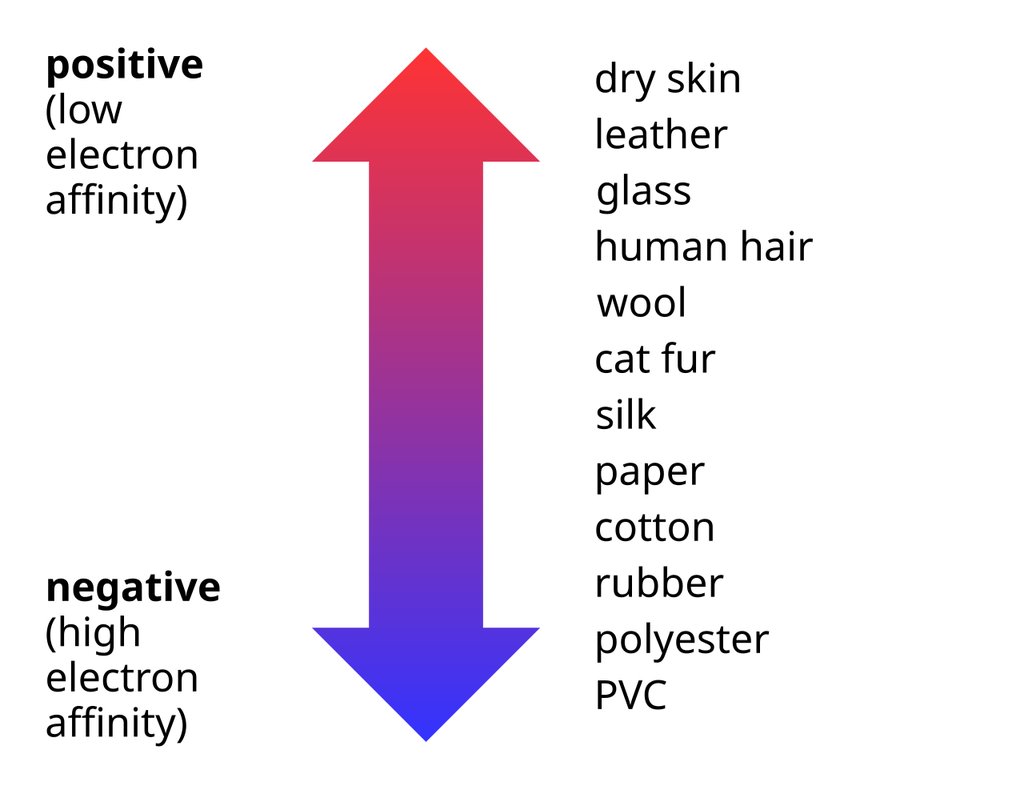
The review, by Ihor Danilov, is titled "Contact electrification and the sign of charge in dielectrics" and runs to 13 sections and 172 references. We have previously published Danilov's article on three recent experiments in contact electrification. Contact electrification is the exchange of charge between two surfaces brought together and then separated, called triboelectric charging when they slide. A dielectric is an electrical insulator; a triboelectric series ranks materials by the sign they take against one another.
The question the review asks
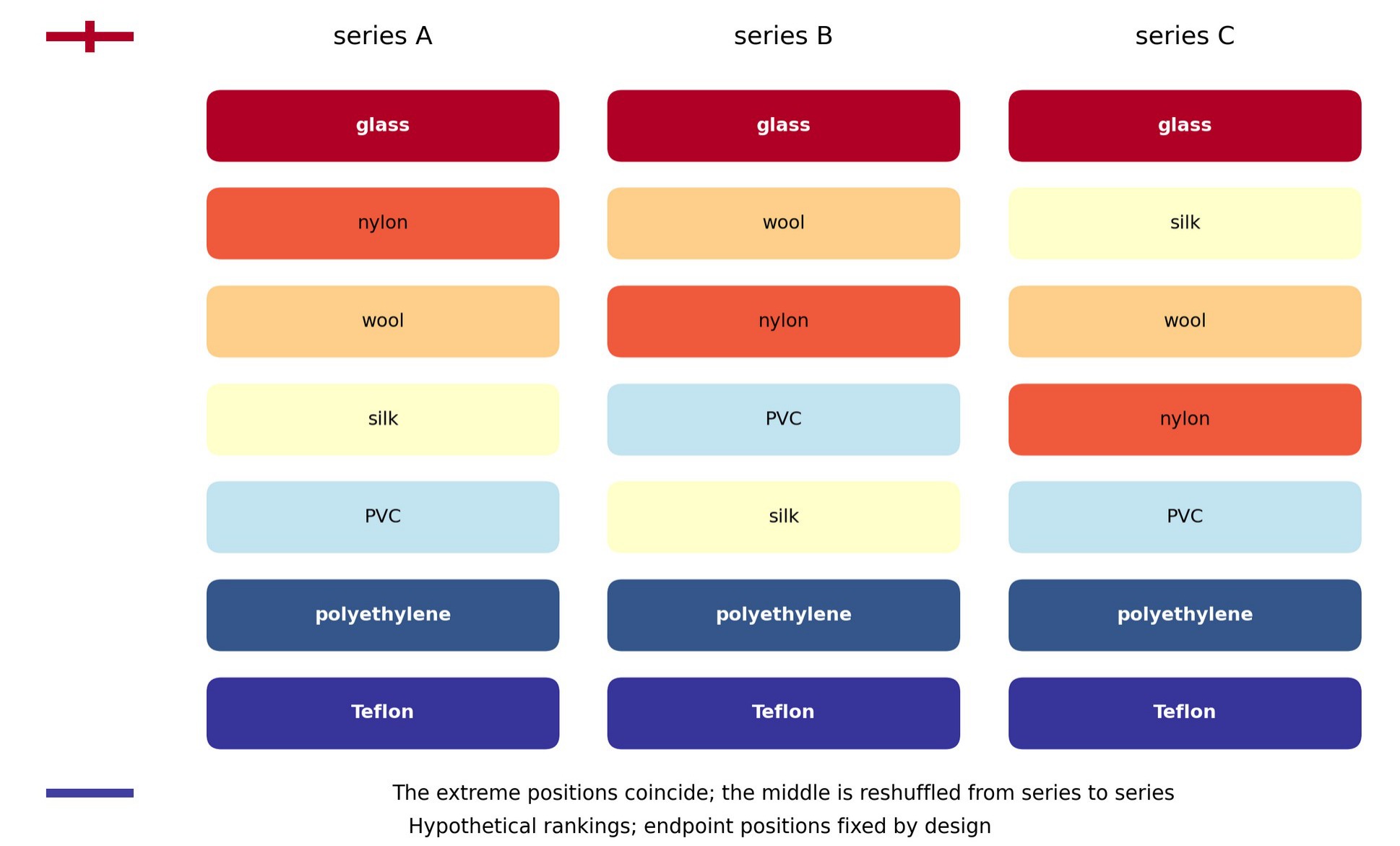
The central question, in Danilov's words, is "what determines the sign of the charge that dielectrics acquire in contact, and why the sign changes between experiments." Dozens of laboratories have published series, and the series differ. Their ends broadly agree, with glass and nylon usually at the positive end and Teflon and polyethylene at the negative one, while the middle "varies noticeably from publication to publication."
The review sets out how it differs from the earlier reviews of the field that it cites: Lowell and Rose-Innes in Advances in Physics (1980); Lacks and Sankaran in the Journal of Physics D (2011); and Lacks and Shinbrot in Nature Reviews Chemistry (2019). Those treat the mechanisms broadly; this one "follows a single line: the dependence of the sign on the state and the prehistory of the sample, which the three central works put on an experimental footing."
A short glossary fixes two terms the rest of the text depends on. Transitivity is the expectation that if A charges positively against B, and B against C, then A will also charge positively against C. "Experimental results do not always satisfy transitivity." The charge carrier is "the physical object that actually crosses the interface: an electron, an ion or a fragment of material."
A chronology, and the explanations on offer
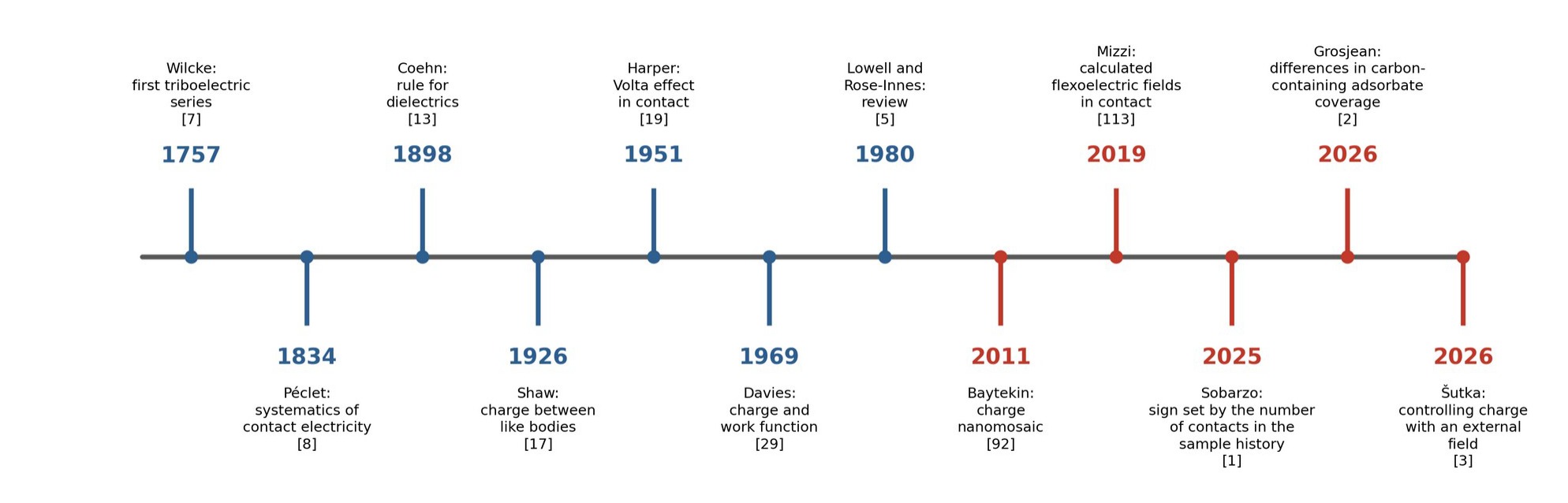
The historical section runs from Gilbert's list of "electrics" in 1600 and du Fay's two kinds of electricity in 1733 to Wilcke's dissertation of 1757, which built the first triboelectric series. It continues through Péclet in 1834, Coehn in 1898 and Shaw in 1926 to Harper's 1967 book, which the review calls "the most complete compendium of the pre-computer era." The section ends on "two warnings that the recent results have made acute": that "the conditions of the experiment can change even the kind of charge," and that "a series is only as reliable as the protocol behind it."
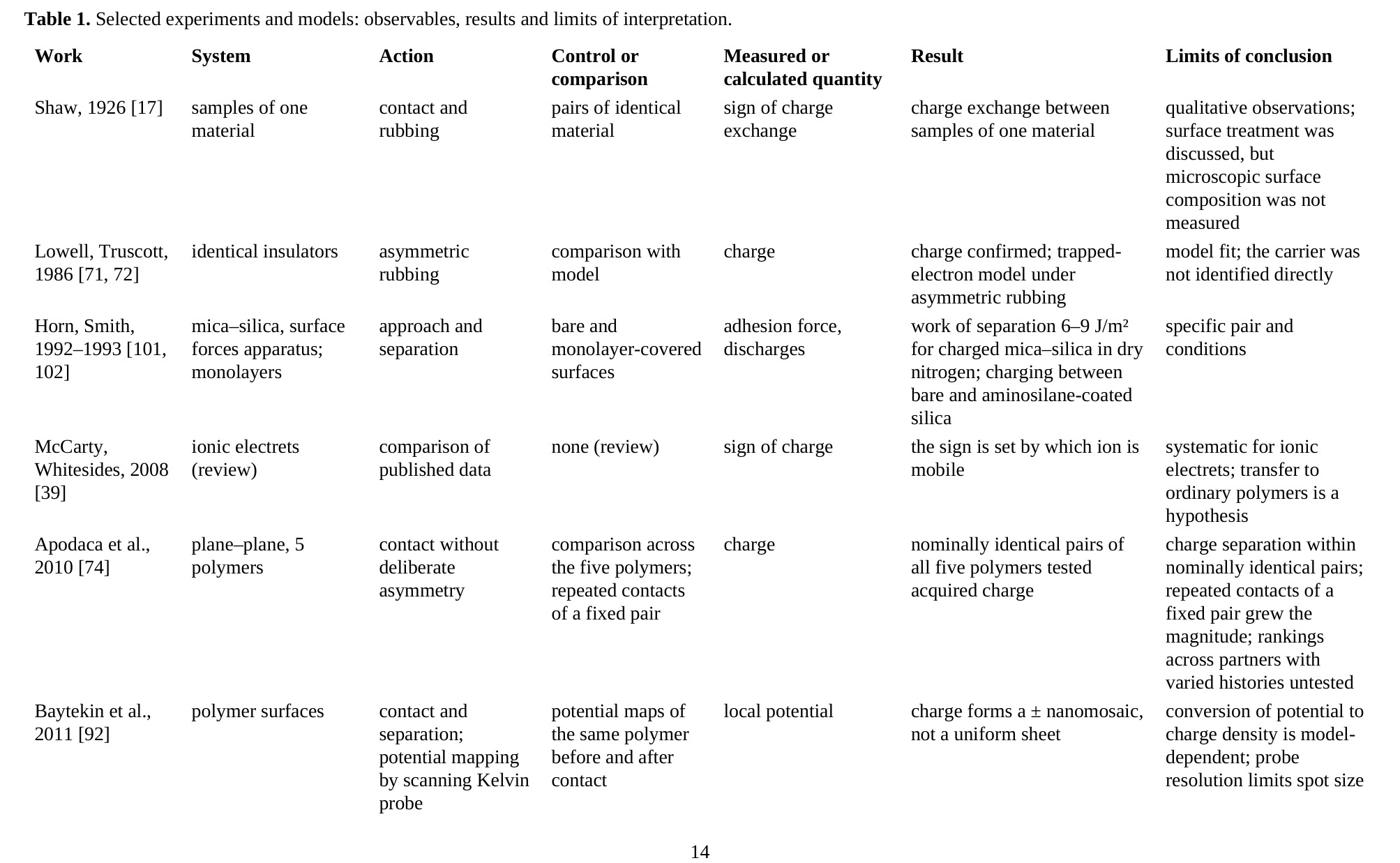
The mechanisms section sorts the candidate explanations into four families, each with the groups that built it: electron transfer; ion transfer; mechanochemistry and material transfer; and adsorbed water. For ions, the review credits McCarty and Whitesides with the line's "strongest formulation," in their 2008 review in Angewandte Chemie, and describes the 2024 Nature Communications study by Fang and co-workers whose results on coated mica supported the transfer of alkyl carbocations, small positively charged hydrocarbon fragments. For water, it sets the program of Galembeck, Burgo and co-workers, summed up in their 2017 monograph "Chemical Electrostatics," against the 2011 experiment in which Baytekin and co-workers found that charging proceeds without water. For material transfer, it cites the 2023 conclusion of Verners and co-workers from Šutka's group that at polymer–polymer boundaries the leading role belongs to bond scission and mass transfer.
Three more lines get their own sections: charging between samples of one material, including the 2014 grain experiments of Waitukaitis and co-workers in Physical Review Letters; the mosaics of positive and negative patches that Baytekin and co-workers mapped in Science in 2011 and that Sobolev and co-workers traced to microscopic discharges in Nature Physics in 2022; and flexoelectricity, the polarization of a material by uneven strain, applied to contact charging by Marks and co-workers from 2019 on. The common limit is stated plainly: none of these approaches "so far gives a quantitative model predicting the sign and magnitude of contact charge for an arbitrary pair of dielectrics."
Sample history as the organizing idea
The core of the review is a section titled "Sample history," built on three recent papers: Sobarzo and co-workers in Nature (2025), on the number of contacts a sample of silicone (PDMS) has already made; Grosjean and co-workers in Nature (2026), on the carbon-bearing layer that settles from air onto oxide surfaces; and Šutka and co-workers in Nature Communications (2026), on an electric field applied during contact. Danilov covered them in detail in an article we published on Nov. 16, 2026.
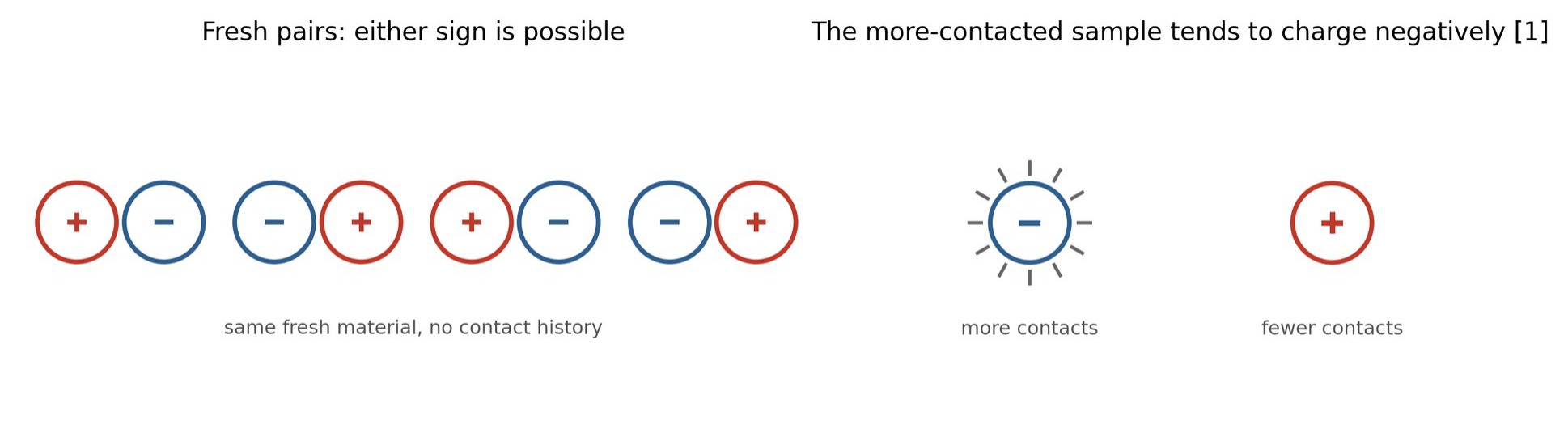
The review groups the three as mechanical, chemical and electrical conditions of a surface, and then qualifies its own frame. The electrical variable, it notes, "has so far been traced only through the residual charge, not through the charging of the sample in later contacts without the field." Whether the three variables are independent of one another is unknown, and the silicone results have yet to be tested on other materials. Two of the three papers come from the same group, and the review names "an independent reproduction of their results by other teams" as the next step.
The section on triboelectric series turns to prediction. It examines three attempts to put materials on a common scale: Zou and co-workers, who measured materials against liquid mercury (Nature Communications, 2019); Shin, Ko, Lyeo and Kim, who derived a governing rule from thermoelectricity and found about 83% average agreement with published orderings (Physical Review Research, 2022); and Zhang, Sundaresan and Webb, whose calculated driving forces matched 9 of 15 polymer pairs in one reference series (Nature Communications, 2024). The review describes the last two checks as retrospective, made against published data, and draws the line between such checks and the test still to come: "A prospective test, in which the relevant surface parameters are measured first and the sign is predicted before the contact experiment, has not been reported for any of these models."
Seven open problems, and what the review contributes
The review closes with seven numbered open problems, several paired with the experiment that would address them. The first is the charge carrier in each class of systems, where the review allows that there may be "no general answer, and perhaps there is none." The second is the mechanism of memory: contacts smooth the surface at the nanometer scale, and the two candidate explanations, mechanochemistry and flexoelectricity, "will have to be tested one by one." The third is a direct test of the flexoelectric channel by measuring the local field inside a working contact. The fourth is the combined effect of contact count, carbon coverage and applied field, which the studies reviewed do not predict and which "remains to be mapped." The fifth is a reporting standard covering the prehistory of contacts, cleaning, exposure to air, humidity and fields at separation, so that other laboratories can "distinguish differences in protocol from differences between materials." The sixth is predicting the series for untested pairs with arbitrary histories. The seventh asks which laboratory conclusions survive in natural settings, where grains charge "without any protocol at all."
The review's contribution is a synthesis and an agenda. It gathers two and a half centuries of measurements around one variable, the history of the sample, and gives the three newest experiments a common frame. It separates control of the sign, shown in specific systems, from prediction, still to be tested prospectively.