The First Solid Meal Reaches the Immune System, and Gut Bacteria Are Not the Messenger

Consider the problem an infant immune system has to solve. Almost everything it meets in its first months is harmless and much of it is edible, so a system tuned to attack novelty would attack breakfast. Yet the same system must stay ready for a pathogen. Get the balance wrong and the consequences arrive years later, as allergy or as autoimmune disease.
For the past decade the leading account of how that balance gets set has run through the gut microbiota. Solid food arrives, the bacterial population in the gut changes abruptly, and the immune system reads the bacteria. It is a good account with strong evidence behind it. It is also, according to work published Aug. 4, not the only one.
A team led by Barbara U. Schraml at the Biomedical Center of LMU Munich, with co-authors in Bern, Ghent, Hannover, Freiburg and at the Technical University of Munich, reports in Nature Communications a signaling circuit that carries information about the change in diet directly to immune cells in the spleen. The first author is Doğuş Altunöz. All of the experiments are in mice.
What the circuit does
The chain has four links. When young mice begin eating solid, grain-based chow, several kinds of lymphocyte respond by producing more interferon gamma, a signaling molecule better known for its role in fighting infection. That interferon gamma acts through a pathway called STAT1 on a particular population of dendritic cells in the spleen, known as cDC1, and pushes them into what the paper calls an immunogenic maturation program. In the LMU account, the activated cells are marked by their production of a second signaling molecule, CXCL9. Those matured cDC1 then shape how CD8+ T cells, the killers of the immune system, differentiate, including the T cells that recognize substances derived from food.
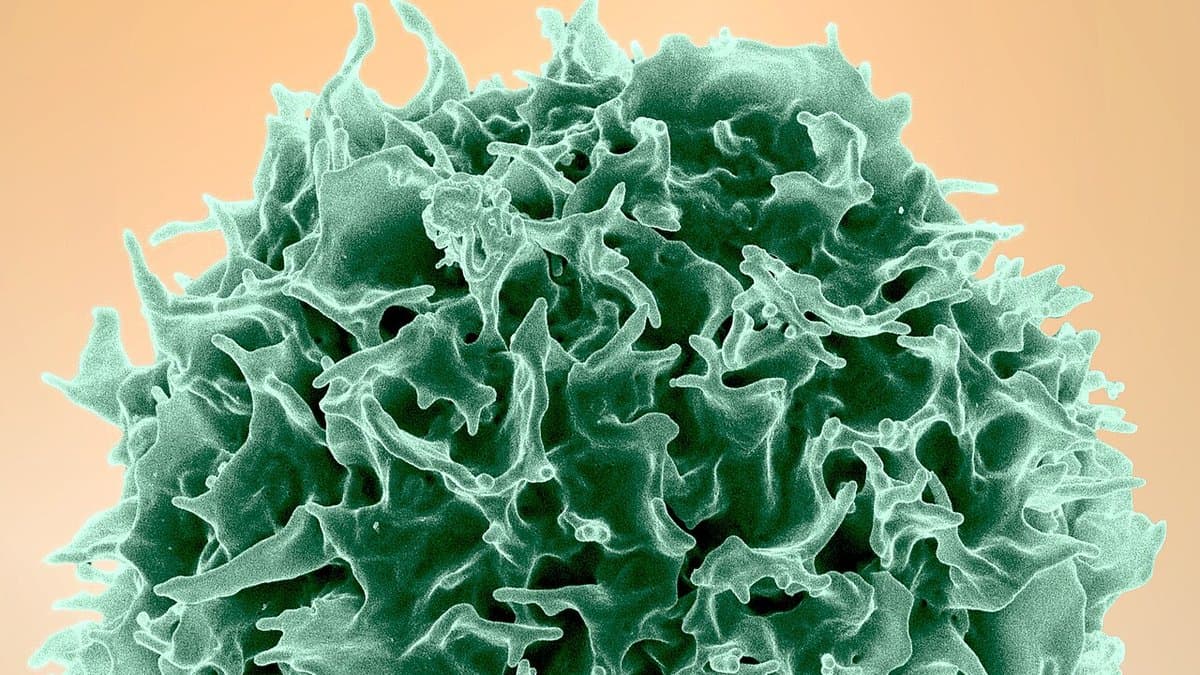
Dendritic cells deserve a sentence of their own, because they are the reason the chain matters. They sample their surroundings, take up whatever they find, and then instruct T cells on what to make of it. Everything a T cell does downstream depends on the briefing it gets. Change the state of the dendritic cell and you change the behavior of the T cell population it instructs, which is what the paper reports happening at weaning.
The location is the part that raises eyebrows. This is not the gut. The spleen filters blood and coordinates systemic immune responses, so a dietary event registering there means the signal has left the intestine and gone body-wide. "Dietary signals are relayed by the immune system and help to recalibrate the developing pool of T cells as the immune system comes into contact with a greater diversity of substances from food and the environment," Schraml said in the university's announcement, translated here from the German.
The germ-free test
The claim that makes this new is a negative one, and it rests on a specific experiment. The team ran the same protocol in germ-free mice, animals raised in isolators with no gut microbiota of any kind. The circuit still ran. Whatever triggers it does not require the bacterial bloom that normally accompanies weaning, which is why the authors say the effect cannot be explained by microbiota changes alone.
That deserves care, because it would be easy to read as a demolition of the microbiome account, and it is not. The best-known result in this area is Al Nabhani and colleagues in Immunity in 2019, which described a weaning reaction that is strictly microbiota-dependent: a transient immune response in the ileum, absent in germ-free and antibiotic-treated animals, whose suppression left mice more susceptible to colitis, allergy and cancer for life. Set the two side by side and they do not collide. One is in the small intestine, the other in the spleen. One is triggered by the microbes that solid food supports, the other apparently by something in the food itself. Interferon gamma appears in both. What the new paper adds is a second, parallel route from the same dietary event to the same developing immune system.
Not a switch that latches
One word needs heading off, because a circuit activated in infancy sounds like a setting fixed for life. The paper does not show that. It reports close to the opposite: the same program "remains operative to dietary intervention in adult mice." Adult animals still responded to a change in diet through the same cDC1 pathway. The authors' conclusion is that diet is a modifiable cue, something that can be adjusted rather than a switch thrown once at weaning and left alone. That is a more useful finding than a permanent imprint would be, and it is also a weaker one, because a channel that stays open is a channel other things can act on too.
"Our results show that food supplies the immune system not only with nutrients but also with information," Schraml said. "That cDC1 respond to changes in diet in adulthood as well opens up the long-term possibility of investigating whether immune responses can be influenced through targeted dietary interventions."
Long-term is the operative phrase there, and the limits are worth being blunt about. These are mice, eating standard laboratory chow, in a controlled facility. Nothing in the work identifies a corresponding circuit in people, and nothing in it bears on how any human infant should be fed or when solid food should be introduced. The species gap in immunology is not a formality: mouse and human dendritic cell subsets differ in ways that have defeated more than one translation attempt.
The team also cannot yet say what in the food is doing the work. "We were not yet able to identify exactly which dietary components influence the immune response," Schraml said. "Conceivable candidates are bioactive substances contained in conventional grain-based feed."
A note on timing. This is a slow result reaching print rather than a discovery announced this week. The paper was received in September 2025, accepted in July and published Aug. 4, and a preprint of the same work has been publicly available since late March.
The obvious next step is chemical. Finding the molecule in grain-based chow that drives interferon gamma output would turn a described circuit into a testable one, and it would say whether the trigger is something peculiar to rodent feed or a general property of eating solid food. Until that molecule has a name, this is a mechanism in mice with an interesting negative attached to it.
Sources
- Nature CommunicationsPeer-reviewed
- idw-online.de