A Galaxy Nearly Empty of Heavy Elements Has Sooty Dust After All

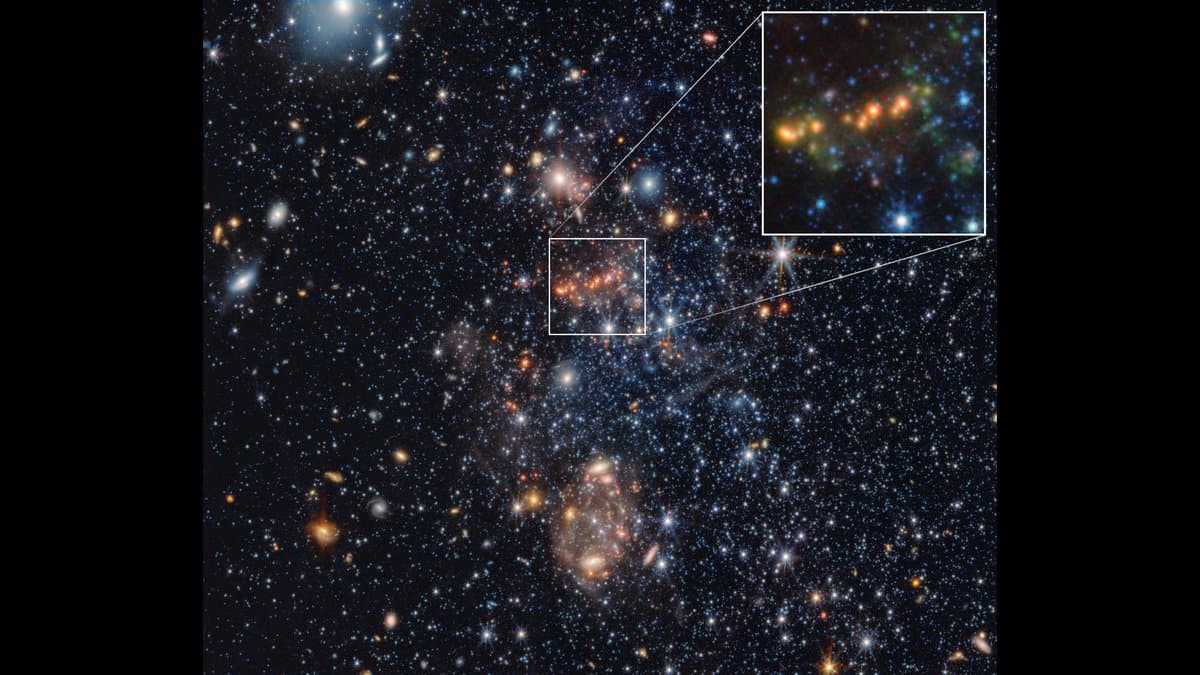
Infrared telescopes have handed astronomers something that looks like a rule: the fewer heavy elements a galaxy holds, the less it glows in the infrared bands produced by polycyclic aromatic hydrocarbons. The particles responsible are ragged carbon molecules, chemical cousins of what rises off a candle flame, and astronomers call them polycyclic aromatic hydrocarbons. In the most element-poor galaxies the signal all but disappears. What the rule never explained was why. Either starlight is breaking the molecules apart in galaxies too thin on dust to shield them, or the molecules are never getting built.
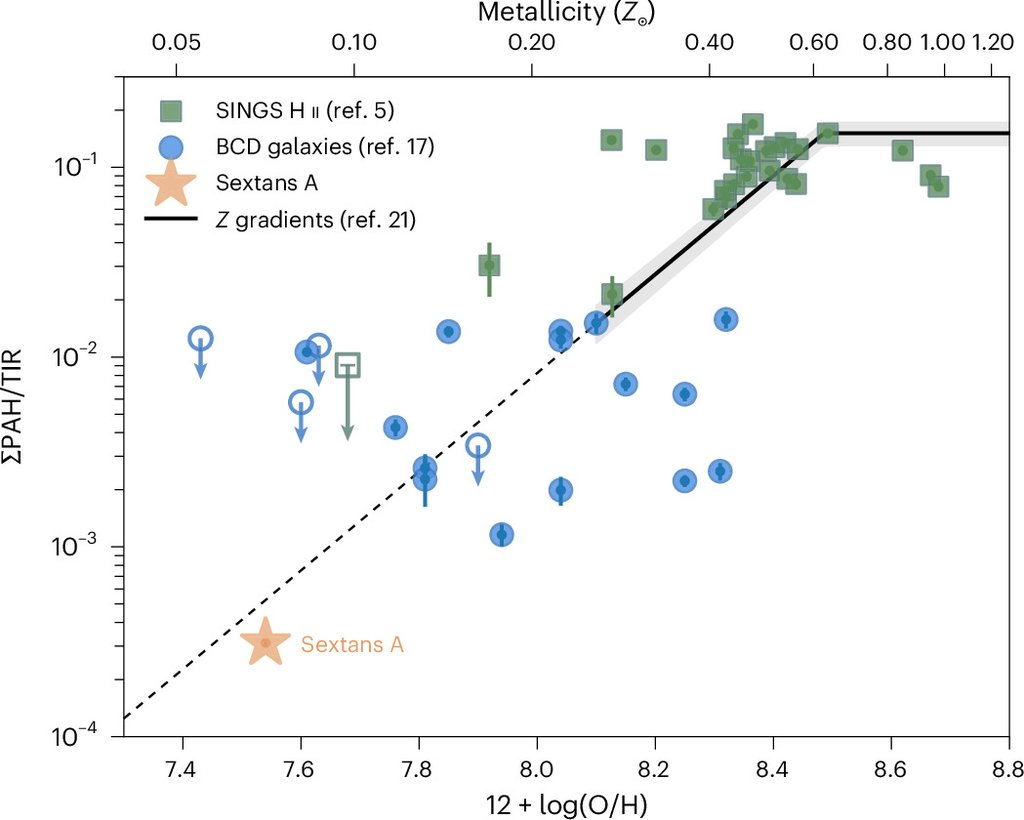
A team led by Elizabeth J. Tarantino of the Space Telescope Science Institute in Baltimore has now taken the measurement into territory where nobody had detected the molecules at all, and published the result Sept. 29 in Nature Astronomy. Using Webb, they found polycyclic aromatic hydrocarbons in Sextans A, a small, untidy galaxy about 4.6 million light-years away, at the outer edge of the Local Group, where oxygen and the other heavy elements run at 7% of the level in the Sun. It is, to their knowledge, the lowest heavy-element content at which this emission has ever been seen. Webb programs had already looked at several galaxies below 10% and come back with nothing.
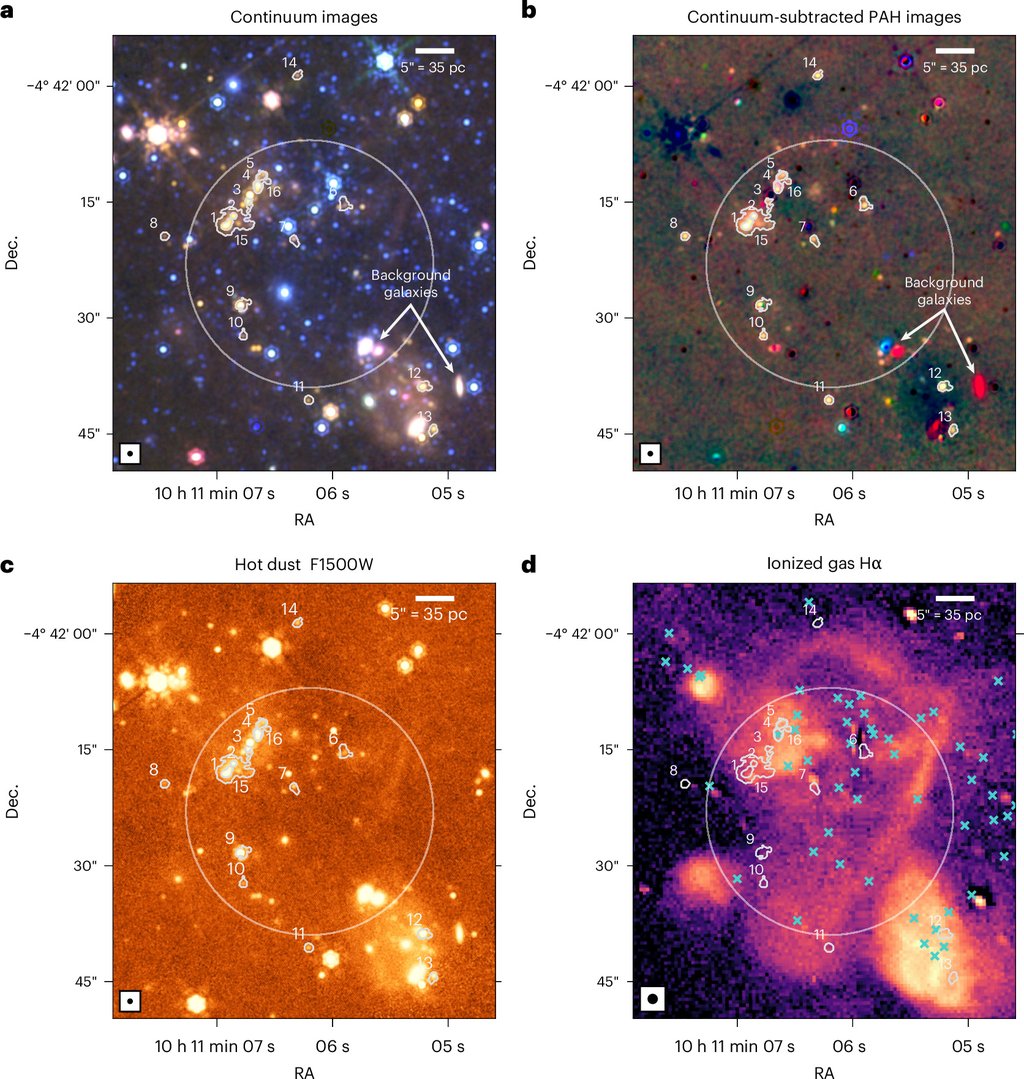
Why nobody had seen it before turns out to be a matter of scale rather than sensitivity. In galaxies with a Sun-like complement of heavy elements, PAH emission can extend across regions hundreds of parsecs wide, so even a telescope with coarse vision catches plenty of it. In Sextans A the emission comes from knots 3 to 10 parsecs across, a parsec being a little over three light-years, and most of them are smaller than the blur in Webb's own images at these wavelengths. An instrument that averages such a knot together with the blank sky around it sees almost nothing.
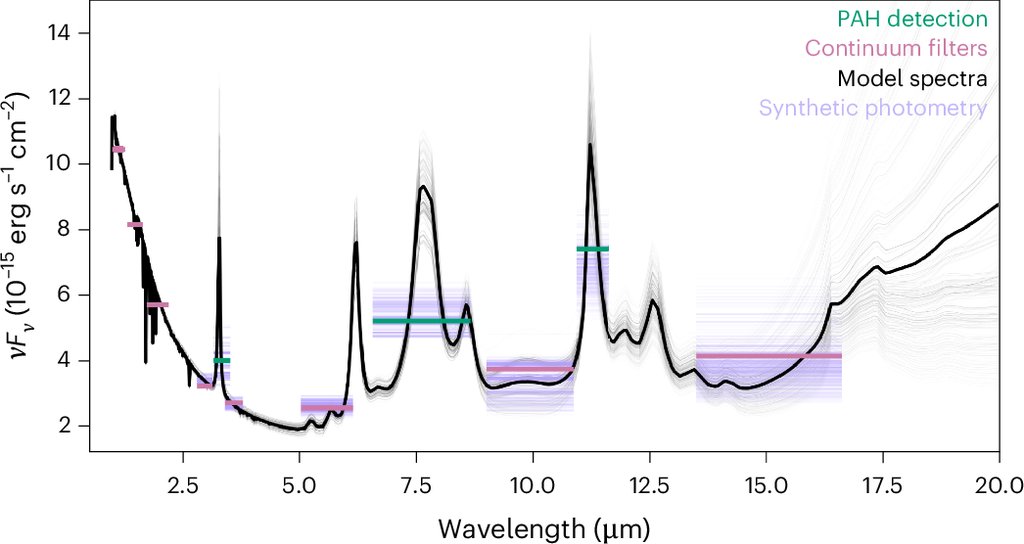
The detection rests on three separate infrared features of the same family of carbonaceous grains, each produced by a different vibration, and the team required them all to show up together, well clear of the noise, in the same spot. A distant background galaxy can be bright in one of those bands and counterfeit a signal; it cannot easily counterfeit all of them. What Webb gathered here is imaging through filters rather than a spectrum, so the strength of each feature is worked out from the brightness measured in and around its band.
The shape of those signals carries the argument. The shortest of them, at 3.3 microns, comes mainly from the smallest grains, which a single ultraviolet photon can heat enough to make them radiate; the middle one comes mostly from grains that have lost an electron. In Sextans A the short-wavelength feature is strong and the middle one is weak, which suggests the grains there are small and largely uncharged. And where the ultraviolet light is fiercest, the small-grain signal gets stronger rather than weaker, the opposite of what substantial processing by radiation fields would leave behind.
Tarantino and colleagues read that as a sign that the soot in Sextans A is not so much being ground down as struggling to form. Their published conclusion is that the evidence favors "inhibited grain growth over enhanced destruction" as the origin of the galaxy's low soot abundance. Growth of this kind needs dense, shaded gas and a supply of carbon, and in a galaxy this poor it should run at least 30 times more slowly than at solar composition, which is why they take the knots to be the few places where it can happen at all. That last step is offered as the likeliest reading of the evidence rather than as a measurement.
The small size is itself part of the argument. With so little dust about, it takes a far thicker column of gas to block starlight than it would in a galaxy like ours, so the shaded pockets where fragile molecules can survive and grow are correspondingly tiny. On that reading the knots are not scattered remnants of a soot supply that once filled the galaxy. They are the places where the chemistry can still run.
Across the star-forming region the team surveyed, the three features together account for about 0.03% of the infrared power, a few hundred times less than in galaxies as element-rich as the Milky Way. That figure leans on far-infrared data too coarse to isolate a single knot, so the fraction inside the knots is higher; the soot is concentrated where the rest of the dust is spread out.
The interpretation has a loose end, and the paper says so. Neither of the two standard models of interstellar dust can reproduce the ratio the team measured between the shortest and middle features, which leaves the grain properties read off those models provisional. One of the models' architects, Bruce T. Draine of Princeton University, is a co-author here. A spectrum would separate the features instead of inferring them, and Tarantino has Webb observing time approved to take one.
Meanwhile the same features keep turning up in galaxies seen as they were early in the universe's history, when heavy elements were scarce everywhere. What Sextans A supplies is a nearby example, close enough to resolve, of what that signal looks like when it comes from a galaxy that has almost none.
Sources
- Nature AstronomyPeer-reviewed