A 518-Million-Year-Old Sea Creature Holds the Earliest Known Blueprint for a Spider’s Fangs

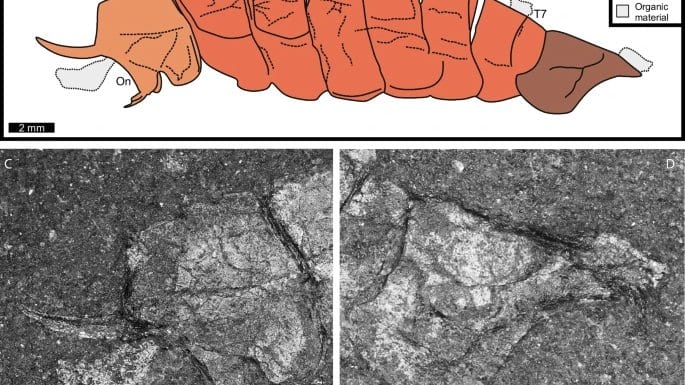
Spider fangs do not look like they should have a fossil record. They are delicate, hollow and mostly made of the kind of soft tissue that rots long before it can turn to stone. So the question of when the chelicerates (spiders, scorpions, horseshoe crabs and their kin) first assembled their signature front pincers has largely been a matter of inference from living animals and a scatter of much younger fossils.
A small creature from the Cambrian is now filling in that gap. Writing in Nature, researchers describe Urokodia, an arthropod two to three centimetres long that lived roughly 518 million years ago in what is now Yunnan Province in southern China. Its remains come from the Chengjiang biota, a fossil deposit famous for capturing soft anatomy (eyes, guts, limbs and gills) that almost never survives elsewhere. That exceptional preservation is what makes the animal worth so much: it records not just a hard shell but the fine structures that reveal how the body was built.
To read those structures, the team turned to X-ray microtomography, a scanning method that builds a three-dimensional model of a fossil layer by layer without breaking it open. The reconstruction showed a pair of pincer-like appendages at the front of the head: chelicerae, the defining feature that gives chelicerates their name and, in modern spiders, does the biting. In Urokodia, these are the earliest known examples of that structure, pushing the documented origin of the spider-and-scorpion front end deep into the Cambrian.
The head is only half the story. The scans also resolved limbs consistent with book gills, the stacked, page-like breathing organs that horseshoe crabs still carry today and that scorpions repurposed into internal book lungs when their ancestors moved onto land. Finding fang-precursors and gill-precursors on the same early animal matters because it ties two hallmark chelicerate features to a single, ancestral body plan rather than leaving them to appear separately later. According to the study, that placement sets Urokodia near the base of the chelicerate lineage, close to the branching point from which the whole group radiated.
Why does the ancestry of a Cambrian oddity reach beyond paleontology? Chelicerates are one of the largest branches of the animal kingdom, with well over 100,000 living species, and their front-end anatomy (the fangs, the pincers, the specialised mouthparts) is central to how they feed, hunt and breathe. Knowing when and how that anatomy first came together helps calibrate the timing of one of evolution's major architectural experiments, and it anchors the molecular family trees that biologists build from the DNA of living species. A fossil that sits near the root gives those trees a fixed point in deep time.
The interpretation rests on the animal's exceptional preservation and on the microtomographic reconstruction of features that are, by their nature, subtle; the difference between an early chelicera and a more generalised arthropod limb can hinge on fine details of segmentation and jointing. The work is peer-reviewed and published in Nature, and it fits a broader picture already emerging from Chengjiang: a 2019 study of the same deposit reported early book-gill-like structures, a separate line of evidence that these breathing organs have deep Cambrian roots. Urokodia now brings the fang-precursors and the gill-precursors together on one body.
For anyone who has ever watched a spider fold its fangs before a bite, or a scorpion lift its pincers, the takeaway is quietly startling. The basic hardware was already being sketched out in a shallow Cambrian sea, on an animal small enough to sit on a fingertip, half a billion years before any of its descendants spun a web or climbed onto land.
The full study is available in Nature (doi:10.1038/s41586-026-10713-2).
Sources
- NaturePeer-reviewed