Stored Blood Samples Reopened Rare-Disease Cases the Genome Left Unsolved

A genome sequence can end a family's search for an answer, and it can also hand them a list. Among the millions of spelling differences that make one person's DNA unlike anyone else's, a clinical analysis will usually flag a few that cannot be sorted: not clearly harmless, not clearly to blame. The report calls them variants of uncertain significance. For a patient with a rare disease, that phrase is often where the search stops.
A team led by Julia Carrasco-Zanini at the Precision Healthcare University Research Institute, Queen Mary University of London, went looking for a second opinion somewhere the genome cannot give one: in the proteins circulating in a patient's blood. Their results were published on September 9 in Science Translational Medicine.
The patients came from the 100,000 Genomes Project, Britain's national genome sequencing program. All 424 in this study had already been through it without receiving a genetic diagnosis, which makes them a deliberately hard group to start from. That is the ordinary situation rather than an unlucky one: the project's 2021 pilot report reached a genetic diagnosis in 25% of the patients whose illness had prompted their family's testing, and the new paper opens by saying that despite sequencing, "a genetic cause is not identified in most patients."
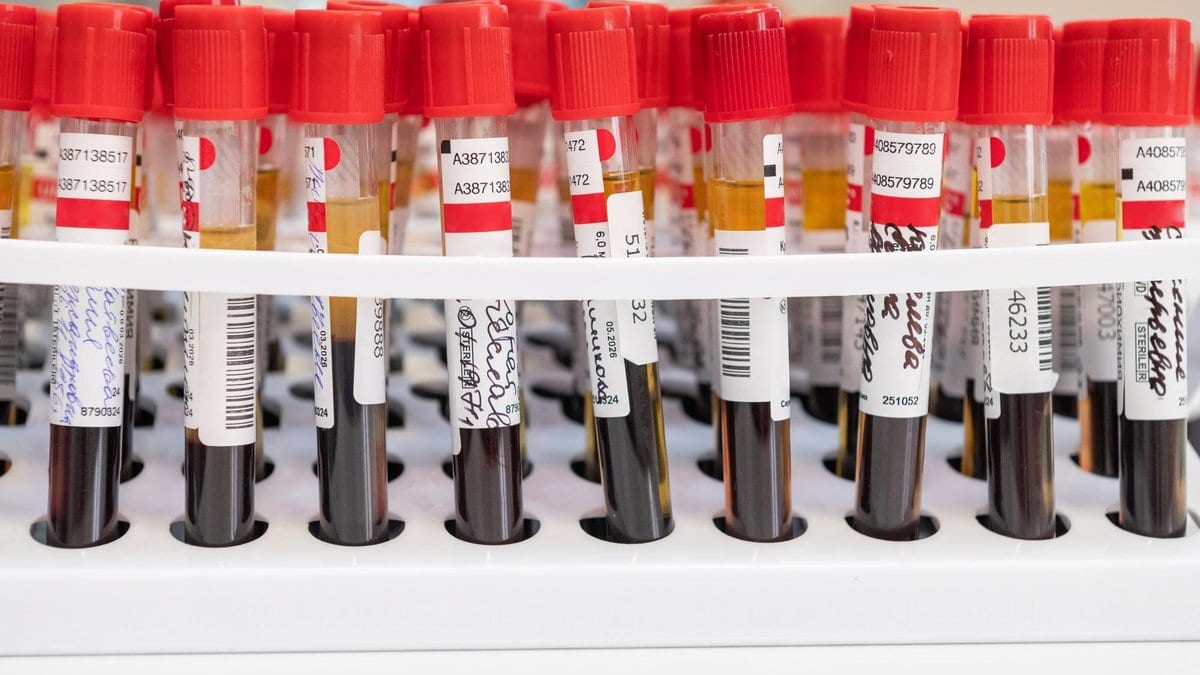
From blood serum already stored for each patient, the team measured 1,463 proteins at once, on a commercial panel called the Olink Explore 1536 assay. Then it looked for the proteins that were conspicuously scarce.
A protein that is scarce in the blood can be a sign that a variant in the gene behind it is doing something real. On its own it is a weak sign. The study counted a protein as low when it fell two standard deviations below the reference average, a cutoff that catches roughly the lowest 2% of readings; across the whole panel, that is a few dozen low results in almost anyone. So a low protein was never allowed to nominate a gene by itself. Every outlier was read together with Exomiser, a tool that ranks a patient's variants against their symptoms.
Thirteen of the 424 patients came out of that process with a confirmed genetic diagnosis. The protein did not make the diagnosis in any of them. It settled a variant of uncertain significance the patient already had on file, or it pointed to a gene worth a targeted second pass through the genome data. For 23 others among the same 424, the paper reports candidate gene-disease links, which is a weaker thing than a diagnosis: a plausible pairing of variant and illness that still has to be confirmed or dropped.
A diagnosis is not a treatment, and for many rare conditions there is none. It still changes things: it ends the search, it names what relatives may carry, and it can redirect care. In that pilot, a quarter of the genetic diagnoses made had immediate consequences for how the patient or a relative was treated.
The paper's worked example belongs to the second group. In one family, a patient with an inherited heart disorder carried a rare misspelling in a gene called TIE1. The same change was present in the patient's father, who has the same condition, and in nobody else in the project. The patient's TIE1 level in blood was not borderline. It sat more than five standard deviations below the reference average, where two was enough to qualify.
That is a striking convergence, and it is not a diagnosis. TIE1's known job is in the growth and stability of blood vessels, and the human conditions attributed to it so far are conditions of vessels, not of the heart. A single-gene heart disorder would be new ground for it. That is why the authors file the variant as a candidate rather than a cause, and say in the institutes' announcement that further studies are needed to confirm their results and their interpretation.
Reading proteins to break open unsolved genetic cases is not itself new, and the paper does not claim it is: it cites a 2021 study that used proteins measured in cultured cells from patients to resolve a share of unsolved cases. What is different here is the sample and the scale. Serum is what a clinic already draws and freezes, and these patients came out of a national program rather than a specialist referral center.
None of this is a test a patient or a doctor can ask for. The proteins were measured on samples already in the freezer and analyzed after the fact, and the authors call the study a proof of principle. How far it travels, they write, will likely depend on four things: whether the protein that matters is made in the tissue where the disease acts, whether it is detectable in blood, whether the panel covers it at all, and whether it can be measured sensitively enough.
"The real opportunity is in bringing different layers of biological information together," said Claudia Langenberg, the study's senior author, who heads the computational medicine group at the Berlin Institute of Health at Charité and directs the London institute. "The genome gives us the blueprint, but proteins can tell us something about how that blueprint is being translated into biology in an individual patient."
Sources
- www.science.orgPeer-reviewed
- idw-online.de
- medicalxpress.com
- doi.org
Medical Disclaimer: This content is provided for general informational and educational purposes only. It is not medical advice and should not be used as a substitute for professional medical advice, diagnosis, or treatment. Always consult a qualified healthcare professional regarding any medical condition, concern, symptom, or treatment decision.