Scientists Can Now Watch Nearly Every Cell in a Young Fish at Once
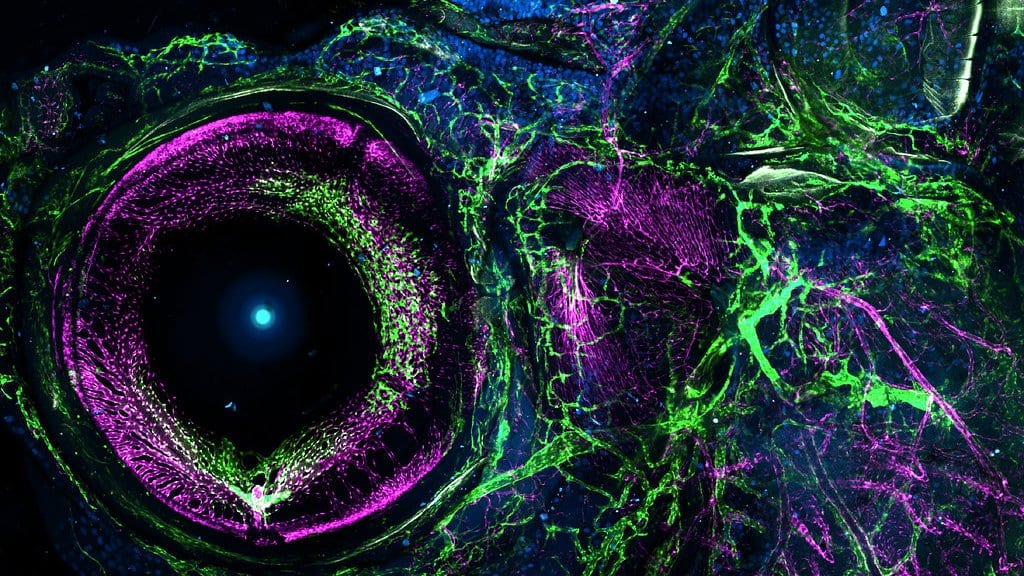
Researchers at the Howard Hughes Medical Institute's Janelia Research Campus have recorded the activity of nearly every cell in a week-old zebrafish larva at once, on a timescale of seconds. The work was published in Nature on September 9, 2026.
The team calls the setup WHOLISTIC. Physiology has been held back, the authors write, by the inability to record cell activity throughout a body at the same time, which leaves interactions between organs out of reach.
The paper reports three parts working together: fast microscopy that images the fish in stacked slices, software that tracks each cell as the animal's muscles shove it around, and a genetically modified fish whose cells nearly all carry a calcium sensor, a protein that brightens when a cell becomes active. The demonstration animal is a larval zebrafish because light cannot cross the large, opaque tissues of most vertebrates; a young zebrafish is transparent.
First author Virginie M. S. Ruetten, senior author Misha B. Ahrens and colleagues list several things the system picked up. Cartilage cells reacted to cold. Cells at the boundary layer around the brain reacted to the anesthetic ketamine. Waves of activity traveled along the nephron, the kidney's filtering tube, arriving in bursts rather than running continuously. Muscle groups that the authors say had not been reported acting together did so. And the brainstem was captured redirecting blood flow around the body.
Combining the imaging with optogenetics, in which light switches chosen cells on, let the group test cause and effect rather than only watch. The authors also report a proof of concept in an adult Danionella cerebrum, a small fish that stays transparent into adulthood. The paper is open access.
Sources
- NaturePeer-reviewed