Corals in the Gulf Kept a Record of American Fertilizer Use

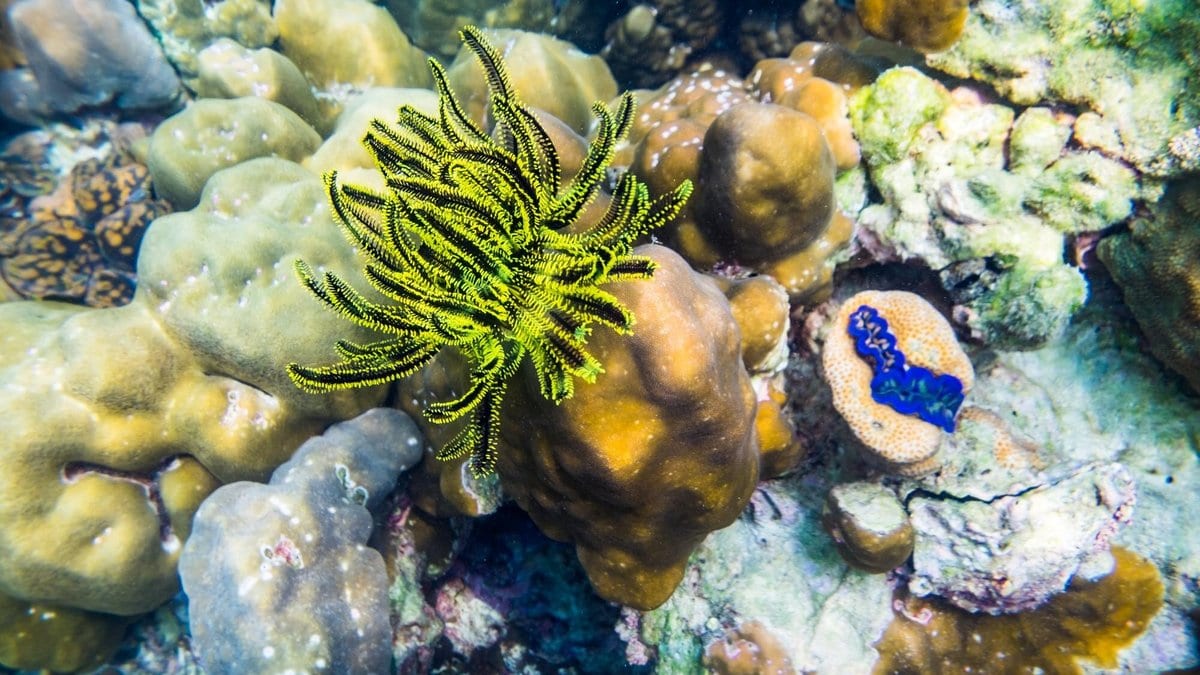
A coral is not a tree, but it keeps the same kind of books. The slow-growing stony corals of the northern Gulf of Mexico add a layer of limestone every year, one on top of the last, for centuries. Sealed into each layer is a trace of the nitrogen the animal was living on at the time. Nitrogen comes in a heavier form and a lighter one, and the balance between them is a fingerprint of where it came from.
A team led by Jonathan Jung of the Max Planck Institute for Chemistry in Mainz and Kristine L. DeLong of Louisiana State University went after that fingerprint. In work published Sept. 9 in Science Advances, they read the nitrogen locked in two coral cores taken on a NOAA expedition to the Flower Garden Banks. Between them the cores hold 270 years of annual bands. The question was a plain one: where has the reef's nitrogen been coming from, and when did that change?
For the first century of the record, nothing much moves. The nitrogen the corals took up looks natural, which means almost none of it was arriving from rivers. Then, around 1850, the human share begins to climb, in step with European settlement across the Mississippi basin and the first use of organic fertilizer on its fields.
The study, featured in the Max Planck Institute's announcement, traces the next century off the cores like a ledger of American engineering. The growing use of guano, the seabird droppings shipped in as fertilizer, shows up from 1856, the year Congress let Americans mine it on Pacific and Caribbean islands. The signal sharpens again after 1873, when the last of the Second Great Raft, an enormous natural log jam on the Red River, was hauled out and the water below it began to run faster. From 1882, levee building along the Mississippi expanded sharply, and the river's water, sediment and nutrients went straight out into the Gulf rather than spreading over its floodplain.
After the 1960s, with the Green Revolution and its synthetic fertilizer, the line turns steeply upward and never comes back down. In recent decades, more than 60% to 80% of the nitrogen reaching the reef has come down the Mississippi. That share rests on two cores from one reef system, so it is a single record rather than a survey of the Gulf.
One of the study's results is not something the corals can see. The team's model divides the reef's nitrogen among its possible sources, and it indicates that fertilizer nitrogen left in Midwestern soils and groundwater years ago is still working its way down and adding to what the river carries now. The corals record what arrived at the reef; the store sitting upstream is an inference from the model. A separate study in Communications Earth & Environment found chemical evidence of the same thing: when the river runs high, it is fertilizer nitrogen in particular that gets carried into the northern Gulf.
The two biggest river contributions in the entire record are recent ones, and both fall on hard years at the reef. In July 2016, a plume of flood water from the Mississippi and Atchafalaya spread out over the East Flower Garden Bank; the water beneath it lost its oxygen, and most of the corals in the small patch it covered died. In August 2022, disease-like lesions turned up on several coral species there. In 2023, during the Gulf marine heat wave, corals bleached, shedding the algae that feed them.
The paper is careful about what that adds up to. Its findings suggest that unprecedented nutrient loading and extreme heat together are key drivers of the recent decline in this reef system's health. That is an argument from timing: a long record whose two largest peaks land on its two worst recent years, alongside a mechanism that other work supports. It is not a demonstration that the nitrogen caused the bleaching or the disease, and the authors do not present it as one.
The reefs themselves are not dying, and the study does not say they are. NOAA's National Coral Reef Monitoring Program, which has surveyed the two banks for more than a decade, has found coral cover above half every time. In its 2024 surveys, cover reached about 65%, the highest of any U.S. Atlantic reef it monitors. The bleaching and the disease of those years have not turned into widespread death: the program notes low levels of recent mortality and a reef system that is still holding. What the study describes is a loss of the margin that lets a reef take a bad year and come back.
DeLong, who leads the coral project at Louisiana State, calls the skeletons archives. Read their chemistry, she explained in a statement released by the institute, and you get natural reference points for what the Gulf was like before industrialization, which is what any judgment about its condition now has to be measured against. Alfredo Martínez-García, the study's senior author at the Max Planck Institute, stated in the same announcement that as long as nitrogen from the Mississippi basin stays at present levels and the water keeps warming, the team expects more bleaching and more disease. The fertilizer behind it is spread on fields far inland, and a good deal of it was spread a long time ago.