A Plant That Has Sex but Never Shuffles Its Genes

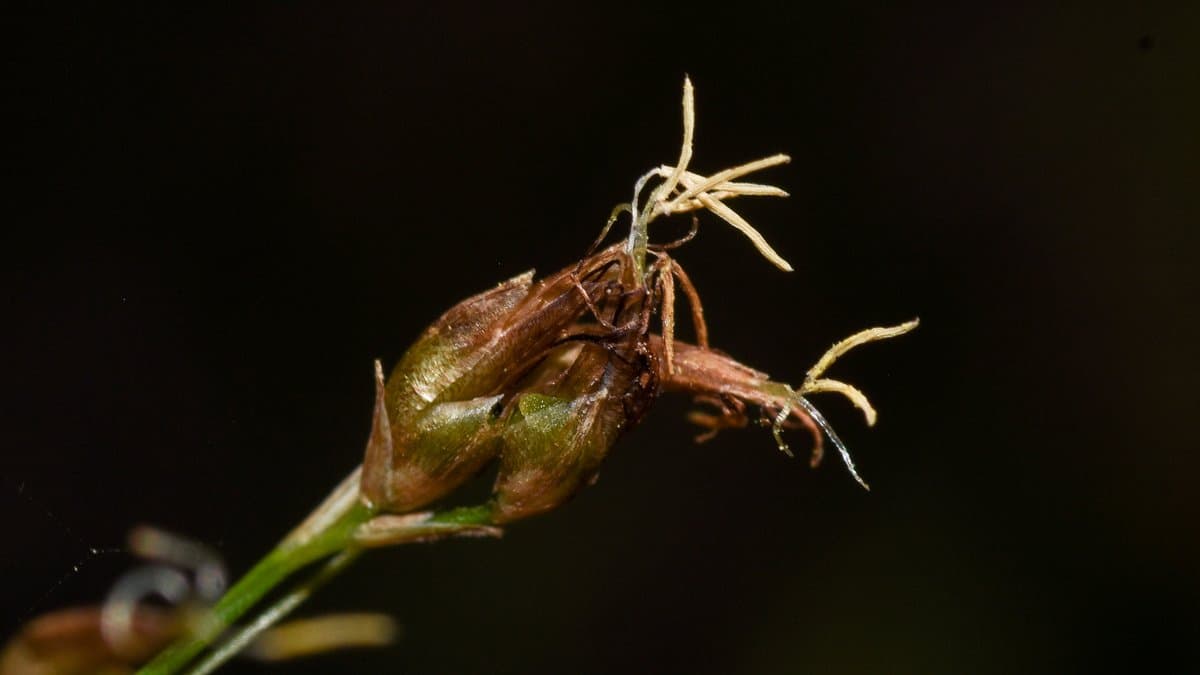
Sex is an expensive way to make a copy of yourself. A plant that reproduces sexually has to build flowers and make pollen, and then take apart the very combination of genes that carried it through its own life, dealing the pieces out again to its seeds. The taking apart is done by crossovers: the physical swaps between the two chromosome sets a parent inherited from its own two parents. In a sedge that grows in the wet grasslands of Brazil, they never happen.
Rhynchospora tenuis is a small beak-sedge of seasonally wet grasslands and savannas across tropical and subtropical America, and it holds a record: with two chromosomes to a set, it has the lowest chromosome number known in any flowering plant. Writing in Nature on Sept. 16, Meng Zhang, André Marques and colleagues at the Max Planck Institute for Plant Breeding Research in Cologne report that the plant makes no crossovers at all, in pollen or in eggs. Seedlings raised from its self-pollinated flowers come out genetically identical to their mothers.
Doing without crossovers in one sex is not, by itself, strange. Male fruit flies manage it; so do female silkworms. It is common enough, and lopsided enough, to have a name: the Haldane-Huxley rule, which says that when a species drops crossovers on one side, it is almost always the side whose sex chromosomes do not match. Dropping them on both sides, in an organism that still reproduces sexually, is what the authors say has not been described before. The claim comes fenced on four sides: obligate, genome-wide, in both sexes, in a sexual species.
Half of it has been on the record for a decade. In 2014, Marques and colleagues reported that male meiosis in R. tenuis, the cell division that makes pollen, runs without the two chromosome sets ever pairing up and with no sign of a crossover. What that microscope work could not settle was whether the female side did the same, and whether crossovers were truly absent or just too rare to catch.
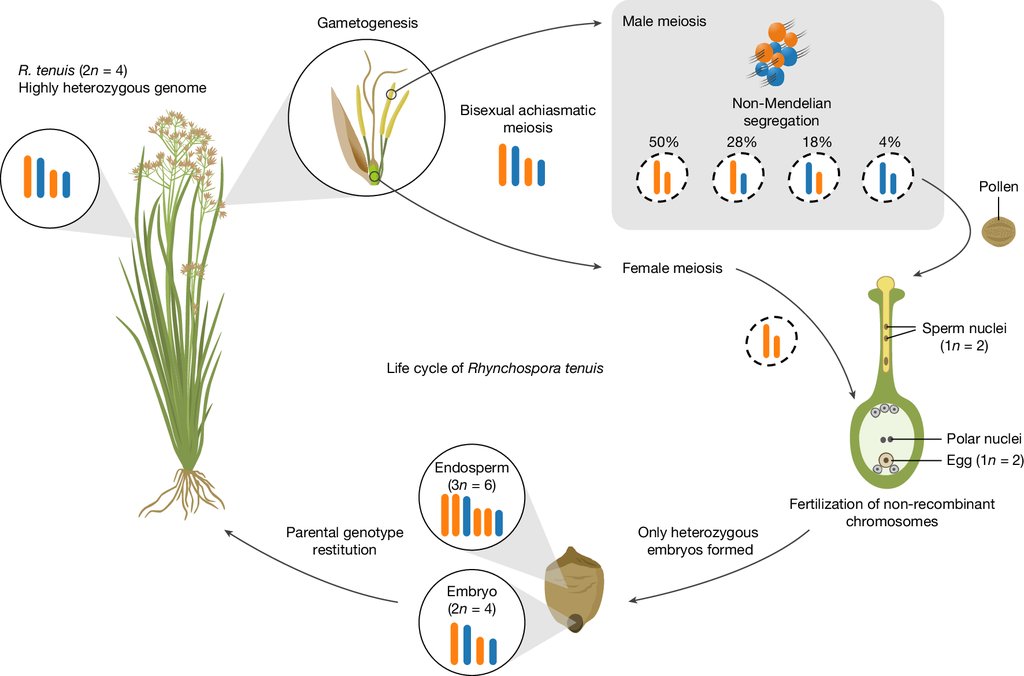
The new work answers with sequencing rather than staining. The team read the genotype of 10,997 individual pollen nuclei from five wild populations, one nucleus at a time, against a map of the plant's own two chromosome sets. Every nucleus carried its chromosomes whole. None showed the seam a crossover leaves where two parental sets have been spliced together. If crossovers happen in pollen at all, the authors write, they must be extremely rare.
Eggs cannot be sampled in the thousands, so the female side was tested through the offspring. The researchers self-pollinated mothers whose two chromosome sets differ from each other, then sequenced 111 of the resulting plants. Not one carried a recombination breakpoint on either chromosome, and every one carried the same two intact sets as its mother. Female meiosis itself was caught under the microscope in only three cells, so this half of the result rests on the offspring genomes rather than on the pictures.
An obvious explanation would be that the plant has quietly stopped having sex altogether. Some plants set seed from unfertilized eggs, a shortcut called apomixis, and their offspring are clones in the ordinary sense. R. tenuis is not doing that. Pollen tubes grow down to the ovule, and embryos begin at the micropyle, the pore where a tube arrives. Inside each seed, the tissue that feeds the embryo carries three chromosome sets rather than two, which happens only when a sperm nucleus has arrived. Seed is set the sexual way. Only the outcome looks clonal.
How the plant gets a clonal result out of a sexual process is the part the authors put forward as a proposal rather than a demonstration. With no crossovers, every chromosome is passed on whole, and two filters then decide which whole chromosomes travel together. In pollen, only one of the four products of each division matures, and the one that wins is biased toward the larger of the plant's two chromosome sets, the one carrying more mobile, repetitive DNA. After fertilization, almost anything that is not the mother's own combination dies: in one population 87% of seeds aborted. In deliberate crosses, seed set only when both parents carried the same rearrangement of chromosome ends, three combinations out of 24 tried, a thin arm of evidence beside the 111 sequenced offspring.
Because the two chromosome sets never trade material, they have been evolving as separate lineages inside the same plant, each picking up its own mutations. Three ways of dating that split give three answers, from a few hundred thousand years to about 1.7 million, and the paper works through the discrepancy rather than settling it. The plant already shows the early marks of a genome that does not recombine, including a recent burst of genes decaying into unusable copies, but not the deep decay of lineages that gave up sex long ago.
What switched recombination off is still open. A gene called SHOC1, which plants and mammals need to finish a crossover, is silent in R. tenuis and chemically marked for silence, though its sequence is intact, and the authors offer that as a possible cause rather than a proven one. What the plant already shows is that the two halves of a textbook distinction can come apart. Sex and cloning are taught as a trade, variety at a cost against copying on the cheap. This sedge pays the full price of sex, generation after generation, and takes delivery of a copy.
Sources
- NaturePeer-reviewed