Around 460 Million Years Ago, Animals Learned to Move Into the Empty Shells of the Dead

Walk any tide line today and you will find the arrangement everywhere: a hermit crab in a borrowed shell, worms and sponges crusting the inside of an abandoned whelk, a whole small economy built inside the leftovers of the dead. It is such an ordinary sight that it seems it must always have been so. It was not. There was a time when empty shells simply lay on the seafloor, vacant, going to waste. Then, at a fairly specific moment in deep time, life moved in.
That moment, according to a team led by Olev Vinn at the University of Tartu, falls in the Middle Ordovician, around 460 million years ago.
The clue that something changed is what came before. Back in the Cambrian, more than 500 million years ago, empty mollusc shells were already accumulating on the ocean floor, and animals that liked to live in sheltered cavities already existed. The two never met. For reasons still being worked out, the interiors of those Cambrian shells stayed uninhabited, a resource sitting untouched for tens of millions of years. Only in the Ordovician did organisms begin colonizing them in earnest, a genuinely new way of making a living. The study appears in Scientific Reports.
You will see this story pinned to roughly 470 million years, and that is fair as the broad window in which the shift unfolds; the first clear colonization the researchers identify sits a little later, in the Middle Ordovician around 460 million years ago. The point is the transition itself, not a single date.
Why the roomy shells won
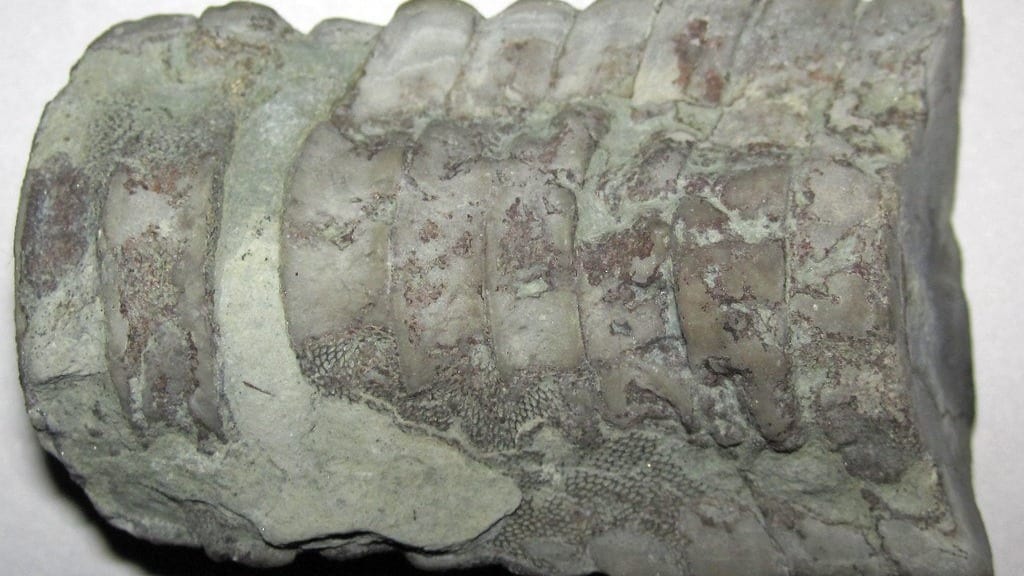
Not every shell made an equally good home, and the fossil communities the team examined show it clearly. The best real estate turned out to be the shells of nautiloids: the coiled and cone-shaped cephalopods whose living relatives include the chambered nautilus.
The reason is plumbing. A nautiloid shell is spacious, its chambers open enough that seawater could circulate freely through them. That flow did the essential work a sedentary animal cannot do for itself: it delivered oxygen and food and carried metabolic waste away. In those airy chambers, the researchers find the most diverse fossil communities of the lot. Narrow snail shells, by contrast, choked off the water exchange, and the life packed inside them stayed sparser and smaller. The architecture of the shell decided what could live in it.
A niche that stuck
What makes this more than a curiosity is that the habit, once invented, never went away. The team describes the colonization of empty shells as a global event that spread across continents through the Ordovician, an ecological innovation that added a new layer of structure to the seafloor.
That layering is the deep point. Complex ecosystems are built not just from more species but from more ways of relating: predators, burrowers, filter-feeders, and creatures that exploit the leftovers of others. Learning to occupy an empty shell added one of those relationships to the marine world for the first time. It is a modest-sounding behavior with a long shadow, running from an Ordovician seafloor all the way to the hermit crab you might turn over on the beach this summer.