Molecular Knots Let a Polymer Set Its Own Stiffness Under Strain

Pull on a rubber band and nothing interesting happens at the molecular level; the chains just uncoil. The materials described in a new paper answer force with a decision.
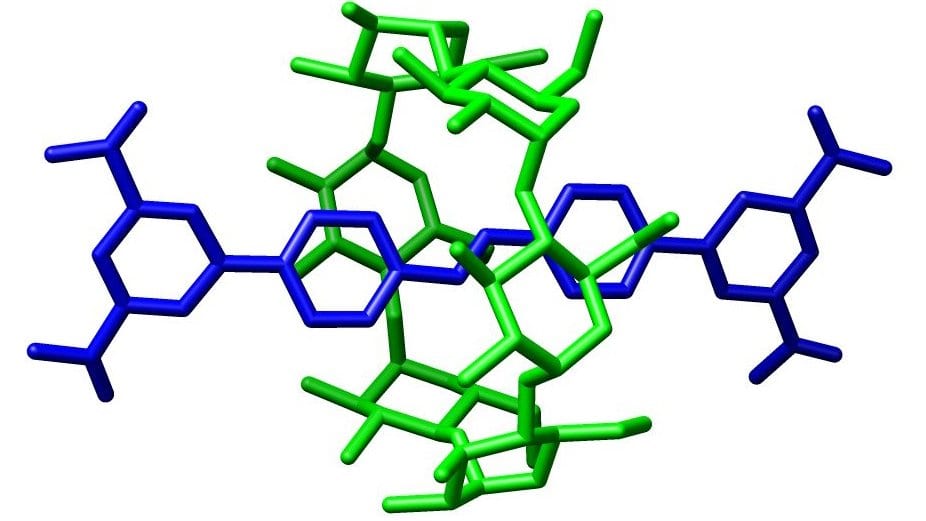
The building blocks are "daisy chains," rings threaded onto molecular axles that can slide and interlock. A team led by Xuzhou Yan at Shanghai Jiao Tong University wove them into two different networks and then pulled. In one, the strained molecules contracted into the shape of a fisherman's knot. In the other, near-identical chains extended into a loop instead. Same starting pieces, two different mechanical fates, chosen by force.
The authors call the effect mechanostereochemistry: a mechanical force, rather than a chemical reaction, driving molecules into distinct three-dimensional forms, what they term "mechanostereoisomers." Because the knot and the loop respond to strain differently, the two networks behave almost alike under a gentle pull but diverge sharply when the strain runs high. The stiffness, in other words, is set by how hard you tug. The work appears in the Proceedings of the National Academy of Sciences.
The appeal is a knob buried inside the molecule itself. Rather than mixing a stiff material and a soft one, a designer could build a single network that reads the load and answers accordingly, stiffening under a hard strain and staying compliant under a light one.
This is still a proof of concept, worked out on specialized interlocked polymers. Its reach is narrow. But it adds a mechanism to the small toolkit chemists have for coaxing a material to change its own properties, using nothing but a pull.
Sources
- Proceedings of the National Academy of SciencesPeer-reviewed