Injure One Root and Its Neighbors Feel the Pressure Drop

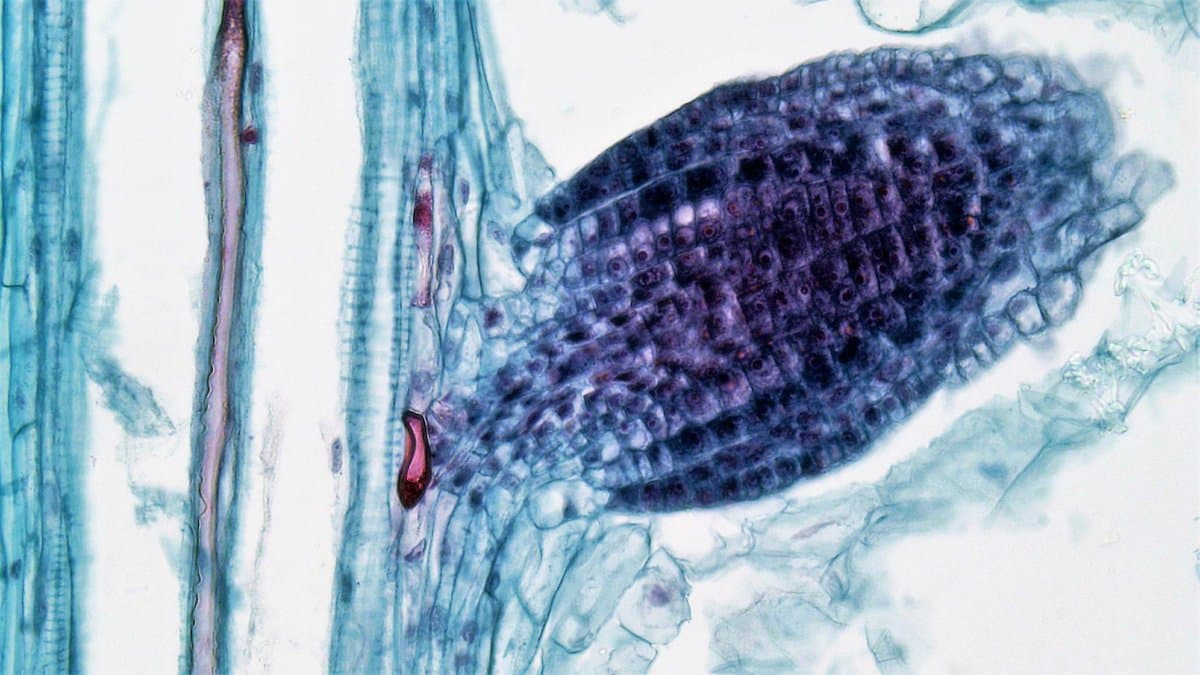
A plant's roots do their work in the dark, and almost everything known about how a plant notices being eaten was learned from the parts that do not. Bite a leaf, and the undamaged leaves hear about it through a wave of calcium moving in the veins. Underground, where larvae and nematodes chew at roots and a grower often finds out only at harvest, that conversation has been close to a blank.
Angel Baudon, a postdoctoral researcher at the Julius-von-Sachs Institute in Würzburg, and seven colleagues have now listened in. In a paper published Sept. 25, 2026 in Science Advances, they report that injuring one lateral root of the small mustard Arabidopsis thaliana shows up in its neighboring roots within milliseconds, and that the messenger is not a chemical. It is a loss of pressure.
"While the defenses of the plant's aboveground parts have already been studied extensively, communication inside the root system remained a puzzle for a long time," Baudon said in the University of Würzburg's announcement of the work, translated from the German.
The recordings are made from inside the cells. Pushing electrodes into single lateral roots, imaging calcium and switching signals on with light, the team found that a mechanical injury drops the voltage across the membrane at once and lifts calcium inside the cell. The size and the length of that calcium response scaled with how badly the root was hurt. The same voltage drop then appeared in neighboring lateral roots, milliseconds later.
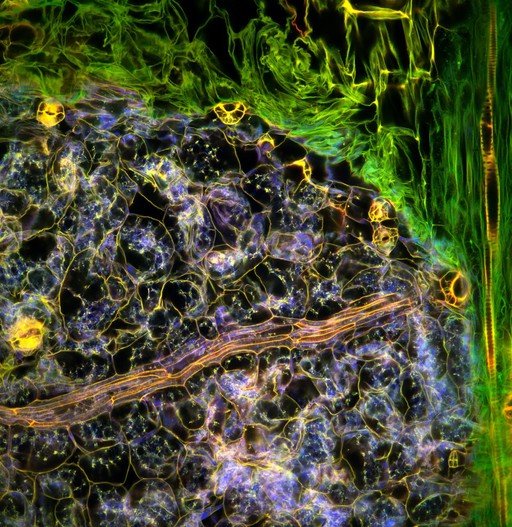
Milliseconds is the part that forces the argument. A molecule drifting from cell to cell cannot cross that distance in that time, and the root's own calcium signal stays within a fraction of a millimeter of the wound. Something physical had to be carrying the news, and the candidate the authors settle on is water. Plant cells are held rigid by internal water pressure, and a punctured cell loses it. "As soon as a root cell is injured, there is an immediate drop in the intracellular pressure, which in plants is very high," Baudon said. The paper argues that the collapse spreads through the connected plumbing of the root network fast enough to reach roots the wound never touched.
The receiving end came from mutants. Plants missing MCA1, a channel that opens when its membrane is pulled taut, gave a blunted response in the neighboring roots, and the authors cast it as the decoder of the pressure signal. Glutamate-like receptors, named for the amino acid that opens them, share the credit for the same long-distance traffic, so chemistry has not been written out of the story. The division of labor looks organ-specific: the university notes that the shoot leans on a different mechanical channel, MSL10, whereas the root leans on MCA1.
The university puts the speed of that pressure loss at about 75 millimeters per second. It also puts a boundary on it. "In leaves, warning signals often spread over long distances with no appreciable weakening. In the root, by contrast, signal strength falls exponentially with increasing distance from the site of injury," Baudon said in the release. The reason offered there is the soil itself: a root pest in packed ground moves far more slowly than an insect walking over a leaf, so a warning that fades within a few millimeters may be all a root needs.
One more result came out of the light-triggered experiments. Roots given repeated calcium spikes, with no wound at all, answered more weakly when they were later injured or exposed to glutamate, and the damping showed up in neighboring roots as well as in the treated one. On the university's reading, calcium signaling may help a root hold its response steady when damage keeps coming or arrives nearby.
The paper carries eight names. Rainer Hedrich, co-senior author, is the former holder of the Botany I chair at Würzburg and is now listed with institutions in Shenzhen; Craig R. Brodersen, at Yale, works on how water moves inside plants, which is the physics the whole claim leans on.
What is missing from all of this is the pressure wave itself. Nobody watched it travel; the case rests on the timing, on the mutants that fail to answer, and on the way an osmotic shock can stand in for a wound. That is a decent argument and it is still an argument, built in one laboratory, on one small plant, with a few seedlings behind each comparison. And pressure is not the only messenger on the table: a separate group has proposed that a wounded root releases protons, and that neighbors sense the acidity, in work that has not been peer reviewed.
The practical hope is stated as a hope. "A deeper understanding of how crop plants sense mechanical damage allows a more targeted optimization of natural resistance against root-feeding insects," Baudon said, and the release's reasoning is that a plant primed to defend its own roots would need less chemical help. No crop was tested here.
Sources
- Science AdvancesPeer-reviewed
- idw-online.de