DNA From Museum Jars Is Untangling Madagascar's Diamond Frogs

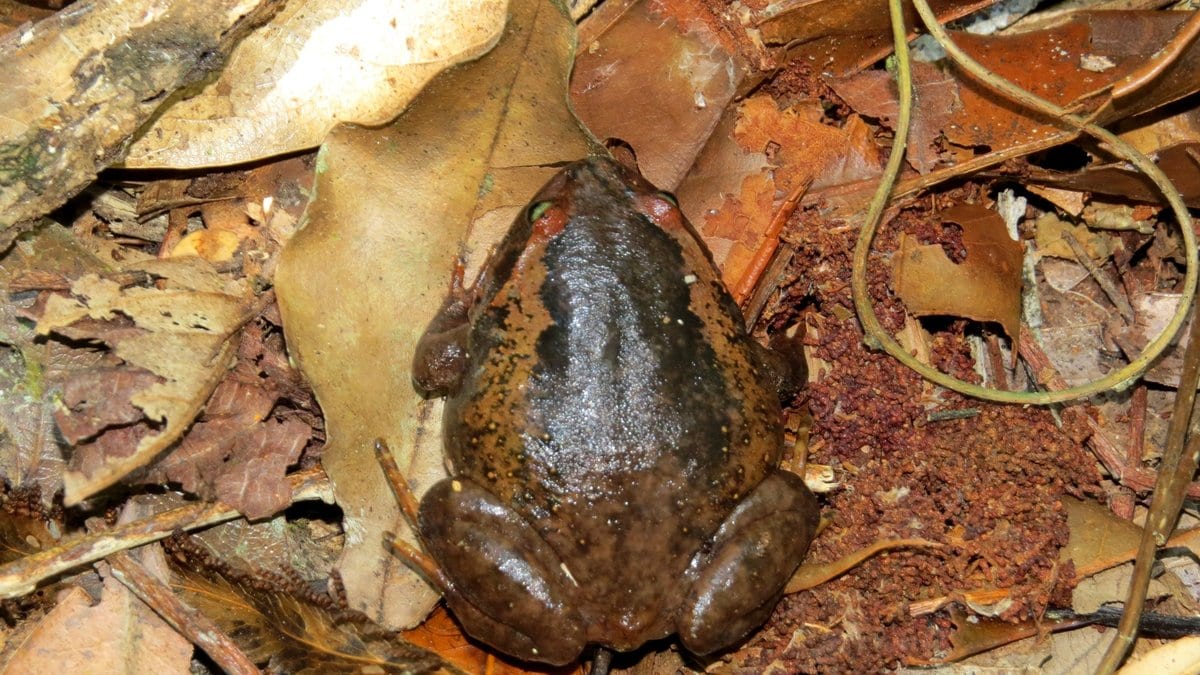
A frog collected on the Marojejy massif in northeastern Madagascar has sat in a jar in Paris for half a century, and for most of that time it was a problem. It is the holotype of Rhombophryne serratopalpebrosa, the one physical specimen that the name is pinned to, and nobody had been able to get usable genetic material out of it. Working in a laboratory kept clean for historical samples, a team finally has. Eighteen readable fragments came off a single gene, a miserable yield by modern standards, and enough to put the animal onto a family tree for the first time.
That jar is one thread in a monographic revision of the diamond frogs, genus Rhombophryne, published in July in the peer-reviewed journal Vertebrate Zoology and free for anyone to read. It treats every species in the group, describes seven new ones and brings the total to 27. Mark D. Scherz, curator of herpetology at the Natural History Museum of Denmark in Copenhagen, led the work, and Angelica Crottini of the University of Florence is its senior author. Achille P. Raselimanana of the Université d'Antananarivo and Andolalao Rakotoarison, both based in Madagascar, are among its authors.
Diamond frogs are small, mostly brown and mostly out of sight. They live in and under the leaf litter of Madagascar's humid forests, and some call from inside burrows, so a field team can narrow a calling male down to a square meter of forest floor and still spend a long time digging him out. Oskar Boettger named the genus in 1880 for one round, small-eyed burrower with spiny projections along its lower lip, and it stayed a genus of one for over a century. Genetic work then pulled in relatives that had been filed under other names, and the count has more than doubled since.
The DNA in old jars is mostly ruined
Recovering DNA from a specimen that spent decades in formalin and then in ethanol is a specialty of its own. The team took small amounts of liver or thigh tissue under clean conditions and processed them in a laboratory equipped for historical material, and recovered something usable from nine museum samples. What came back was thin. The holotype of R. testudo, the frog Boettger had in front of him, yielded one fragment of each of two gene regions, a few dozen letters apiece, but still enough to place it, tentatively, with the other frogs carrying that name. Another holotype, of R. coudreaui, produced nothing readable at all, and a set of specimens from Ivohibe in the southeast failed even after a second extraction method was tried.
This matters because a name is only ever as good as the specimen behind it. A description published in the nineteenth century pins a frog down in words; a sequence read from that same specimen says which living animals the name actually covers. The revision reports DNA from the name-bearing specimens of 23 of the 27 species, and museomics, the recovery of DNA from long-preserved collection material, did the work for the types of three species collected before 1976. It also produced a small surprise: a second specimen of R. serratopalpebrosa, genetically matched to the Paris holotype and the only other one ever found.
Five kinds of evidence before a frog gets a name
No single line of evidence names a species in this work. The team used one mitochondrial marker for a first pass and a nuclear gene to check that the lineages were not still interbreeding, then added body measurements, recordings of the males' advertisement calls and micro-CT scans of the skeleton. The scans matter more than they sound: they show the skull and the vertebrae without cutting anything open, which is decisive when a species is known from a handful of animals in a drawer. Where the lines of evidence disagreed or the material was too sparse, the authors held back, and several candidate lineages are discussed in the paper and deliberately left unnamed.
The genus itself turns out to be far more varied than "small brown frog" allows. Adults run from 11 millimeters in the most miniaturized species to nearly 59 in the largest, and the group takes in stocky burrowers, long-legged leapers and frogs with spines above the eye. Reddish flash markings on the hind limbs show up in several separate branches, which the authors read as the same trick evolving more than once.
Most of the genus is in trouble, on the team's own reckoning
Fewer than half of the species in the genus have been assessed for the IUCN Red List at all, and most of those that have been are listed as threatened. Having redrawn both the ranges and the species boundaries, the authors propose fresh assessments for the whole genus, and on that proposal 24 of the species would sit in a threatened category. Two of them, they argue, probably warrant the Critically Endangered label. One is R. kilonjy, described here for the first time and known from a handful of specimens in the fragmented forests of the Sahamalaza Peninsula. The other is R. matavy, found only in low-elevation forest in Montagne d'Ambre National Park, where the authors report that illegal logging continues.
None of that reflects a decline in the frogs themselves. It reflects better information about where they live, and how little of it there is. Habitat loss is the main pressure the authors identify, with fire close behind, and elevation decides who feels it first: a species at the foot of a massif sits nearer to logging and burning than one high on the same mountain.
The genus is not finished either. Several lineages are still waiting on more specimens before anyone can decide whether they are species, and the authors expect under-surveyed forests in the north and northeast to yield more. Some of the basics are missing too. No egg and no tadpole of any diamond frog has ever been described, and what these animals do to reproduce is inferred from one burrow of froglets found decades ago.
Sources
- Vertebrate ZoologyPeer-reviewed