Three Molecules Folded Into Shape Inside an Acid That Dissolves Metal

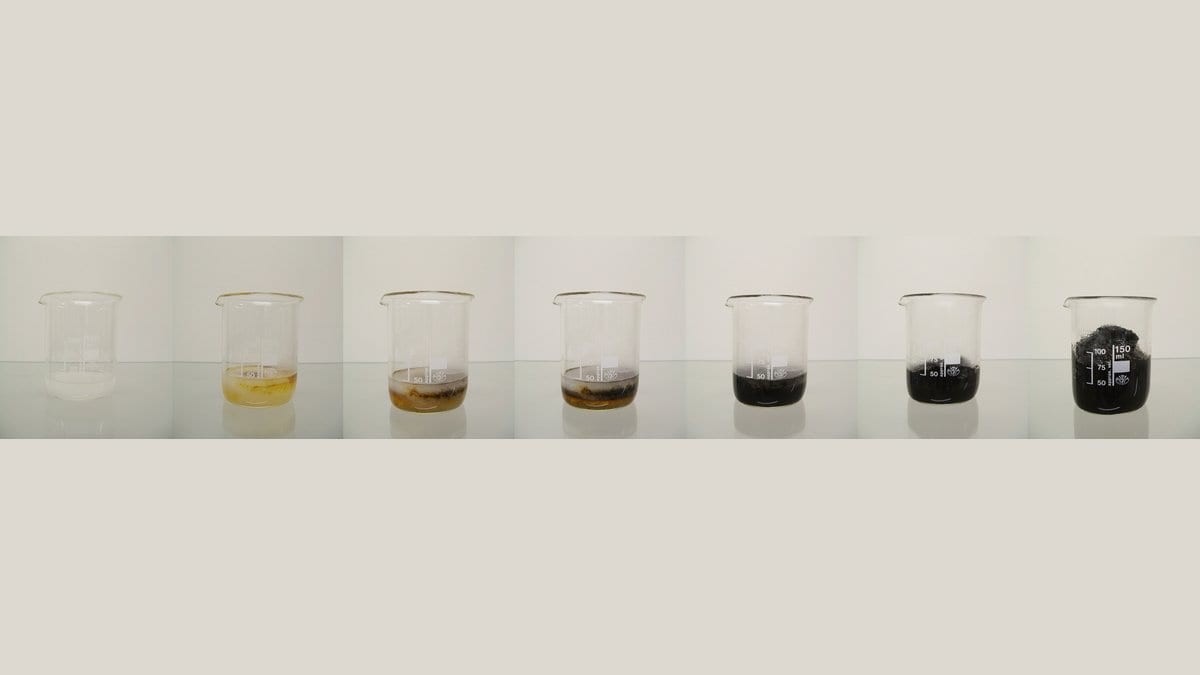
Concentrated sulfuric acid is what a chemist reaches for when the goal is destruction. At 98% by weight it pulls the water out of sugar, chars paper to carbon and eats through metal. It is also the weather on Venus. The planet's permanent cloud deck is made of droplets of the stuff, floating at altitudes where the temperature would otherwise be pleasant. For decades that combination has been treated as a closed door: whatever else those clouds have going for them, nothing with a complicated shape could keep it there.
A paper published on September 4 in the Proceedings of the National Academy of Sciences pushes on that door. Jia Yi Zhang, a graduate student in Mei Hong's chemistry lab at MIT, put three short peptides (chains of amino acids, the units proteins are built from) into 98% sulfuric acid and waited. Two were seven amino acids long, one longer. A high-field magnetic resonance instrument, which pinpoints individual atoms inside a molecule, showed that none of the three had come apart. Each one folded, and all three folded the same way: into a compact loop that doubles back on itself, the shape structural biologists call an omega loop after the Greek letter it resembles.
Why they survived comes down to something absent. An acid normally breaks a peptide chain by hydrolysis, a reaction that consumes a water molecule to cut the bond. At that strength there is barely any water in the bottle to consume. "Without water, an acid that you would consider a harsh solvent suddenly is not as menacing as one might think," Hong said in MIT's announcement of the work. That the droplets on Venus are similarly dry is not this group's claim alone; a 2021 analysis in Nature Astronomy of how much water is actually available in those clouds put them far below anything a known organism can grow in.
The folding itself, the paper states as a result rather than a suspicion. The loops, the authors write, are "stabilized by solvent-mediated interactions and intramolecular hydrogen bonding": held in shape partly by bonds inside each molecule and partly by the acid around it. MIT's release goes a step further, saying the team believes acid molecules slide into the center of each loop and prop it open. That picture is a belief the researchers hold, not something the measurements settle.
None of this means sulfuric acid cannot cut a peptide, and the paper's own reference list is where the check sits. In 2024 the same collaboration reported that most of 20 two-amino-acid peptides broke down within a few weeks in this solvent, at 98% and at the weaker 81% alike, not by hydrolysis but by a different reaction that needs no water at all. A follow-up the next year proposed how that reaction proceeds. Two of the 20 held out for four months. So the narrow reading of the new work is the interesting one: these three peptides did not merely last, they took a shape and kept it.
What the journal version carries that the August announcement did not is the coordinates. Three atomic-resolution structures were deposited alongside the paper, one for each peptide, in the Protein Data Bank and the Biological Magnetic Resonance Bank: entries 12UF, 12UG and 12UI, filed in April and public now. A structure claim that arrives with downloadable atomic positions is a different kind of claim from one that arrives in a press release: anyone with the software can pull the loop up and argue with it.
The reason a chemistry result about three molecules is being read as an astronomy result is the assumption it pokes at. The search for life beyond Earth has been organized around liquid water, and the habitable zone around a star is drawn where water can be liquid. The paper's opening sentence names that assumption directly, and its closing one says the finding "expands the range of planetary environments that may support complex chemistry." Venus is the case in hand, and the paper says so on its first line. But the question underneath belongs to chemistry as much as to planetary science: whether a liquid other than water can hold a large molecule in a working shape.
Adriaan Bax, a biophysicist at the National Institute of Diabetes and Digestive and Kidney Diseases who had no part in the study, called the results "important and unexpected" in the same announcement, and said they raise the prospect of folded protein structures existing in environments very unlike Earth's. Sara Seager, one of the paper's senior authors, leads the privately funded Morning Star Missions to Venus (MIT's release says so plainly), and a result that strengthens the case for going there is not a disinterested one.
Nothing in the paper says anything is alive in Venus's clouds, and it does not test whether an omega loop in acid can do a job. Folding is the precondition for function, not the demonstration of it: a protein has to hold a shape before it can grab hold of anything. Three molecules are also a small sample by construction, and one of them was chosen partly because Hong had studied it before. The lab wants to try longer peptides next, and Seager's group is working on a synthetic, DNA-like molecule that has already held together as a single strand in acid. Those are chemistry experiments, and they can be run on a bench in Cambridge long before anything is sent to Venus.
Sources
- Proceedings of the National Academy of SciencesPeer-reviewed