The Textbook Rule That Just Fell: Photosynthesis With One Photosystem

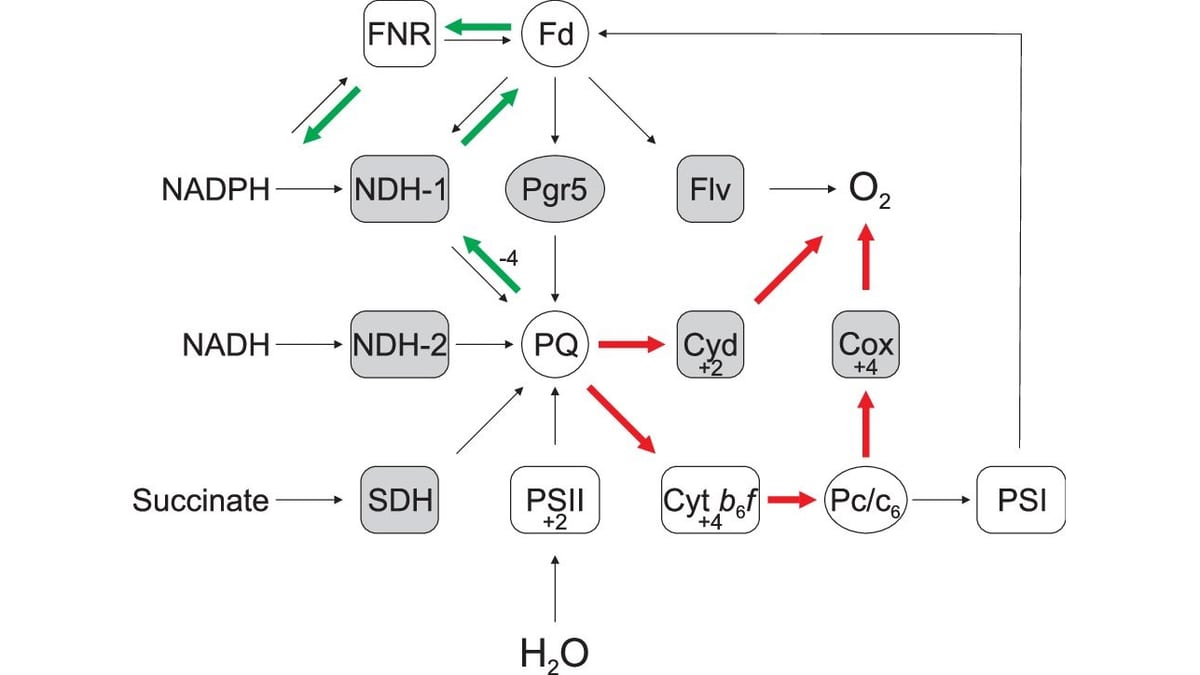
Open almost any biology textbook to the chapter on photosynthesis and you will meet the same diagram. Light hits a green cell and its energy runs down a chain built from two linked machines, Photosystem II and Photosystem I, arranged in series like two waterwheels on one river. Photosystem II splits water and releases oxygen. Photosystem I takes the electrons the rest of the way and helps make NADPH, the cell's portable chemical fuel. Two photosystems, working together. That has been the rule for more than fifty years, and it holds for every oxygen-producing organism ever studied, from pond scum to redwoods.
A cyanobacterium in a Munich lab did not read the textbook.
Working at LMU Munich, Dario Leister and his colleagues report in Nature Communications that they coaxed a cyanobacterium into performing complete oxygenic photosynthesis with only one photosystem. Photosystem I was gone entirely, and the cells still made oxygen and NADPH. If the finding holds up under the scrutiny it will now attract, it unsettles one of the most confidently taught facts in cell biology.
The result did not come from a clever redesign so much as from patience. The team used what biologists call adaptive laboratory evolution: keep a population of microbes alive under pressure, generation after generation, and let natural selection do the engineering. Along the way they ended up with strains that had lost Photosystem I altogether. By the textbook, those cells should have been dead in the water, unable to complete the light reactions. Instead they were quietly making oxygen.
So how does a cell run the second half of photosynthesis without the machine that is supposed to do it? The answer lies in a piece of equipment the cell already owned. A complex called NDH-1 normally works in one direction, but the evolved bacteria drive it backward. A steep gradient of protons across the cell's internal membrane, built up by the light reactions, supplies the push. Running in reverse, NDH-1 generates NADPH, taking over the very job Photosystem I once monopolized. The cell had a spare part all along and, under enough evolutionary pressure, learned to reroute the circuit through it.
"Our results reveal that nature is much more flexible than we previously believed," Leister said of the work.
The implications reach beyond a single surprising microbe. Photosynthesis is thought to have evolved in stages, and the two-photosystem arrangement is old and deeply conserved, which is part of why it seemed non-negotiable. Showing that a living cell can make oxygen with just one photosystem widens the space of what early photosynthetic life might have looked like, and how the modern machinery could have been assembled from simpler ancestors. It is a reminder, as Leister put it, that "even one of the best investigated processes in biology can still reveal profound surprises."
There is a practical thread as well. Researchers have long wanted to redesign photosynthesis to capture light more efficiently, for crops or for engineered microbes that turn sunlight into useful chemicals. A photosynthetic system that works with fewer moving parts is exactly the kind of blueprint that effort needs. Whether a stripped-down, one-photosystem cell can ever match the efficiency of the two-machine original is an open question, and not one this study settles.
For now the headline is the biology itself. The waterwheels, it turns out, can run on a single wheel, if evolution is given enough time to find the way.
Sources
- www.lmu.de
- Nature CommunicationsPeer-reviewed