A Single-Celled Hunter That Rents Its Compass From the Bacteria Living Inside It

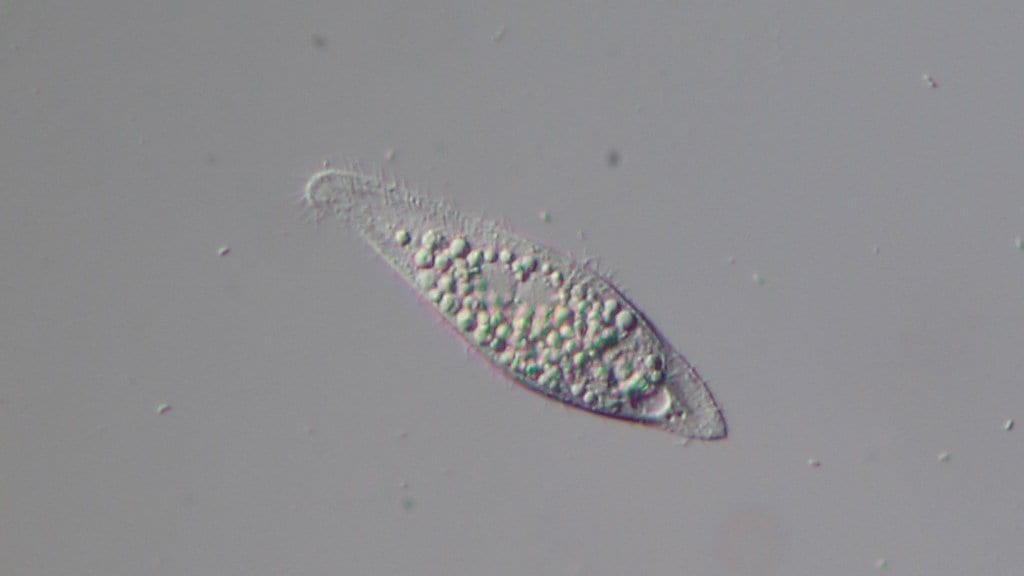
In the airless mud of a river near Libreville, in Gabon, a single cell keeps finding its way down. It is a ciliate: a fringe of beating hairs, a nucleus, the sort of organism a high-school microscope turns up in pond water. And yet it orients to the planet's magnetic field the way a compass needle does, steering itself toward the low-oxygen sediment where it feeds. The strange part is what happens when you look inside it. The cell owns no compass of its own. It has been renting one.
That is the picture drawn by Mitali Chitnis, Leon Kaub, William Orsi and colleagues at Ludwig-Maximilians-Universität München, working with collaborators in Slovakia, in a paper published July 20 in the Proceedings of the National Academy of Sciences (10.1073/pnas.2609513123). They give the organism a new species name, Tropidoatractus magnetotacticus, and describe how it navigates: not through any structure the ciliate itself makes, but through a three-way microbial partnership packed inside a single cell.
The trick, and who really does it
Navigating by magnetism is an old talent among bacteria. Certain species grow chains of magnetite, a naturally magnetic iron mineral, inside tiny compartments called magnetosomes. Strung together, those crystals turn the whole microbe into a swimming compass needle that lines up with Earth's field and drifts along it. Biologists have catalogued this behavior in bacteria for half a century.
Finding it in a eukaryote (a cell with a nucleus, the branch of life that includes us) is rarer, though not unheard of. A handful of earlier cases exist, including a marine protist that borrows magnetic bacteria stuck to its outside. What sets the Gabon ciliate apart is where the borrowing happens and how it is paid for. The magnet-builders are not passengers on the hull. They live within the cell, and they are wired into its metabolism.
Under the electron microscope, the team saw magnetite particles arranged in chains "resembling strings of pearls," as the group described them: the classic magnetosome signature. But the chains belong to rod-shaped bacteria tucked inside the ciliate, not to the ciliate itself. Genomic and transcriptomic analysis identified those bacteria as magnetosome-producing, sulfate-reducing microbes. They are the source of the host's magnetic sense. The ciliate, in effect, houses its own compass factory.
A closed loop of favors
A second lodger completes the arrangement. Alongside the magnet-makers, the ciliate carries methane-producing archaea, microbes from a domain of life distinct from bacteria. The three organisms form what the authors call a tripartite syntrophy: a feeding-across, a metabolic economy in which each partner's waste is another partner's fuel.
Roughly, it runs like this. The host cell's byproducts feed its internal microbes; the methanogens mop up hydrogen and other leftovers that would otherwise stall the chemistry, keeping the whole system energetically viable in mud where oxygen is scarce. And the magnet-building bacteria hand the ciliate a way to steer toward exactly that kind of low-oxygen sediment. Each organism gets something it could not make alone. Pull one out and the loop breaks.
"Discovering that they navigate by using these endosymbionts revealed a fascinating new way," lead author Leon Kaub said of the find, according to LMU. Chitnis framed the larger point: a new capability, she noted, "can emerge not just through the evolution of a single organism, but also from the long-term symbiosis."
What is genuinely new here
It is worth being precise about the claim, because it is easy to overstate. This is not the first time a eukaryote has been shown to sense magnetism; that ground was broken earlier, including a 2019 report of a marine protist steered by magnetic bacteria clinging to its surface (Nature Microbiology, 2019). What the LMU team reports is narrower and, in its way, more specific: the first described magnetotactic ciliate, and the first eukaryotic magnetotaxis built on an intracellular three-way syntrophy. That is a mechanism, not just a behavior. The genus Tropidoatractus was already known to science; the species name magnetotacticus is the new label pinned to this organism.
That distinction matters for what the work implies. If a cell can acquire a full sensory ability by domesticating microbes and knitting their metabolisms into its own, then the toolkit of complex life may owe more to borrowed partnerships than to slow solo invention. The same LMU group has published companion work on this organism in Nature Communications. That is the same team describing the same cell from another angle, not a separate lab confirming the result, so the finding still rests on one research group's account rather than independent replication.
Orsi, for his part, expects the ciliate will not stay unique for long. "Now that this type of symbiosis has been discovered," he said, "I anticipate that many more similar cooperations will be discovered." The PNAS paper is peer-reviewed.
Sources
- Proceedings of the National Academy of SciencesPeer-reviewed
- Proceedings of the National Academy of SciencesPeer-reviewed