A Primate-Only Switch, and the Brain Cell It Helps Build

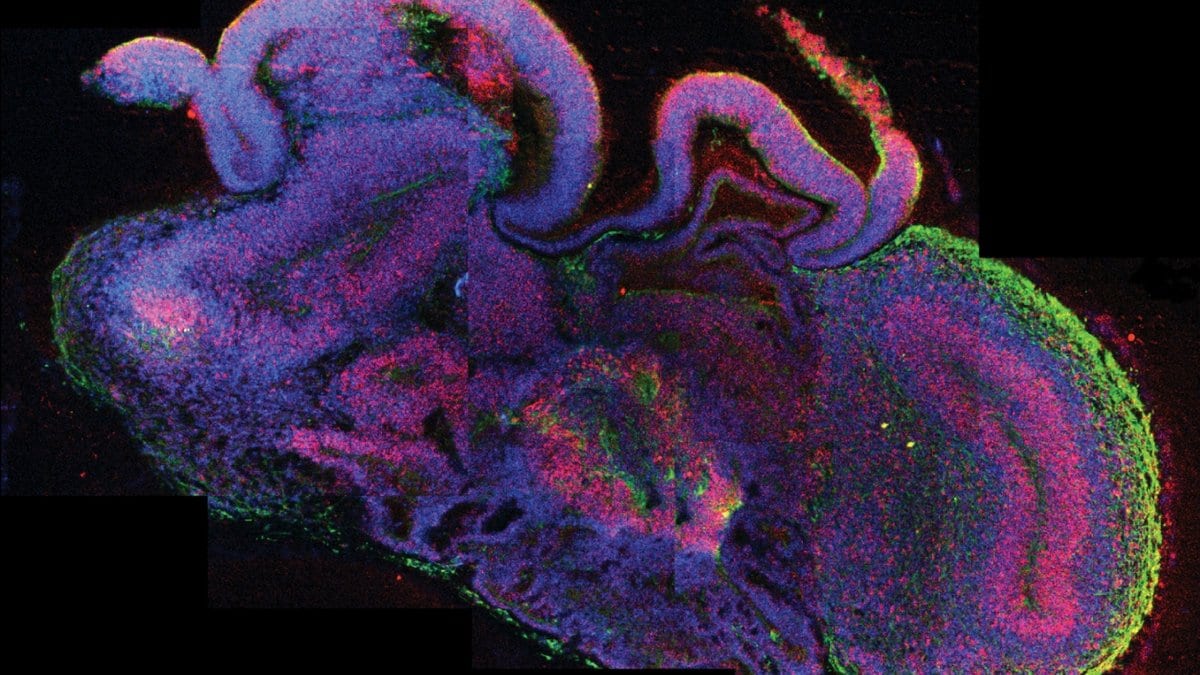
Take a gene out of a mouse's developing cortex, the outer sheet of the brain, and little happens. Take the same gene out of human cortical tissue grown in a dish, and that tissue stops making one of its most distinctive cells. The mismatch is where this story starts, and what explains it is not the gene.
The gene is DACH1. The cell is the basal radial glia, a neural stem cell that divides away from the brain's inner surface. Primate brains make these cells in quantity; rodent brains barely make them. In a paper published Nov. 13, 2026, in Science Advances, Pei-Shan Hou of National Yang Ming Chiao Tung University and Hung-Chih Kuo of Academia Sinica, both in Taipei, report with colleagues that a short stretch of regulatory DNA switches DACH1 on in cortical stem cells. The stretch is there in primates and not in mice.
Basal radial glia can divide and renew themselves many times over, so each one can found a lineage instead of producing a neuron and stopping. Earlier work has tied their abundance in primates to the supply of upper-layer callosal neurons, the cells whose axons cross between the two halves of the cortex. What nobody could say was how an anchored stem cell comes to produce so many of them.
The six letters mice do not have
DACH1 turned up in a comparison of single-cell gene-expression data from developing human and mouse cortex. Two stem cell groups were common in the human data and all but absent in the mouse, and DACH1 was among the strongest markers of one of them. An earlier survey had already mapped DACH1 across the developing human cortex and striatum.
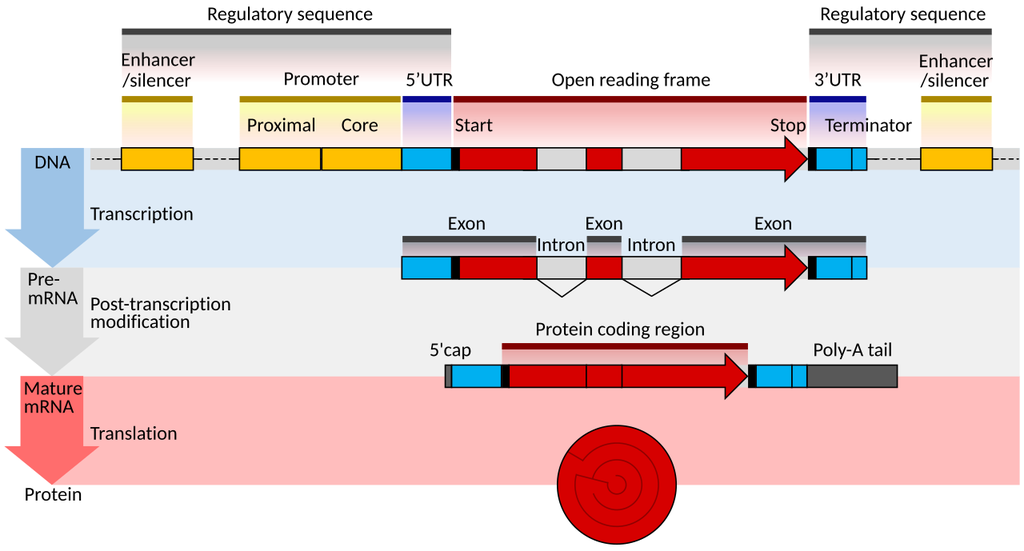
The switch came next. LHX2, a gene that acts broadly in the developing forebrain, raises DACH1 levels. It does so even when PAX6, the other candidate, is knocked down. Hou and colleagues found LHX2 sitting on 4 of 16 predicted binding sites near DACH1 in human neural progenitors, and on none in undifferentiated stem cells. One of the four, called Dc3-4, carries a complete six-letter LHX2 binding motif, TAATTA. That motif is complete across primate genomes and incomplete or absent in other vertebrates. No LHX2 binding was found at the matching mouse location.
Taking it out, and putting it in
To test the element, the team deleted it. Using CRISPR-Cas9, they removed the 310-base-pair Dc3-4 sequence from two embryonic stem cell lines, one human and one rhesus monkey. From those lines they grew cortical organoids, small balls of lab-grown brain tissue. In 76-day-old human organoids and 60-day-old rhesus monkey organoids, the basal radial glia marked by the protein HOPX were scarcer than in controls. The stem cells that stay anchored at the cavity, marked by PAX6 and SOX2, were unchanged, and so was the overall layout of the tissue. No animal was edited. Putting DACH1 back into the edited cells restored those genes in both species, which ties the effect to DACH1 and not to the cut itself.
Then they ran it the other way. A copy of the human Dc3-4 element, half a kilobase long, was knocked into the matching Dc3 location in the mouse genome. The method, in utero electroporation, delivers DNA into a patch of cells in an embryo's cortex rather than into the whole animal. These were not transgenic mice; the change sat only in the cells that took it up. The knock-in was done midway through the mouse's cortical development and scored two days later, in six embryos per group across two litters. Mouse cells carrying the primate element were more likely to express Dach1 and Hopx, the markers of the cell in question.
What the cells become
A separate experiment, with DACH1 itself rather than its enhancer, shows the shift one division at a time. The team put extra DACH1 into mouse cortex and filmed individual stem cells dividing. In those cortices, 28 of 192 daughter cells took on the basal identity, against 5 of 120 in controls. A week after birth, the labeled cells leaned toward Satb2, a marker of the neurons that cross between hemispheres, and away from Ctip2, a marker of the ones that project down the spinal cord.
The human side runs the same way. In organoids grown for about four months from stem cells with DACH1 knocked out entirely, CTIP2 neurons increased while SATB2 and BRN2 neurons fell. Mice are the odd case. The authors write that "loss of Dach1 expression in the mouse neocortex had little impact," and their own mouse knockout changed neuron identity little or not at all.
How DACH1 does this is still a proposal. The authors' model is that DACH1 binds the promoter of a small regulatory RNA, miR-215, and holds it down. Released, miR-215-5p damps genes the cell needs for its division machinery, including CENPE, CENPF and STIL. That is also what a stem cell uses to let go of the wall it is anchored to. Adding miR-215-5p to healthy organoids reproduced the shortage. Blocking it in knockout cells restored those genes. Whether DACH1 does all of that through gene expression alone is not settled.
The scope of all this is narrower than it sounds. The authors' own reading of their transcriptome data is that DACH1 biases the choice a stem cell makes at division, rather than enlarging the progenitor pool in general. Nothing in the paper measures cortical size, thickness, surface area or folding. Their argument for the fate bias is a timing asymmetry. In the knockout organoids, the HOPX cells thinned out first, while the general progenitor pool held steady for another two weeks. The enhancer deletion points the same way, because it cut the basal cells without touching the anchored ones.
That is the honest limit of the result. The paper is peer-reviewed and open access, and the enhancer experiments run in both directions, but the primate evidence comes from stem cell lines and organoids rather than from primate brains. The authors say as much. They write that they cannot demonstrate the full impact of this pathway in a developing primate neocortex, because their access to primate brain samples was limited. The counts behind the organoid work run from 7 to 21 per comparison, all from one laboratory.
The result also sits in an existing class. A human enhancer of FZD8 and the human-specific gene ARHGAP11B have both been put into mice before, and both of those did report effects on cortical size. This one reports something narrower: a change in the supply of one cell type, and in the kind of neuron that cell goes on to make.
Sources
- Science AdvancesPeer-reviewed
- pmc.ncbi.nlm.nih.gov
- Cerebral Cortex