Ultraviolet Light Reveals the First Known Babies of a Mysterious Jurassic Fish

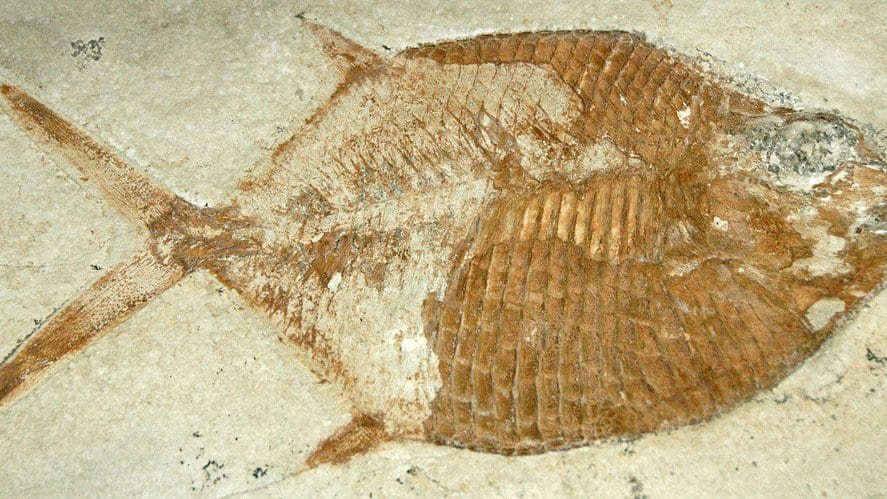
Some discoveries need a new dig site. This one needed a new lamp.
For roughly 150 years, fossil slabs of the Jurassic fish Mesturus verrucosus have rested in museum collections across Europe, studied by specialists who catalogued the adults in careful detail. What they missed, a new paper argues, was the young.
Paleontologist M. Ebert, writing in the Swiss Journal of Palaeontology (vol. 145: 751–783, July 2, 2026), revisits Mesturus and its relatives from the Jurassic of England and Germany. The fish lived roughly 152 million years ago, in the Tithonian age near the close of the Jurassic, a world of warm, shallow reef seas.
The twist, as described in press reporting on the study, is the method. Under normal light, small juvenile specimens are easy to overlook. But shine ultraviolet light on the same slabs and certain fossilized tissues fluoresce: scales and body spines that were all but invisible suddenly stand out against the rock. Using that glow, the study identifies the first known juveniles of the species: youngsters just a few centimetres long, reportedly in the range of 4 to 9 centimeters, belonging to a fish whose adults could reach about half a meter.
The appeal of this approach is easy to see. Ultraviolet imaging is an established technique on the famous Solnhofen fossils, and it keeps proving that the richest new specimens are sometimes the ones already in the cabinet. The fish did not change. The light we look at it with did.
Sources
- Swiss Journal of PalaeontologyPeer-reviewed