Human Immune Cells Read Gut Archaea Through a Single Sensor, TLR8

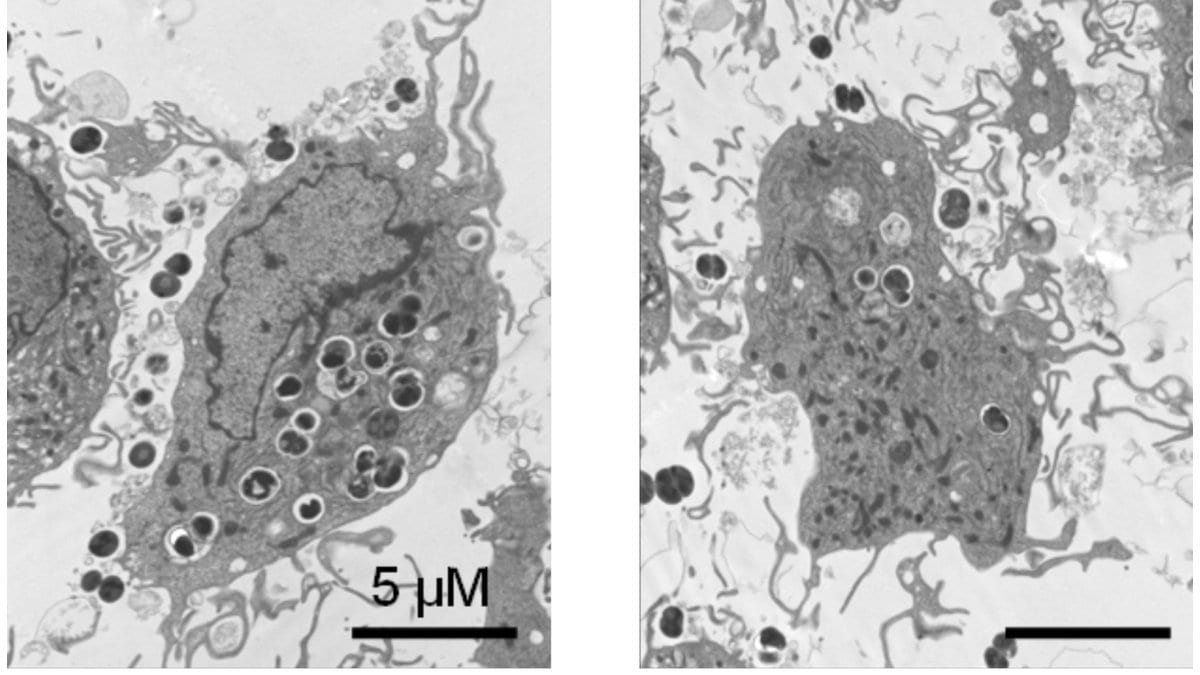
The human gut is usually told as a story about bacteria. It is not only bacteria. A third branch of life lives there too: the archaea, single-celled organisms that are neither bacteria nor the kind of cell we are built from, and the methane-making ones among them can make up as much as 4% of a gut's microbes, by the estimate the paper cites. To an immune cell they are also almost featureless. Archaea carry none of the cell-wall molecules immune cells normally use as a bacterial fingerprint, so a system built to read surfaces faces a resident microbe with nothing recognizable on the outside.
On Nov. 2, 2026, Fan Xu, Holger Heine and colleagues at the Research Center Borstel, Leibniz Lung Center, with Christine Moissl-Eichinger's group at the Medical University of Graz, published an answer in Nature Communications: immune cells do not read these microbes from the outside at all. They swallow them whole and read what is inside. All of it happened in a dish. The blood came from nine healthy donors, the archaea were added to the cells, and nothing in this study was measured in anyone's gut, in an animal or in a patient.
The first difference was not in the reading but in the swallowing. The two species compared, Methanosphaera stadtmanae and Methanobrevibacter smithii, are both common gut methane-makers, and monocytes, the blood's main eating cells, took one in far faster than the other. After an hour, about 48% of monocytes held at least one M. stadtmanae cell, against about 7% for M. smithii, more than six times as many cells. That counts cells that had taken something in, not how much, and the gap narrows: by four hours it was under three times. With swallowing blocked by a drug, the response to both species collapsed and the difference between them vanished.
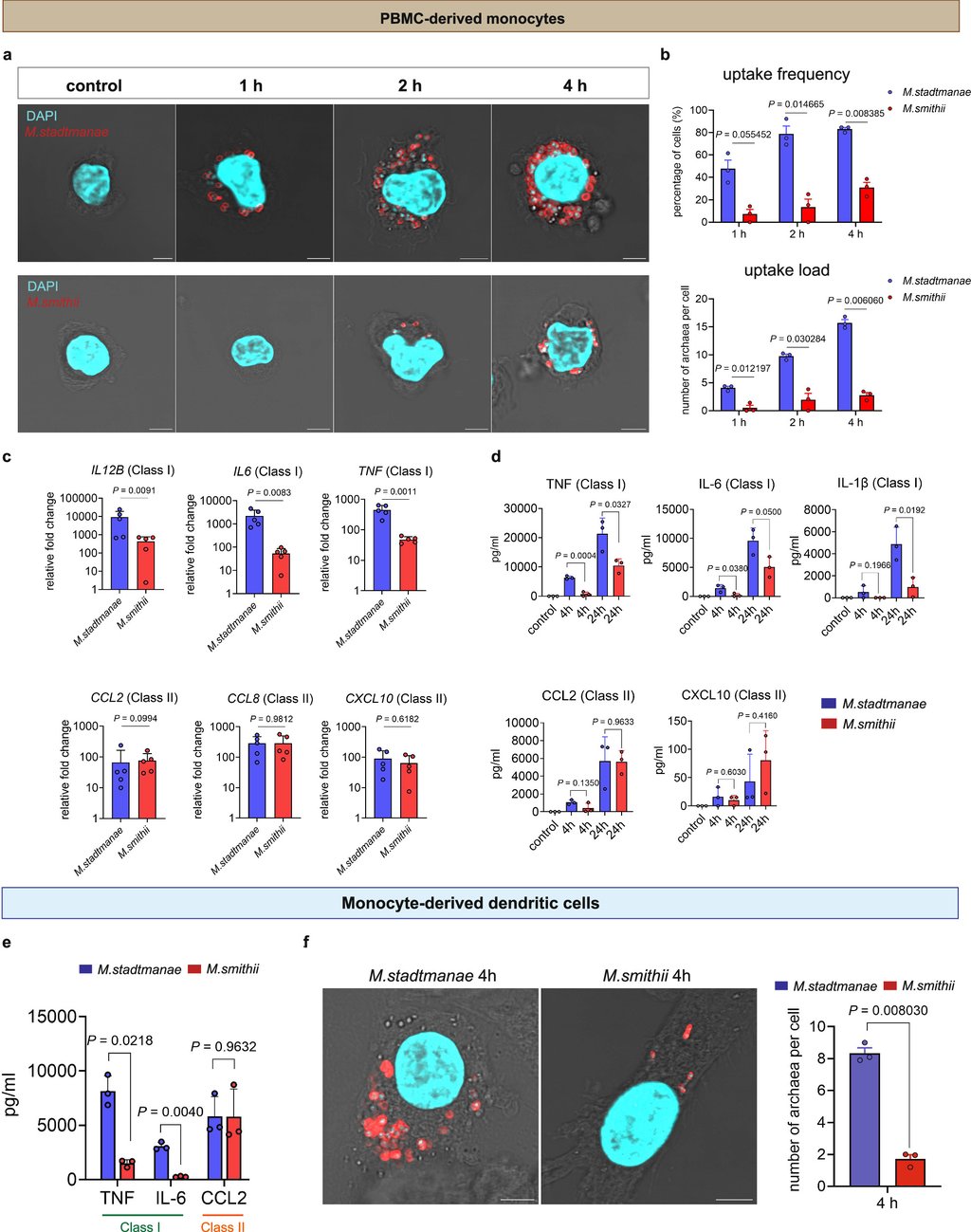
What the cells then did was mostly shared. Sequencing the donors' cells, the authors found a core of 443 genes switched on under every stimulated condition they tested. At four hours that core split in two. One group, 247 genes, answered M. stadtmanae more strongly; the other, 195 genes, answered both species about equally, and exactly one gene leaned the other way. Within a day the two responses had largely converged. The authors call the two groups Class I and Class II.
The cells read them from the inside
Both groups run through the same receptor. TLR8 sits inside the cell, in the acidic compartment where swallowed material is broken apart, and it reads fragments of microbial RNA. Heine's group had already shown archaeal RNA is the trigger; the new work tests the receptor from two directions at once. A selective blocker, CU-CPT9a, cut both gene groups to near baseline. In monocyte-like cells with the TLR8 gene deleted, IL6 induction was, in the authors' words, "abolished in TLR8 knockout cells and returned to basal levels", while the same cells still answered a bacterial molecule normally. A drug and a deletion agreeing is what makes "depends on TLR8" a mechanistic claim rather than a correlation.
Predominant is not total, and the paper says so itself. Of 171 genes that M. stadtmanae switched on both with and without the blocker, 107 were largely unaffected by it, and one of them, SLC7A11, was unmoved by the deletion too. The authors' summary is that the response is "predominantly TLR8-driven, with a smaller set of genes remaining TLR8-independent".
"For a long time we did not understand how such different activation programs can be steered through one and the same receptor," Holger Heine, who heads the innate immunity group at the Research Center Borstel, said in the institute's announcement of the work, speaking in German.
How much gets in, not whose it is
The quantity argument comes from a separate experiment. Instead of varying what the cells ate, the team extracted total RNA from each species and delivered measured amounts straight into monocytes on a positively charged fat droplet; naked archaeal RNA on its own did nothing. Delivered that way, the two species' RNA behaved alike, which puts the difference between them in the swallowing rather than in the molecules. Then the researchers changed the amount. The lower-threshold group came on at 0.1 micrograms of RNA per milliliter, while the inflammatory group needed 0.5 or more for a robust answer.
The low-threshold group is led by chemokines, the signals that call other immune cells toward a site: CCL2, CCL8 and CXCL10. The high-threshold group holds the familiar drivers of inflammation, IL6, TNF and IL12B. The same split appeared one layer down: a low dose was enough to bring STAT1 and STAT2, two proteins of the interferon response, onto the low-threshold genes' switches. The inflammatory genes waited for a different protein, NF-κB.
Figure 8 of the paper is drawn as a three-layer model, and the abstract's closing verb is "support": uptake sets how much RNA reaches TLR8, and the size of that input decides which group of genes clears its threshold. The two halves of that chain were measured in different experiments, one with live archaea and one with delivered RNA, and those delivered amounts are not amounts a gut hands out.
A dial the paper went looking for
TLR8 is not an obscure receptor. Selective TLR8 agonists, molecules that switch the receptor on, are in clinical testing in cancer and in chronic hepatitis B, so a receptor that divides its output at a threshold is of interest to anyone aiming one. The paper tested the obvious version of that idea and did not get it. A dose series of the synthetic agonist TL8-506 across its full tested range "induced both programs without a clear low-dose Class II bias", the authors report. The threshold showed up with archaeal RNA and not with a stand-in, which they put down to the processing real RNA needs first.
The authors do put a prospect of their own on the table. The separation between the two gene groups, they write in the discussion, suggests practical means to tune inflammation and "motivates biomarker strategies based on archaeal load or uptake features". The associations around these microbes point several ways at once, and the paper's introduction lists them without resolving them: an overabundance of Methanobrevibacter has been linked to colorectal cancer, a depletion to inflammatory bowel disease, and early colonization by M. stadtmanae to a reduced risk of childhood asthma. Why one species is swallowed so much faster is unanswered, and the authors name it as their next job. Their paper is open access, and the sequencing data are deposited at the European Genome-phenome Archive.
Sources
- Nature CommunicationsPeer-reviewed
- idw-online.de