After Months Underwater, a Frog's Brain Restarts Without Burning Sugar

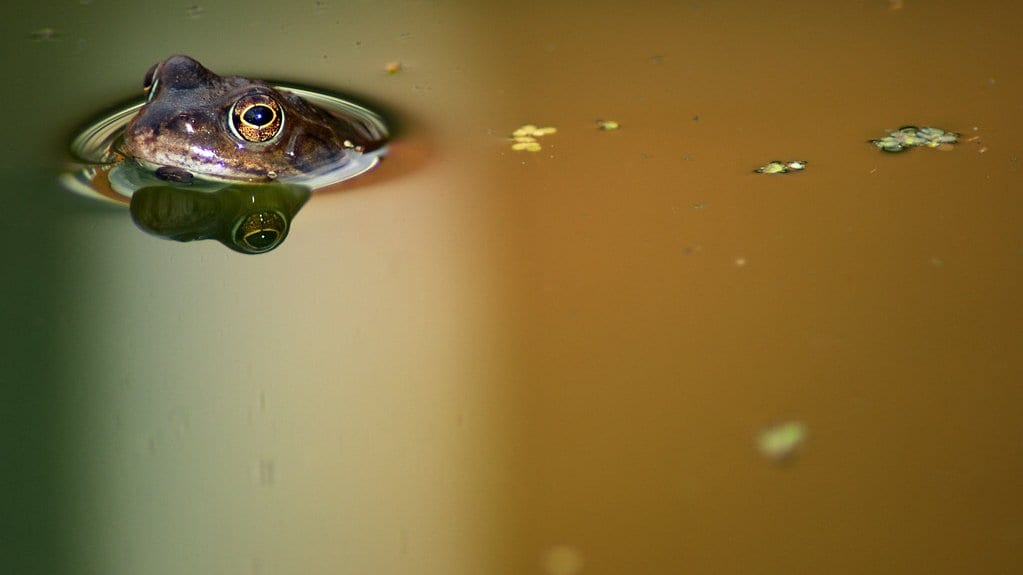
Spend the winter at the bottom of a cold pond and there is very little to work with: no food, and water so poor in oxygen that most animals would be in trouble within hours. Frogs manage it for months, and then, in spring, their nervous systems have to come back online. By the textbook, that should be the hard part. The vertebrate brain is notoriously particular about its fuel. It runs on glucose, and when glucose metabolism is disrupted, neural activity falters.
That rule matters because of what happens when it breaks. In people, an interruption of the brain's glucose supply (during a stroke or in severe hypoglycemia) brings on confusion and loss of function quickly, and the organ keeps almost no fuel of its own in reserve. A brain that could make its own would be a different kind of organ.
A paper published Wednesday in the Proceedings of the National Academy of Sciences describes an animal that gets around the rule. Hafsa Yaseen, Joseph Santin and colleagues at the University of Missouri–Columbia report that after emergence from hibernation, neural circuits in frogs can stop metabolizing glucose, shifting in part to a different fuel: ketone bodies made exclusively within the brain itself.
Ketone bodies themselves are ordinary. In a person who has gone without food, the liver breaks down fat and releases ketone bodies into the blood, and the brain burns them. That arrangement has a supplier and a customer, and they are different organs. What the Missouri group describes is a brain that is both. Astrocytes are the non-neuronal cells that sit between the blood supply and the synapses and handle much of the brain's local housekeeping. Here they make the ketone bodies and pass them to neurons, and the transfer is enough to power synaptic transmission, the signaling that neurons do to one another. The authors also report that genes controlling fat breakdown and ketone body transport are turned up, the supply line adjusted to match.
That such a hand-off might exist is not a new idea. Two biochemists at Complutense University in Madrid once published a review whose title was a question: "Is there an astrocyte-neuron ketone body shuttle?" Astrocytes were already known to be capable of making ketone bodies, and ketone bodies were already known to keep neurons going when glucose ran low. What had not been shown was an animal in which the shuttle carried the load. That is what makes this result unusual in degree rather than in kind: a familiar pathway, taken further than anyone had documented it going.
Sugar is not the only problem an emerging frog has. Underwater hibernation means severe oxygen shortage as well, and low oxygen degrades neural performance in most animals. The brain-made ketone bodies helped there too. They prevented the drops in activity that hypoxia otherwise causes. The same fuel answered both halves of a winter spent submerged.
The capacity, as described, belongs to a particular moment: after months underwater, on the way back. It is not offered as something frogs do all the time. Within that scope the authors make a broad claim. The vertebrate brain, they argue, can serve as its own fuel reserve while glucose metabolism is shut down, which reframes the brain's use of glucose not as a hard-wired necessity but as a plastic trait that can in some cases be entirely abandoned.
Where else that capacity might be is the open question. The equipment is not exclusive to frogs: astrocytes in culture make ketone bodies when oxygen and glucose run low, and the machinery for burning them is standard neuronal issue. What the frog adds is evidence of how far the arrangement can be pushed: far enough to carry a working circuit with the usual fuel switched off. Hibernators have long been the place to look for physiology that other vertebrates carry and never use. This one spends the winter underwater and comes back with a brain running, in part, on fuel it made itself.
Sources
- Proceedings of the National Academy of SciencesPeer-reviewed