Physicists Turn a Qubit's Worst Enemy, Leakage, Into a Way to Keep Entanglement Alive

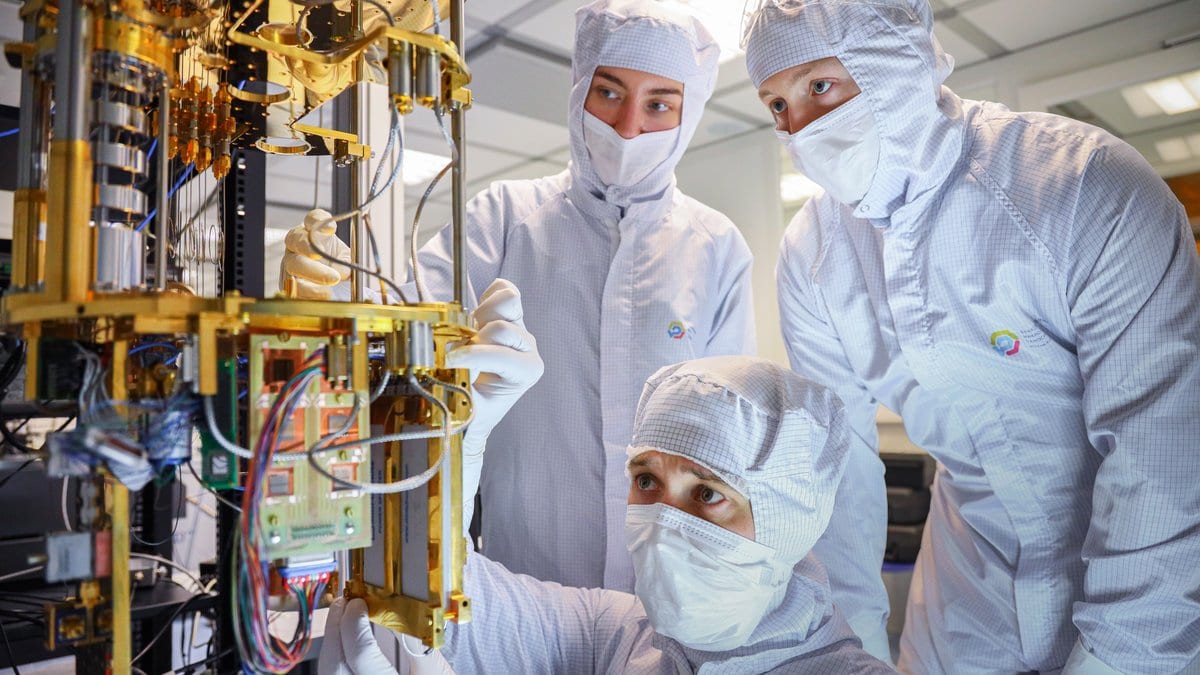
Every quantum engineer spends their career at war with the same opponent. A qubit holds its delicate state for only so long before energy bleeds away into its surroundings and the information dissolves into noise. Dissipation, the physicists call it, and the standard playbook treats it as damage to be minimized: colder fridges, cleaner materials, faster operations that finish before the leak matters.
A team led by Wolfgang Pfaff at Illinois and Aashish Clerk at Chicago has spent the last few years asking a stranger question. What if you stopped fighting the leak and started aiming it? Their answer, published July 15 in the journal Physical Review X, is that a carefully shaped flow of energy out of a system can leave behind exactly the thing everyone has been struggling to protect: two qubits locked in entanglement, and staying that way.
The setup is deceptively plain. Two superconducting qubits sit along a waveguide that carries light in only one direction, so that one qubit's emitted light washes over the other and never comes back. Physicists call this a cascaded system. Light continuously absorbed and re-emitted down the line would normally scramble anything useful. The trick is to add a second, external beam of light and balance it against what the system throws off. Tune that balance correctly and the qubits settle into a steady state in which they are entangled, not for a fleeting instant, but as their resting condition.
That is the part worth pausing on. In the usual approach, you build entanglement in one place and then ship it somewhere useful, and the shipping is where it dies. Here there is nothing to ship. "We've shown that it's possible to bypass the transport stage altogether," Pfaff said. The entanglement is not a package in transit but a standing arrangement the system relaxes into and holds, the way water finds its level.
Making that work outside a chalkboard took a piece of engineering the team named synthetic squeezing. Real hardware is never as clean as a theorist's equations. It has stray noise, imperfect components, and losses the idealized model ignores. Synthetic squeezing is a framework for compensating, dialing the experiment's knobs until the messy apparatus behaves like the pristine one on paper. Pfaff described it as reducing the whole problem to fine-tuning in the lab. He reached for another image too: something "almost like having a 'refrigerator' that pumps out external influences to maintain entanglement." The dissipation is doing the pumping.
The researchers in this article are careful to include a caveat: the steady state can, in principle, be maintained indefinitely over arbitrarily large distances because nothing has to travel and decay along the way. That qualification matters.. It is a statement about what the physics permits, not a demonstration of two qubits entangled across a city. The experiment establishes the mechanism; the long-distance promise remains theory that future work will have to test.
Still, the direction is what makes the result interesting. A quantum internet, in the versions people sketch, is a chain of nodes that must share entanglement across the gaps between them, and every scheme so far has to keep re-establishing that link as it decays. A way to hold entanglement as a stable, self-sustaining condition, with the environment's own leakage doing the maintenance rather than eroding it, would be a genuinely different foundation to build on. The work is peer-reviewed and appeared as a featured result, with a viewpoint in the journal Physics, so it has cleared the field's own scrutiny.
For decades, dissipation has been seen as one of the main obstacles to quantum coherence, something every experiment has to fight against. This result turns that idea on its head: under the right conditions, dissipation can actually help. As Clerk and Pfaff's teams frame it, the leak is no longer the failure mode. Arranged with enough care, it becomes the mechanism, the thing holding the quantum state together instead of pulling it apart. You can read the university's account of how they got there.
Sources
- Physical Review XPeer-reviewed
- phys.org
- iquist.illinois.edu