Skip to content
See the World Through ScienceA project of ALLATRA
Source: Peer-reviewedScience Advances1 source

Scientists Read the DNA of Jonathan, a 194-Year-Old Tortoise

Science

Republish this story

Our work is licensed under Creative Commons BY-NC 4.0. You may republish this piece for free — with credit to ALLATRA Media and a link to the original, unedited beyond length trims, and not for commercial use.

Read the full license

A large Aldabra giant tortoise walks across a grass lawn toward the camera, its domed shell and scaled front legs in full view.
Jonathan on the grass of St. Helena, the South Atlantic island where he lives. The sequencing team read both his genome and his methylome."Jonathan (27242406408)" by Luke McKernan, via wikimedia, CC-BY-SA-2.0

A research team has sequenced the genome of Jonathan, a 194-year-old Aldabra giant tortoise, and reports that he carries unique gene variants in most aging pathways. The comparison is with two other giant tortoises: one of his own species, Aldabrachelys gigantea, and one Chelonoidis abingdonii.

The authors say they read his genome and his methylome, the chemical marks that sit on DNA, to look for the molecular basis of his longevity. The paper, published Oct. 9, 2026, in Science Advances, describes Jonathan as the world's oldest terrestrial animal.

The methylation half of the work sets that single animal against a different group: four other Aldabras, from a 5-year-old juvenile to older adults. Against those four, the authors report substantial changes in Jonathan's methylation and in his methylation entropy, a measure of disorder. The regions of his methylome with the least disorder sat at gene promoters, the on-switches of genes. They clustered on genes of the mitochondrial electron transport chain, which releases energy inside cells, and on genes that process RNA.

This, the authors say, suggests that accurate copying of those genes may be crucial for long-lived species. They propose a model in which orderly methylation at gene promoters goes together with efficient energy production in mitochondria, efficient RNA processing and efficient genome repair.
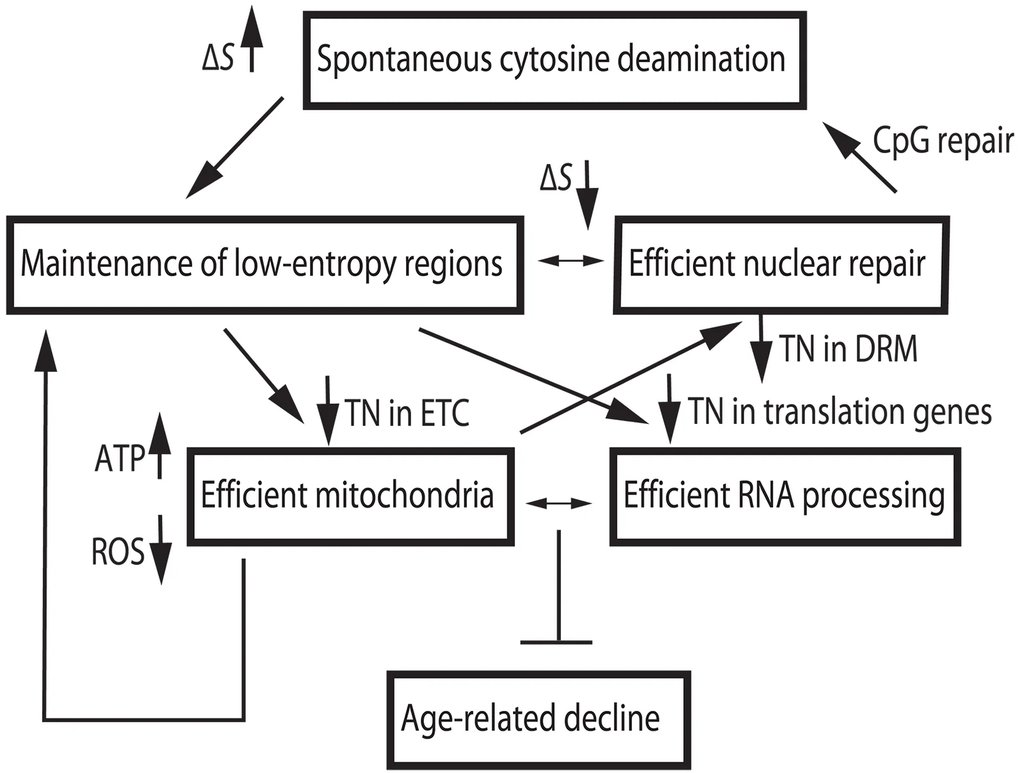
A diagram of the authors' longevity model, linking low methylation entropy at gene promoters to mitochondrial function, RNA processing and nuclear repair in a feedback loop.
The model the authors propose: orderly methylation at gene promoters goes together with efficient energy production, RNA processing and genome repair, which in turn keep those promoters orderly. Fig. 5 from Benjamin Vaisvil et al. (2026), "Epigenetic insights into extreme longevity in the world's oldest terrestrial animal, Jonathan", Science Advances — CC BY-NC, resized

Benjamin Vaisvil of Igenbio in Chicago is the paper's first author and Stephen W. Clark of the Kallel Foundation in Nashville its senior author. The author list spans Vanderbilt University, the St. Helena Government, the Technical University of Munich, Harvard Medical School and the University of California, Los Angeles.

Sources

By Olga SchmidtEditor-in-Chief, Writer

Spot an error?

Spot an error?

Report an error

Spotted a mistake on this page? Tell us what's wrong and our editors will take a look.

What kind of problem?

Only if you'd like us to be able to follow up. We won't use it for anything else.

We correct mistakes openly. Select any text to flag it. Fixes are logged under our Corrections Policy.

Report an error

Reporting on

Scientists Read the DNA of Jonathan, a 194-Year-Old Tortoise

What kind of problem?

Only if you'd like us to be able to follow up. We won't use it for anything else.

We read every report. Corrections are logged publicly.