Cancer's Loose DNA Rings Fall Silent When a Dividing Cell Misfiles Them
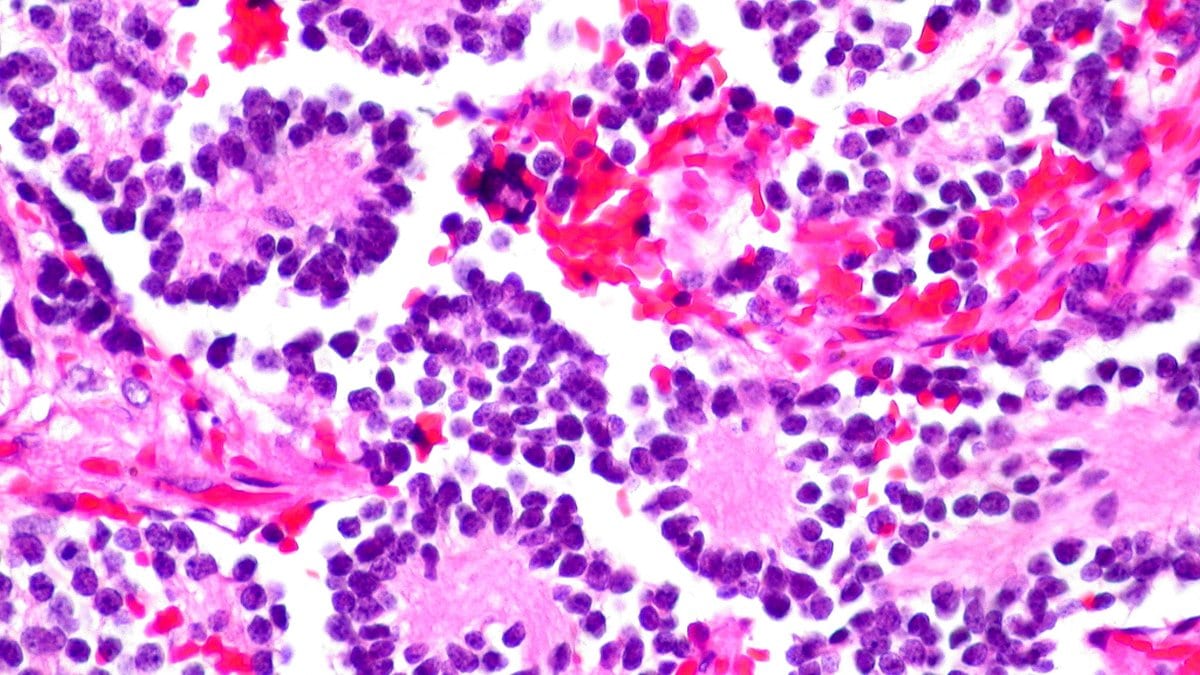
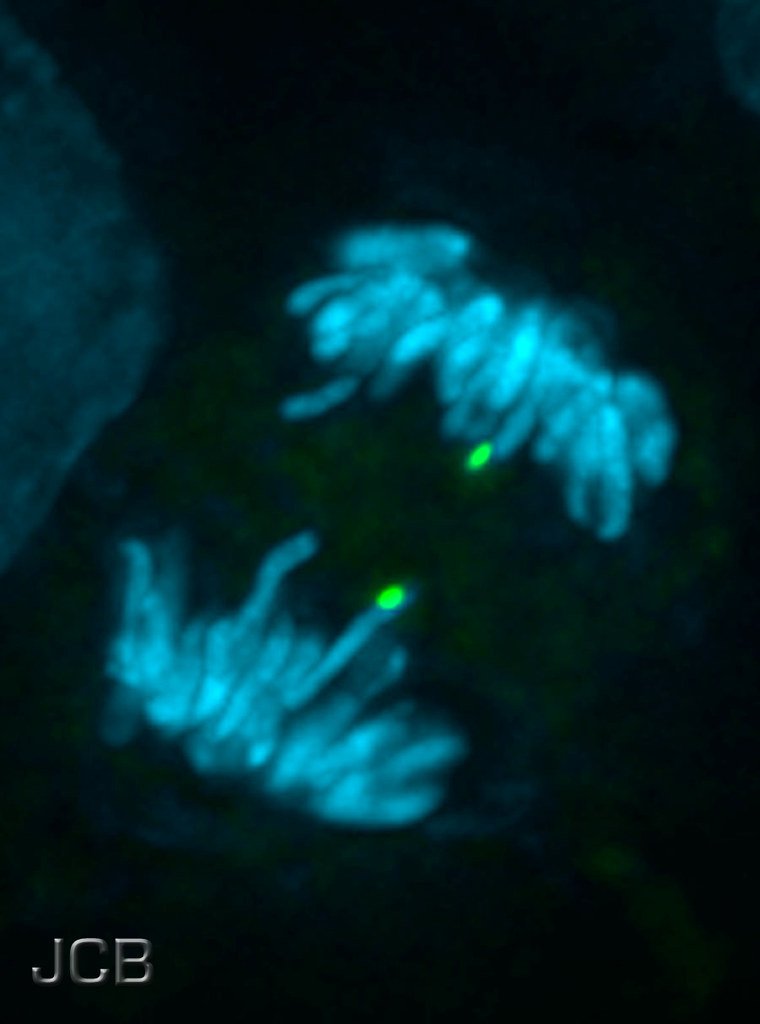
When a human cell divides, every chromosome has a handle. A structure at its waist, the centromere, is what the machinery of division grips to pull one copy into each of the two new cells. The rings of DNA that the most aggressive tumors carry, known as extrachromosomal DNA or ecDNA, have no handle at all. They are small loops, loaded with the genes that drive the cancer, and when the cell splits they have to improvise.
Anton G. Henssen, who leads a group on genome instability in childhood tumors at the Max Delbrück Center in Berlin, described the improvisation in the institute's German-language statement. "They lack the structures needed for orderly transport," he said. "Instead they attach themselves to the chromosomes and try to hitchhike, as it were, into the new cells." Some rings manage the trip. A paper published Oct. 12, 2026, in Nature Genetics follows the ones that do not.
The ones that miss end up somewhere specific. At the close of division, the cell wraps the stranded DNA in a membrane of its own, making a micronucleus: a small side compartment outside the main nucleus, visible under an ordinary light microscope and noticed in cancer cells for decades. Henssen's team, with Lotte Brückner, Robin Xu and Jun Tang as joint first authors and Paul S. Mischel of Stanford University as co-senior author, went looking inside them.
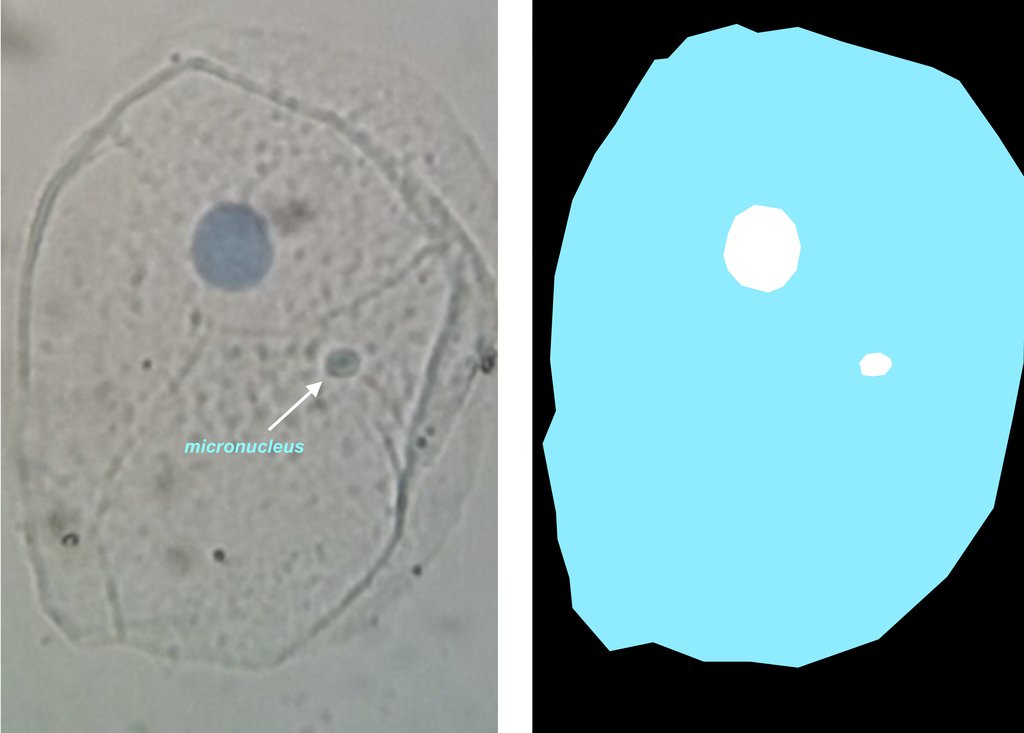
They cut single micronuclei out with a laser and sequenced them one at a time, a method the institute credits to work with Ana Pombo's group in Berlin. In cells under replication stress, meaning trouble copying their DNA, about seven in ten micronuclei were loaded with every ring species those cells carried, and the great majority held no detectable piece of a chromosome. The rings did not drift off singly: they clumped together during division and went as a group into one micronucleus, in one of the two daughter cells. "We found that what is in the micronuclei is above all ecDNA," said Robin Xu. "So from the visible micronuclei we can infer the amount of ecDNA in the cancer cells."
Sealed in, the rings change. The chemical tags that mark DNA as open for reading thin out, and there is less of the active form of the enzyme that copies genes into RNA. When the team hunted for freshly made RNA from the cancer genes, most micronuclei had none. "As a result the cell can no longer read the genes that sit on the rings and turn them into proteins," said Lotte Brückner. Sequencing confirmed it for MYC, one of the genes those rings carry. All of that was measured in cancer cell lines, and mostly after a drug had been used to put them under replication stress; none of it is a measurement in a patient.
The cost shows up at the next division
Then comes the cost to the cell. Filming single cells for three days, the team watched a daughter cell that had inherited a large ring-filled micronucleus take longer to divide again, and die more often, than its own sister: the cell that came out of the same division without one. The sister comparison is the strong part, because the two start out from the same parent. The penalty did not track with how many rings were left in the main nucleus, only with how many had been shut away. It rests on one cell-line system and 143 cells followed to the end of the filming.
The children's half of the study is the thinner half
If a sealed-away ring really costs a tumor cell something, tumors that misfile them often should behave less aggressively in a patient. The team looked for that in biopsies taken at diagnosis, before any treatment, from children with neuroblastoma, a cancer that grows out of immature nerve cells and mostly strikes the very young. They screened 387 of those stored samples and analyzed the 86 whose tumors carried extra copies of the gene MYCN on rings, confirmed under the microscope.
In half of those tumors, more than 8.3% of the cells held a ring-filled micronucleus. Those children lived longer, and went longer before the disease progressed, than the children whose tumors had few or none. Taking the frequency as a sliding scale rather than a split, each additional percentage point of ring-filled micronuclei corresponded to a 4.9% lower risk of death (hazard ratio 0.951, 95% confidence interval 0.914 to 0.990). The paper's own word for the relationship, in its title and its abstract, is associated.
The number comes from one pooled group, drawn from three German trial registries, with no second, independent group in the paper to check it against. The authors report a Cox model on a single variable, the percentage of ring-filled micronuclei. They report no adjustment for the factors that normally shape a neuroblastoma prognosis, such as disease stage or age at diagnosis. The effect is also modest: the upper edge of that interval almost touches the value that would mean no effect at all. Median follow-up was 6.8 years among the 36 children who were still alive.
One result inside that analysis is harder to explain away. Neither the total number of rings in a tumor's main nuclei nor the overall count of micronuclei tracked with survival at all. Only micronuclei with rings inside them did. The direction still looks backwards, since rings of this kind have marked the worst tumors for years. It is not without precedent. A 2011 analysis in Cancer Research led by Nicolai J. Birkbak found that the most chromosomally unstable breast, ovarian, gastric and lung tumors fared better than moderately unstable ones, as though disorder past a point costs a tumor more than it gains.
The next step the authors want is a drug
None of this is a test a family can ask for or a treatment a child can be given. What the authors put forward is narrower: that counting ring-filled micronuclei in a diagnostic biopsy might help sort patients one day, and that the grip the rings keep on the chromosomes during division is a weak point worth attacking. "We already know of drugs, for example, that block exactly the proteins the ecDNA uses to attach itself to the chromosomes," Henssen said in the institute's statement. He co-founded the London company Econic Biosciences in 2022, and the statement says it is hunting for more such compounds. The paper discloses that interest, along with Mischel's co-founding of Boundless Bio and Howard Y. Chang's position as an employee and stockholder of Amgen.
No experiment in the paper pushes more rings into micronuclei and then measures whether anything survives longer, in a dish or in an animal. The children's tumors were sampled before treatment began, and the ring-filled micronuclei were counted afterward. What the work offers for now is a different way to look at a tumor cell: as something that has to carry its own most useful genes through every division with nothing to hold them by, and that sometimes drops one.
Sources
- Nature GeneticsPeer-reviewed
- idw-online.de
Medical Disclaimer: This content is provided for general informational and educational purposes only. It is not medical advice and should not be used as a substitute for professional medical advice, diagnosis, or treatment. Always consult a qualified healthcare professional regarding any medical condition, concern, symptom, or treatment decision.