Forgetting Can Make a Machine More Efficient, Even When It Hurts Prediction

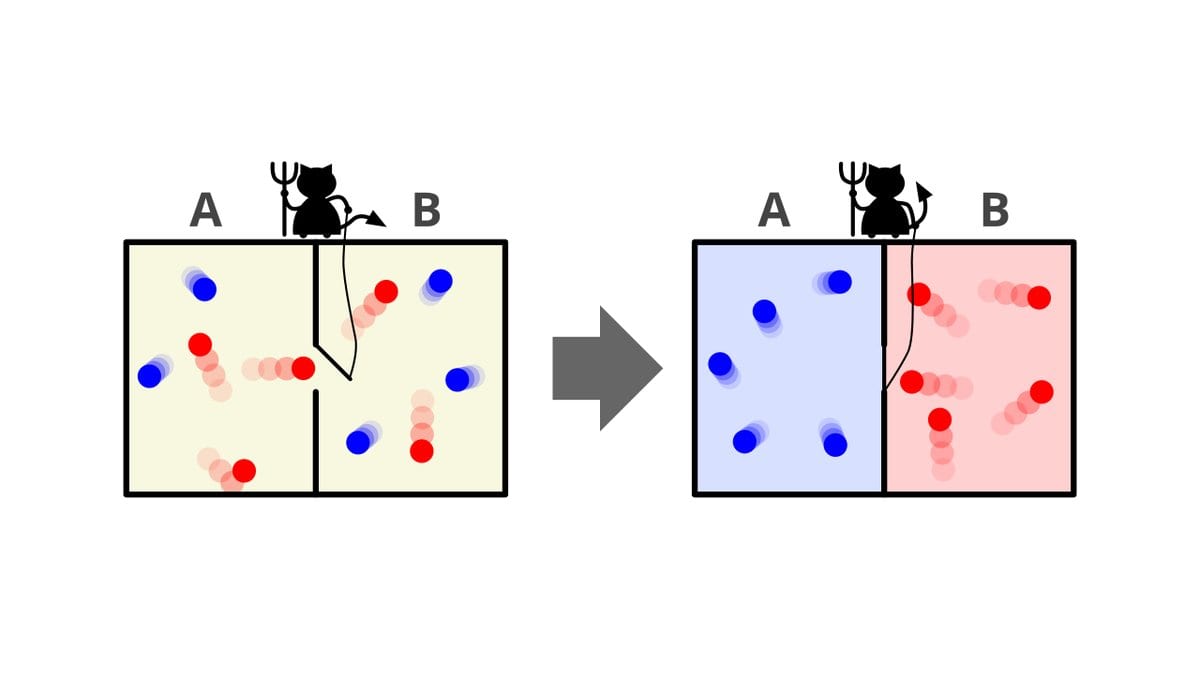
In 1961 Rolf Landauer worked out what it costs to forget. Erasing a bit of information carries a physical price that no better engineering can get under: memory is matter, and clearing it gives off heat. The trade runs in the other direction as well. Under the right conditions, a system that holds information about its surroundings can turn that information into useful energy drawn out of them.
For anything that has to decide what to keep, that exchange has carried a tidy lesson. Earlier work on systems that merely watch the world found that such a system squeezes the most out of thermodynamics only by spending its memory on prediction, holding on to whatever helps it anticipate what is coming. Four physicists at the University of Innsbruck have followed the lesson into the case where the system can also push back on the world, and it does not survive the journey. Their paper appeared Oct. 5, 2026, in Physical Review X.
The word the paper uses for such a system is agent, and it is not the industry's word. The title calls it a channel with memory: a formal object that takes in observations, emits actions and keeps some record in between. It sits inside "percept-action loops, a model of agent-environment interaction", a closed circuit in which the agent's own actions reshape what it will see next. Nothing in that definition is a chatbot, a product or a piece of silicon. Work means the same thing here as it does for a steam engine: energy drawn out of an environment, not the computing a processor does.
The difference matters because an agent that acts is tangled up in what it is trying to forecast. "Through his actions, the agent changes the world he himself is trying to predict. We wanted to understand what that changes about the physics of information processing", says Lukas Fiderer, the study's lead author.
To ask the question precisely, Fiderer and his colleagues needed a quantity that did not exist yet. They introduce work capacity, defined in the paper as "the maximum rate at which an agent can expect to extract work from its environment". It is a ceiling rather than a bill, the most an ideal agent could expect to draw per exchange with its surroundings. The University of Innsbruck describes it as a thermodynamic benchmark for comparing different ways of organizing an agent's memory and actions.
What the authors prove is that the two goals come apart. In some environments an agent that keeps everything it needs for the best possible prediction cannot reach the best possible energy efficiency. To get there it has to drop part of the record of its own past actions, including parts that would have sharpened its forecasts. The paper states the conclusion as a balance: "work-efficient agents must balance prediction and forgetting", which it calls a fundamental departure from the thermodynamics of passive observation. The paper keeps the scope narrow: prediction and energy efficiency "may be at odds" in systems that act on their environment rather than only observing it. This is an existence result for a class of agents, not a law every machine must obey.
"The surprising part is that an agent can benefit energetically from forgetting information that would actually improve its predictions," says Fiderer. The University of Innsbruck's account of the work reaches for a door to make that concrete. A robot pushing one open could remember exactly how hard it pushed, which tells it something about how the door will swing; forget the push and the prediction gets worse. The study finds that in some environments an agent has to give up that kind of useful detail to get the most energy out of its interactions. The robot is the university's picture, not the paper's, which makes its case in mathematics.
Nor is this a story about the cost of memory chips. "The trade-off between prediction and forgetting persists even if we disregard the practical costs of building and maintaining memory. This, then, is a conflict arising from the fundamental laws of physics," says Fiderer. Giving the agent more room to store things does not make the trade-off go away either.
What the paper does not contain is a machine. There is no chip in it, no trained model and no energy bill for any existing system, only a framework and proofs about the agents inside it. "Today's computers are still far from these fundamental limits. Our work gives us a way to explore what efficient agents could look like as the technology moves closer to them," says Fiderer. By the university's account he thinks a proof-of-principle demonstration should be possible with experimental setups that already exist. Nobody has run one.
The paper's own first sentence puts prediction at the center of machine learning, biology and economics, so the line to learning machines is one the authors draw themselves. Where it goes next, they put as a question. "Prediction and forgetting are familiar features of intelligent behavior. Finding a connection between them in a fundamental thermodynamic objective may provide insights for the research and development of more sustainable AI systems," says Fiderer. Landauer priced erasing. This is a price on keeping.
Sources
- Physical Review XPeer-reviewed
- www.uibk.ac.at