A Flatter, Stiffer Framework Gave Its Electrons Time to Make Hydrogen

A picosecond is a trillionth of a second. Light itself crosses only about a third of a millimeter in one. Inside the carbon-based solids chemists want to use to make hydrogen from sunlight, that is close to the whole story. A photon dislodges an electron and leaves behind the positively charged gap it came from. The two find each other again almost at once, the energy comes back out as a faint glow, and no chemistry gets done.
Yuxiang Zhao and colleagues at the Chinese Academy of Sciences have now made that window vastly longer, and they did it by swapping a single chemical joint. Their paper appeared in Nature Synthesis on Sept. 8, 2026. The work was led by Xu-Bing Li at the Technical Institute of Physics and Chemistry in Beijing and Tao Zhang at the Ningbo Institute of Materials Technology and Engineering.
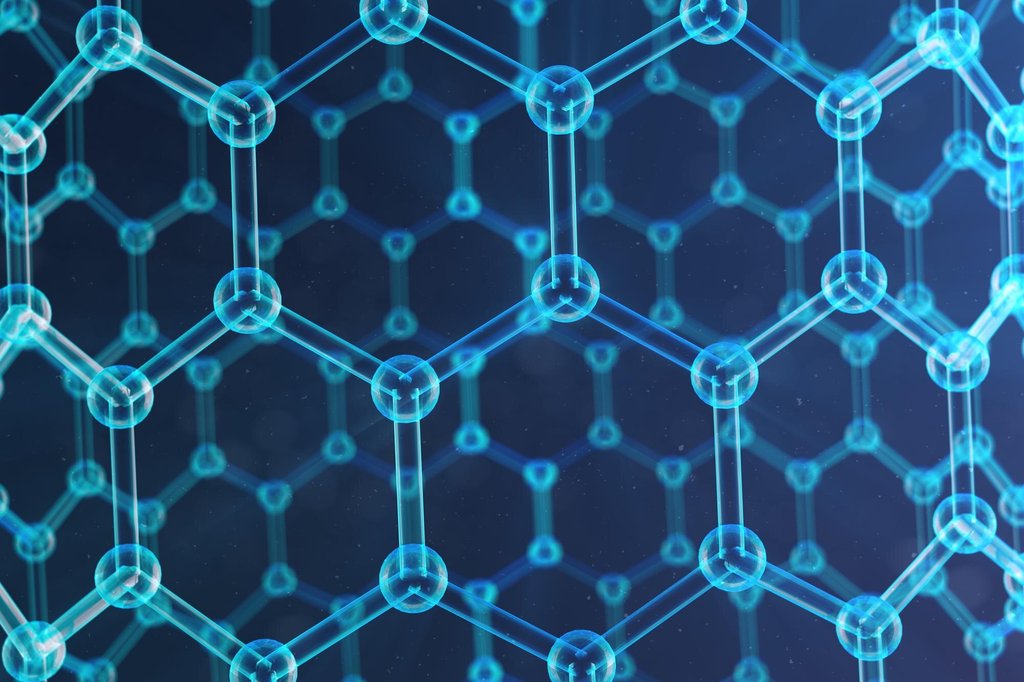
The material is a covalent organic framework: a porous solid whose flat sheets are stitched together by ordinary chemical bonds into a regular, repeating pattern. What changes from one framework to the next is the stitch, and that is the appeal of these materials for a question like this one. A chemist can change one piece and hold the rest fixed. The usual stitch is an imine linkage. This team used a coumarin instead, a small double-ring unit, assembled in one pot from two common classes of organic building blocks. It leaves the backbone markedly flatter than either the imine-linked or the vinyl-linked version they built alongside it, with the electrons shared further along it.
Flatness buys time because of what it does to the pair. A flatter, stiffer backbone slows the rate at which the electron and its hole recombine and hand the energy straight back as light. Calculations in the paper make the same point about the structure, putting the excited electron and the hole on visibly different parts of the coumarin unit.
To watch it happen the team used femtosecond transient absorption spectroscopy, which fires one laser pulse to start the clock and a second, a known delay later, to read what the material is absorbing. Fitted to those data, the long-lived charge-separated state in the coumarin framework lasts about 1,080 picoseconds. The same state in their imine-linked framework lasts 1.07. That is the roughly thousandfold gain. The baseline is the framework the same team built alongside it, not the field at large.
Even so, the endpoint is about a nanosecond, which is no time at all by any human measure, though that is not the comparison that matters here. The charges have to reach the platinum particles that sit on the framework, deposited there by the light of the reaction itself, and that is where hydrogen is made. That transfer takes 407 picoseconds. The shorter-lived state never makes the trip; the coumarin one makes it with room to spare.
The hydrogen numbers follow from there, and each one comes with a wavelength attached. Under 405-nanometer light the framework reaches an apparent quantum yield of 37.95%, a measure of how many of the photons arriving at that single wavelength end up making hydrogen. It is not an efficiency under sunlight and it is not a solar-to-hydrogen figure. Under 440-nanometer light the framework produced hydrogen at 531.2 millimoles per gram of catalyst per hour, a laboratory rate scaled to the mass of powder rather than to anything a device delivers. The authors put this as rivaling the state of the art in organic photocatalysts rather than beating it: other covalent organic frameworks have been reported with higher apparent quantum yields at comparable wavelengths.
The result also comes with real limits. This is the hydrogen half of the reaction, run with a platinum helper on the surface. There is no oxygen result in it, no overall water splitting, and no solar-to-hydrogen efficiency. The paper opens by naming water splitting as the goal the whole field is working toward. Its title says hydrogen evolution, and hydrogen evolution is what was measured.
Coumarin-linked frameworks are not new. Heyang Zhang, Omar M. Yaghi and colleagues introduced them in the same journal in 2025. What is new here is a version in which the shared electron system runs unbroken through the framework, and the measurement that says what the joint is worth. The authors end on that rather than on fuel: linkage chemistry, they argue, is what decides how one of these frameworks performs under light.
Sources
- Peer-reviewedNature Synthesis
- doi.org