The Moon Might Have Been Caught Whole, Not Built From Debris

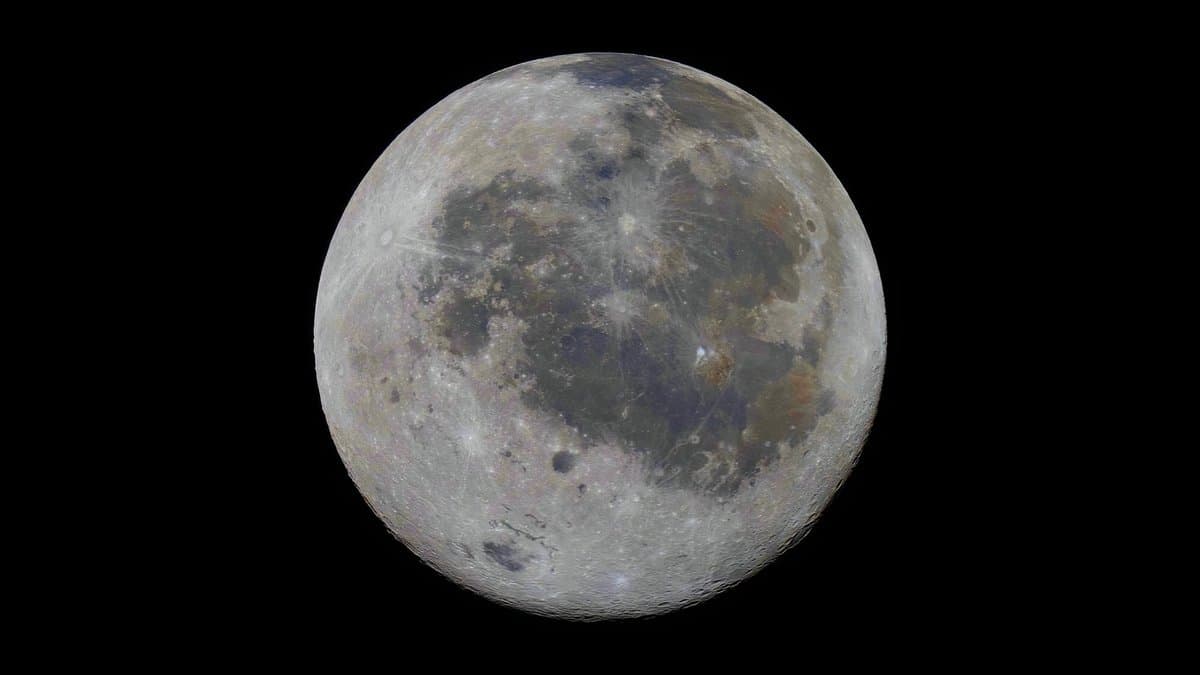
In a computer, the collision that made the Moon has always been a collision between two liquids. It is not that anyone thought the young Earth and the body that struck it were molten all the way through. It is that the pressures in a planetary collision are so enormous that the strength of rock, its refusal to flow, looked like a rounding error beside them. Out of that assumption came the story most people know: a Mars-sized planet called Theia hit the proto-Earth, the wreckage spread into a glowing ring, and the Moon gathered itself out of the ring.
A study published Sept. 1 in The Astrophysical Journal Letters puts the strength back in. C. Adeene Denton, a postdoctoral researcher at the Southwest Research Institute, ran the standard Moon-forming impact with rock that behaves like rock, together with Erik Asphaug of the University of Arizona and two colleagues there. Strength is still nothing against the pressures deep inside a planet. In the outer few hundred kilometers of Theia it is enough to keep the body from deforming freely, and that changes how the collision passes momentum around.
Then comes the surprise. Take one set of the usual impact conditions, the ones inherited from the founding models, and change nothing except how hot the two bodies start out. A hot but solid Theia is caught almost whole, and Earth ends up with a Moon that is a surviving piece of the thing that hit it. A colder Theia, which is to say a stronger one, comes apart into the familiar ring. The warmer, weaker body is the one that survives, and the reason is not about what breaks more easily but about how the collision moves momentum.
The hand-off works like this. When strength holds Theia together, the part of it that rebounds off the proto-Earth does not smear out. It shears into two solid pieces. Earth swallows the inner and heavier one, and that swallowing hands angular momentum, the momentum of turning, to the outer piece. That piece, about 44% of Theia, is thrown into an orbit it can hold. It loses more material over the next twenty hours and settles into a single, probably molten satellite made mostly of Theia.
One number from this work has traveled further than any other: five hours. It belongs to Denton, quoted in the Southwest Research Institute announcement that carried the study to the press. She is describing a run in which she matched the original modeling's setup exactly, down to the temperatures inside both bodies: "within around five hours, an intact Moon emerged." The paper's own clock is longer and less tidy. Theia splits five to ten hours in. The surviving piece swings back past the proto-Earth and sheds more mass over the following twenty hours. Runs that end in capture are carried to 36 hours, long enough to watch the new satellite go around several times and see whether its orbit holds. Five hours is the earliest edge of the splitting, not the age of a finished Moon.
An intact satellite is not the same thing as a Moon, though. In one of the warmer cases, Theia's surface sits near 800 K, warm but still well short of melting. The body deforms more under the blow and lofts a smaller satellite into orbit. That one is stable for only about twelve hours. Its orbit brings it back too close to the proto-Earth, and it is stripped into a debris disk at the encounter. Capture happens in this model. It does not always stick.
None of this touches the oldest problem in the field. Earth and the Moon are made of nearly identical stuff, isotope for isotope, which a Moon built mostly out of another planet has trouble explaining. Capture makes that harder rather than easier, since the satellite here is a piece of Theia and not a blend of the two worlds. The institute's announcement says as much, calling the close compositional match an open scientific question, and points to the usual way out, that Theia and the proto-Earth formed in the same neighborhood and were made of much the same material to begin with.
Denton has seen this happen in another system. A 2025 paper in Nature Geoscience, with Asphaug among its authors, used the same kind of strength-aware simulation to argue that Pluto captured Charon whole rather than assembling it from a disk. That is a reason to take the lunar version seriously. It is not a second measurement of it: the same group ran the same code.
The comparison rests on one set of the standard impact conditions, varied in temperature, as the paper says in its opening lines. It shows that the outcome can flip, not how often it does. The one comment from outside the author list in the institute's announcement comes from Robin Canup, who calls the results surprising and exciting. She is a vice president in the same division as Denton, and with Asphaug she wrote the 2001 Nature paper that put the debris disk at the center of lunar science. Her point is still the one worth keeping. If the Moon's origin turned on temperature, then something about the Moon today, perhaps how much of its easily vaporized material it kept, is a record of how hot two worlds were on the day they met.