A Jellyfish's Sting and Your Sense of Hearing May Share an Ancestor

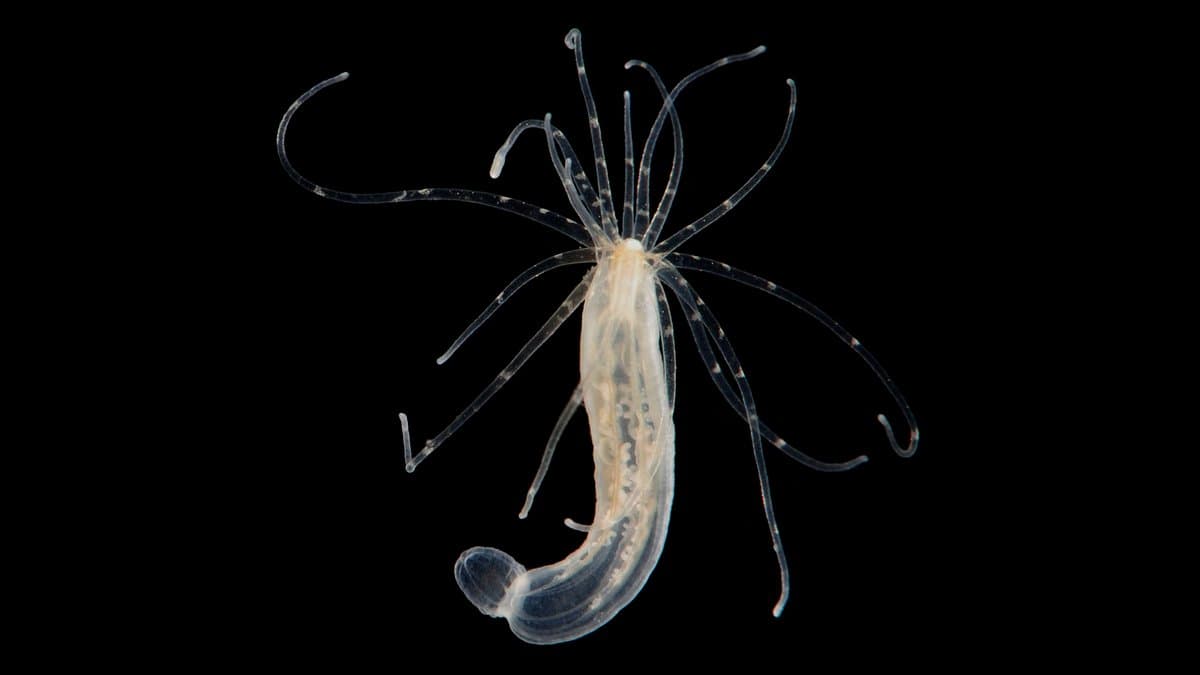
Touch the tentacle of a sea anemone and something explosive happens at a scale too small to see. Inside a stinging cell, a coiled thread fires outward, turns itself inside out, and harpoons whatever brushed past. The trigger for all that is a tuft of fine hairs standing up from the cell's surface. Put that tuft under an electron microscope and it looks uncannily like the tuft on top of a cell in the human inner ear, the one that turns a sound wave into a nerve signal. The resemblance has been in the literature for decades. The question has always been whether it means anything.
Zeeshan Z. Banday, Eduardo Perozo and colleagues argue that it does. Their case appeared in the Proceedings of the National Academy of Sciences on September 28, 2026; the authors work at the University of Chicago, the Marine Biological Laboratory in Woods Hole, Lehigh University and the University of Kentucky. They report that two proteins from the same family that runs hearing in vertebrates sit in the hair bundle of cnidarian stinging cells. The two are called TMC5 and TMC7, and they sit in the bundles of both Clytia, a small jellyfish, and Nematostella, the sea anemone used as a laboratory model.
That is a claim about shared inheritance, and its direction matters. Cnidarians are not our ancestors. They are our cousins. The branch holding jellyfish, corals and sea anemones split from the branch holding insects, worms and vertebrates in the late Precambrian, and both have been evolving ever since. So the argument is not that the ear's hair cells came from stinging cells. It is that the ancestors of both trace back to one mechanically sensitive cell in an animal nobody has ever seen.
On the vertebrate side that machinery is well mapped. A hair cell carries a staircase of stiff hair-like projections called stereocilia, linked at their tips by fine protein tethers. When sound or head movement tips the bundle, the tethers pull open channels at the tips of the shorter projections, charged particles flow in, and a physical push becomes an electrical signal. Two proteins, TMC1 and TMC2, form those channels.
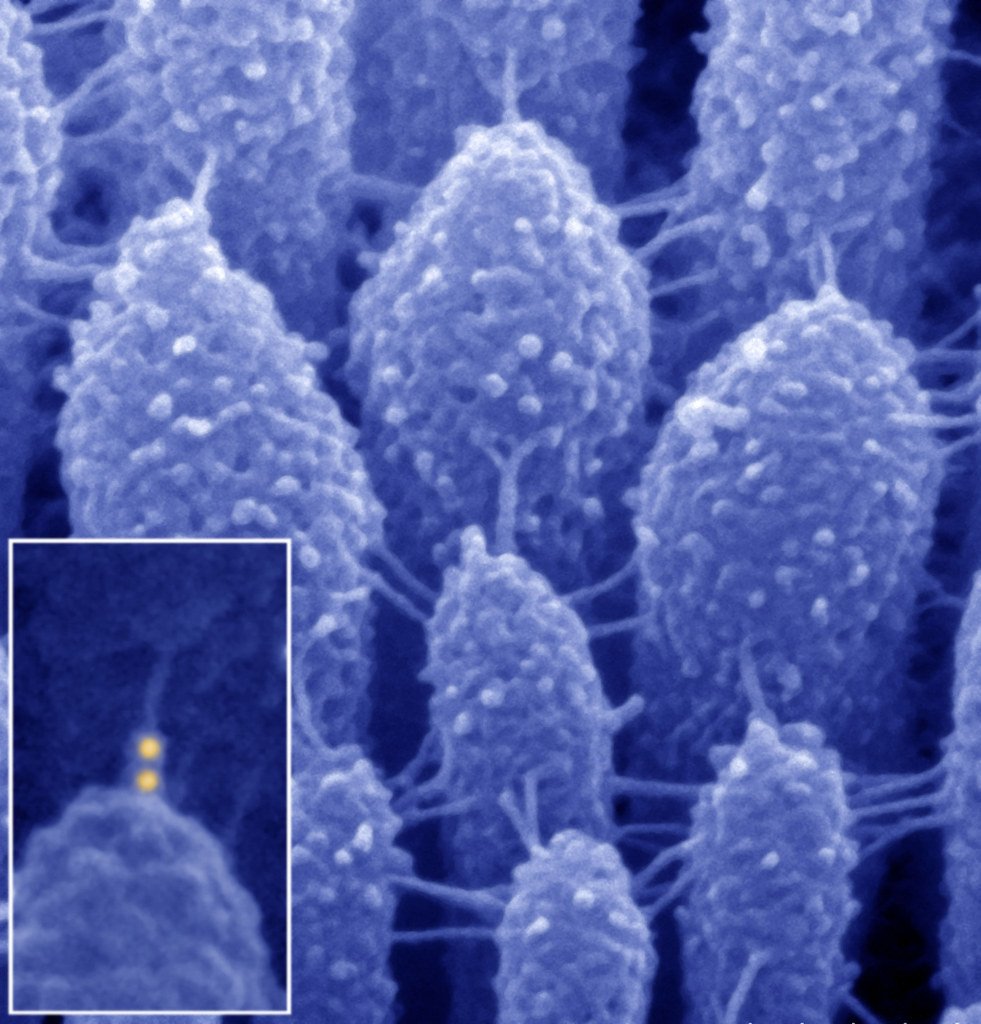
TMC5 and TMC7 are not those proteins. They are different members of the same family, which is what makes the comparison worth making: what looks conserved is the kind of channel and the use it is put to, not a protein carried unchanged since the Precambrian. The cnidarian bundle also has the same sort of tethers between its hairs. And cells that had just been mechanically triggered took up a dye that passes only through open transduction channels. It entered through that bundle and not through the cnidocil, the single stiff bristle standing beside it. The paper calls the bundle the proposed site of the sensing, not the established one.
One candidate for the trigger did not survive the tests. A touch channel called NompC, from the TRP family, turned out not to be needed for the cells to fire. The genetic test ran the other way: silencing TMC5 and TMC7 with RNA interference, which turns a gene down rather than off, made firing fall significantly in both species. That is a damped cell rather than a dead one, and the paper's claim is scaled to it. The two proteins play a fundamental role in the process, which is not the same as having been caught acting as the channel.
The ground under the new claim has been filling in from other laboratories. On December 23, 2021, Ethan Ozment and colleagues at the University of Arkansas reported in eLife that a gene regulator called POU-IV also controls hair cell development in Nematostella. POU-IV is essential for building mechanosensory cells throughout our own branch of the animal tree, and in the anemone's hair cells it switches on a distinctive set of genes. The same laboratory reported in Nature Communications on February 10, 2025, that the sea anemone has at least two kinds of hair cell. One of the two needs polycystin-1, a channel from the same TRP family as NompC, to feel a gentle touch. TRP channels, then, are still part of how cnidarians feel; they are just not what these stinging cells needed. Neither paper touches TMC5 or TMC7, so neither confirms the new result. What they establish is that the cnidarian hair cell is a real, developmentally distinct cell type with deep roots, which is the thing worth comparing an ear to.
A single Precambrian cell type leaves no fossil, so a claim like this is always assembled rather than observed. This one is assembled from anatomy, behavior, drug tests, sequence comparison and gene silencing, all pointing the same way. It is peer-reviewed and published, and it is an argument rather than a settled fact. If it holds, the harpoon and the ear are two uses of the same very old invention, and the cell that made both was doing something animals have never stopped doing, which is turning a push into news.