The Machine That Pastes a Gene Into DNA, Caught With Every Part in Place

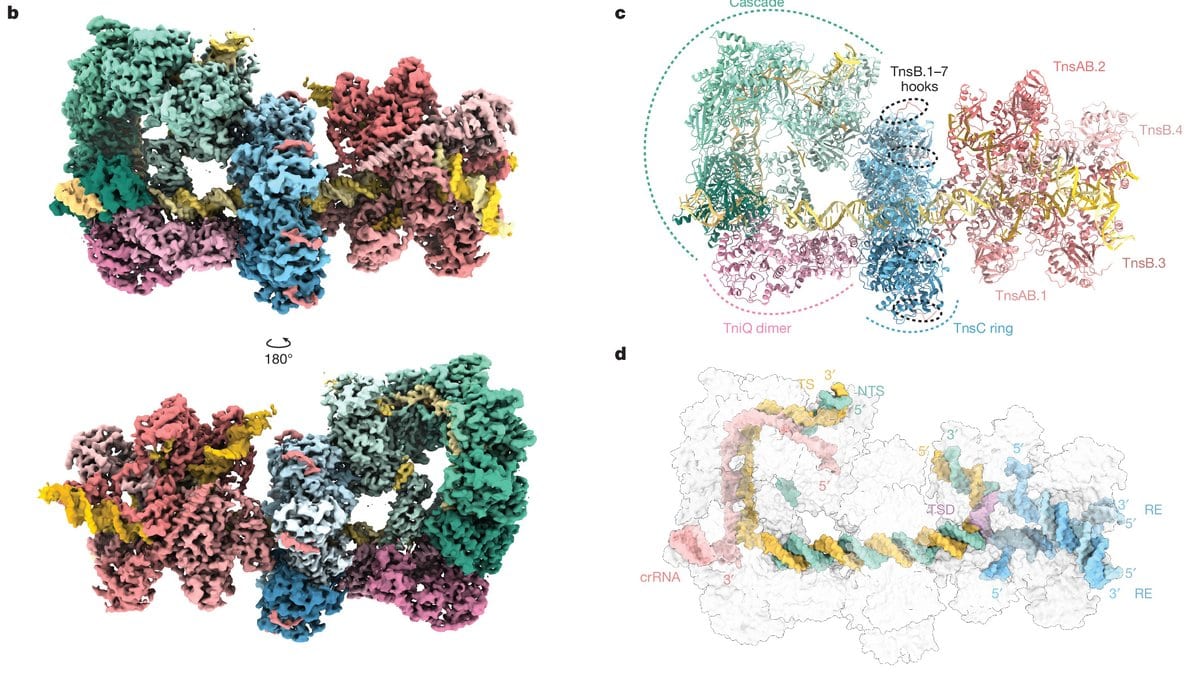
A gene-editing enzyme that cuts DNA is a pair of scissors. One that inserts DNA is a loading dock: it has to find one address in a genome of millions of letters, hold both ends of a cargo, cut, stitch, and do none of that anywhere else. Biologists building the second kind have worked for years from fragments of a machine nobody had seen whole. On Nov. 25, 2026, two laboratories published it whole in Nature, and both found the same thing waiting inside: a catch that keeps the machine inert until it is in position.
One of the two structures comes from Giada Finocchio, Seraina Oberli and Martin Jinek at the Department of Biochemistry of the University of Zurich, with George D. Lampe and Samuel H. Sternberg at Columbia University; the other from Shirin Fatma, Elizabeth H. Kellogg and colleagues at St Jude Children's Research Hospital. Each team took a different bacterium's version of the same device, a CRISPR-associated transposase, or CAST. A transposase is the enzyme a jumping gene uses to move itself; in a CAST it has been wired to a CRISPR guide, so it inserts where the guide points instead of wherever it lands.
Both papers conclude that the machine's chemistry is a property of the finished assembly, not of any one part. The site that does the joining falls into a working arrangement only when every component is present and docked at the address the guide specified. The St Jude team states it flatly in its abstract: "the catalytically competent state is stabilized only within the full assembly." The Zurich and Columbia group describes the same requirement as the last of a series of checkpoints, each of which has to be cleared before the next.
That is a conclusion drawn from still pictures, not a film. Both groups froze their machine on a DNA substrate that mimics the finished insertion product, so the order in which the parts move is inferred from the snapshots. Kellogg's team writes that "our reliance on a strand-transfer substrate does not allow us to establish the stepwise order of these conformations directly," and says whether the adapter ring is complete before the transposase arrives is unknown and not answerable by its method. Jinek and Sternberg's group calls its own relay "a potential allosteric relay mechanism," a push felt at a distance, and writes that its precise role needs further work.
Three chances to refuse
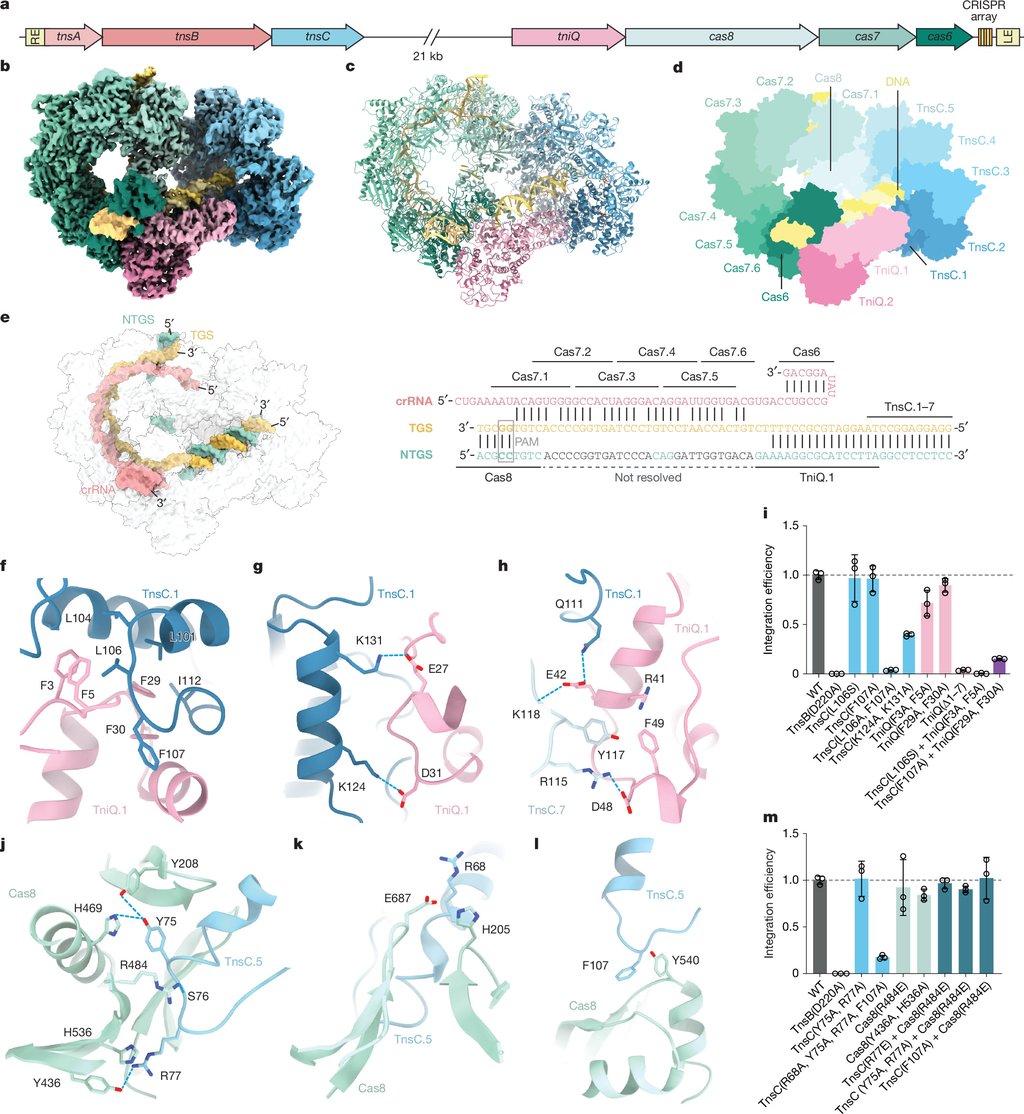
The Zurich and Columbia team caught its system at three stages and found a refusal built into each. First the guide RNA pairs with its match, and a bundle of helices in the targeting complex swings about 90 degrees into a locked position that only a fully matched target allows, so a near-miss fails early. Locked, the complex recruits a ring of seven copies of an adapter protein called TnsC, which closes around the DNA like a collar. Only a closed collar presents the hooks that reel in the transposase, and only once the transposase has gripped both the collar and the target DNA does its own catalytic site settle into a working shape. The authors report that mutating any one of those contacts costs most or all of the system's activity in living bacteria.
"Complete" is exact for one of the two structures and wants a footnote on the other. The Zurich and Columbia holocomplex, 1.2 megadaltons of protein, RNA and DNA, resolves to 3.1 ångström overall, fine enough to place individual side chains. The St Jude complex resolves to 4.5 ångström overall, 3.7 at the core and roughly 7 at the outer edges; in that map the seventh collar subunit is faint, which the authors read as partial occupancy or movement, and a bacterial host protein that was in the reaction mixture never appeared at all, which the authors put down to sample preparation.
The protein that had to be redesigned before it could be seen
The St Jude structure exists because of a detour. TnsA, the subunit that cuts the donor DNA free from its old home, refused to purify, and the reason turned out to be that the natural protein is largely unfolded. So the team modeled the assembly with AlphaFold, rewrote the TnsA sequence with a computational protein design tool while holding the residues known to matter fixed, screened 500 of the top-ranked designs in E. coli, and picked a winner: 27 substitutions, a well-folded protein, about a hundredfold more integration activity than the natural version. Kellogg and colleagues put that gain on a par with seven rounds of directed evolution across a whole related CAST system. It was also enough to bring the complete complex within reach of the microscope.
The abstract says the redesign raised activity "without compromising specificity," and specificity there means on target: 98% of insertions landed at the intended site. Product purity is a different quantity — and it did fall. Long-read sequencing found the redesigned enzyme made clean single insertions 42% of the time against 96.2% for the natural one; the rest co-integrates, in which the whole donor plasmid comes along with the cargo. One substitution accounted for it: reverting that single residue restored clean insertions to 92.4% and kept the activity gain.
Every number here was measured in bacteria
Every activity figure in both papers comes from Escherichia coli. Neither reports an experiment in human or any other mammalian cells. The 10 to 30% insertion efficiency that often travels with these systems is prior work: it belongs to evoCAST, a directed-evolution variant reported in 2025 and cited as background by the Zurich and Columbia paper. Therapy appears in both introductions as a prospect, and both groups have declared an interest: Columbia has filed patent applications on CAST technologies naming Lampe and Sternberg, and St Jude writes that it "intends to file a US provisional patent application based on this work."
The pair is independent in the ways that count and companionable in the ways that are easy to oversell. Different laboratories, different bacteria, different branches of the CAST family, no citation of each other, separate submission and acceptance dates. Also one journal, one publication day, one shared funder, the same named referee, and each paper listed on the other's page as associated content. Two groups converging on the same mechanism from different starting material is the fair description of it; two unrelated groups happening to agree is not.
What they agree on is the part an engineer can act on. If the ability to cut and paste belongs to the finished assembly and not to any single subunit, then improving these tools means stabilizing the assembly, which is what one better-folded protein did at St Jude, and what the Zurich and Columbia checkpoint map now makes it possible to attempt deliberately.
Sources
- NaturePeer-reviewed
- www.nature.com