Comparing Siblings Barely Dents the Genetic Signal for Personality

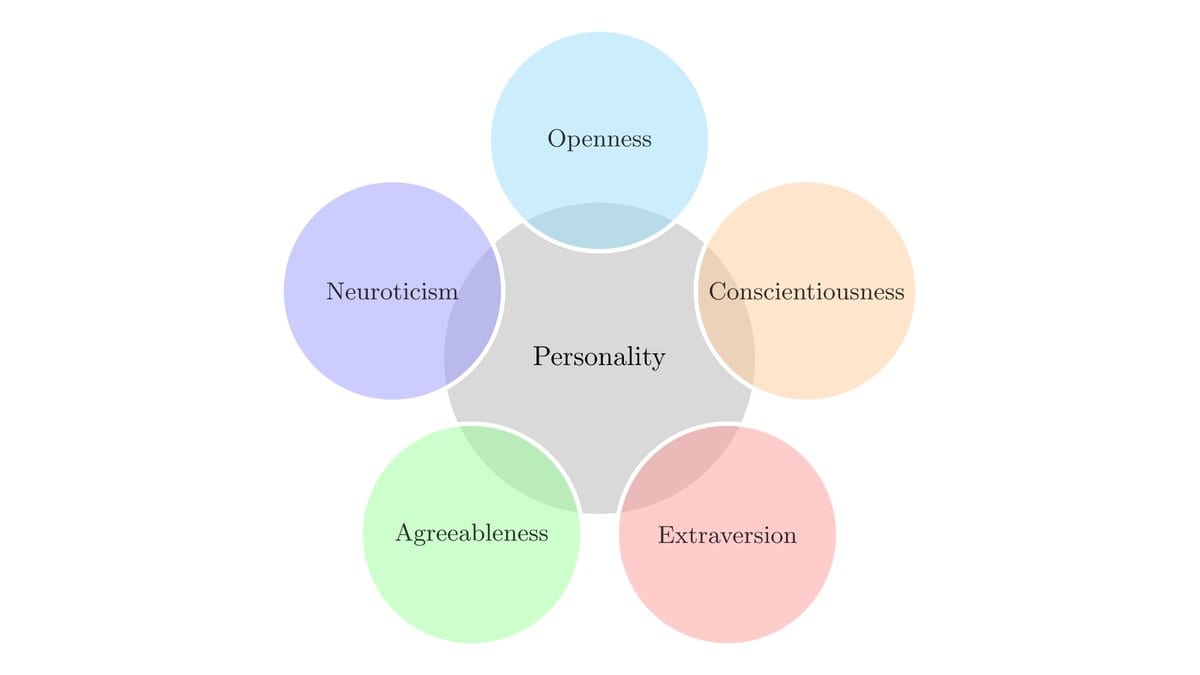
Somewhere in the middle of a long health survey, a question asks whether you agree that you are talkative. A few pages later, whether you worry a lot. A few pages after that, whether you finish what you start. Answer enough of them and a psychologist can compress the result into five numbers: extraversion, agreeableness, conscientiousness, neuroticism and openness to experience. For decades those five have been the field's working summary of a person.
On September 2, a collaboration spanning 46 cohorts published in Nature the most detailed picture yet of how DNA relates to those five numbers. The Revived Genomics of Personality Consortium, led by Ted Schwaba with Michel Nivard and Elliot Tucker-Drob as senior authors, pooled genotypes and personality questionnaires from between 611,037 and 1.14 million people, depending on the trait. Only neuroticism reaches the upper figure; agreeableness, the smallest, sits at the lower end. Between them those samples yielded 1,260 lead genetic variants associated with personality, 824 of which had never been tied to their trait before. The paper is open access.
What that buys is not a set of personality genes. The individual effects are minuscule: the median extraversion variant, corrected for the optimism that comes with picking winners, shifts a person by about a third of a percentile.
The percentage is not a percentage of you
The number most likely to be misquoted from this paper is 4.8% to 9.3%, the share of variance that common genetic variants explain, running from agreeableness at the bottom to extraversion at the top. The words attached to it carry the whole meaning. It is variance in measures of each trait, in people's scores on an imperfect questionnaire, not in the trait itself. That estimate applies across a population, not for a person. And it comes from the participants with European-like genomes.
Questionnaires are noisy, and the paper shows what the noise costs. Personality measures with better reliability come out more heritable, and once the imprecision of a typical instrument is corrected for, the range rises to roughly 9% to 13%. Both sit far below the 40% to 60% that twin and family studies have long attributed to genes, a gap the authors put down to what common-variant methods cannot see, including rare variants and gene interactions. The paper states the consequence plainly: all methods find that personality is substantially influenced by a person's environment.
None of it converts into a test. The consortium built polygenic indices (running scores summed across a person's genome) and used them to predict things like how an interviewer rated a participant's manner, or whether teenagers in an at-risk subsample had been suspended from school. The associations are real and they are small, and the authors write in the same breath that "these PGIs cannot predict an individual's future behaviour."
Then they compared siblings
The result the authors put at the center is not the variant count. It is what happened when they looked inside families. A genetic association found by comparing unrelated strangers can pick up things that have nothing to do with the DNA in question: the neighborhood, the schooling, the fact that people with similar genomes often had similar upbringings. The standard check is to compare siblings, between whom inheritance is shuffled almost at random.
For most behavioral traits that test hurts. Genetic prediction of educational attainment retains only about 60% of its strength inside families. Personality lost almost nothing. Across dizygotic twin pairs in the Netherlands Twin Register and the Twins Early Development Study, prediction within the family came to 96% of the population-level figure. A separate decomposition using parents and their adult children at deCODE in Iceland put the directly transmitted share of the effect at 96.2%, against 75.1% for educational attainment in the same data.
Confounding was not entirely absent, as the paper says in as many words. Conscientiousness is where it shows: parental variants that were never passed down still contribute about 8% of the predicted effect. For neuroticism and agreeableness, the within-family and population-level results correlate at less than one, which means the two are not quite measuring the same thing.
That contrast is the paper's most genuinely new claim, and it changes what the rest of the results are worth. If the genetic signal for personality mostly survives a comparison between siblings, then correlations built on it, with psychiatric diagnoses or substance use or where people end up living, are less likely to be artifacts of social sorting.
The samples lean overwhelmingly European
Every contributing cohort had participants with European-like genomes, and ten of them also had participants with African-like genomes. About 95% of everyone in the study sits in the first group, and every headline heritability figure comes from it. Scores trained on those samples did predict extraversion, neuroticism and openness among participants with African-like genomes, the first evidence of its kind for personality, though far more weakly.
Within that population the signal travels well, if not perfectly. Genetic correlations sit around 0.85 across country clusters, age groups and questionnaire families. In the Estonian Biobank they hold between how people rated themselves and how someone close to them rated them. That is high without being identical. Agreeableness wanders most from cohort to cohort, which is part of why its heritability lands lowest, and the authors say conclusions about it need more context than the rest.
Where the paper reaches toward cause it moves carefully. Treating inherited variants as a kind of natural experiment, the team found 33 exposure-and-outcome pairings whose effects held up across estimators: conscientiousness toward a lower body mass index and less smoking, neuroticism toward poorer scores on a measure of healthy aging. Some ran the other way, from life experience back to personality. Negative controls such as birthweight turned up nothing, the reassurance the method is meant to provide. The authors call these plausible causal effects and ask for other approaches to triangulate them.
One of those correlates is quietly awkward for the rest of science. Variants associated with openness and agreeableness also track with completing optional questionnaires, while variants associated with neuroticism track with leaving them unanswered or picking "prefer not to say." Much social and medical research runs on survey data, and the consortium's point is that personality genetics may be shaping who ends up in those samples, largely unacknowledged. Alongside the paper the team has posted a plain-language FAQ setting out its rationale and results in everyday language.